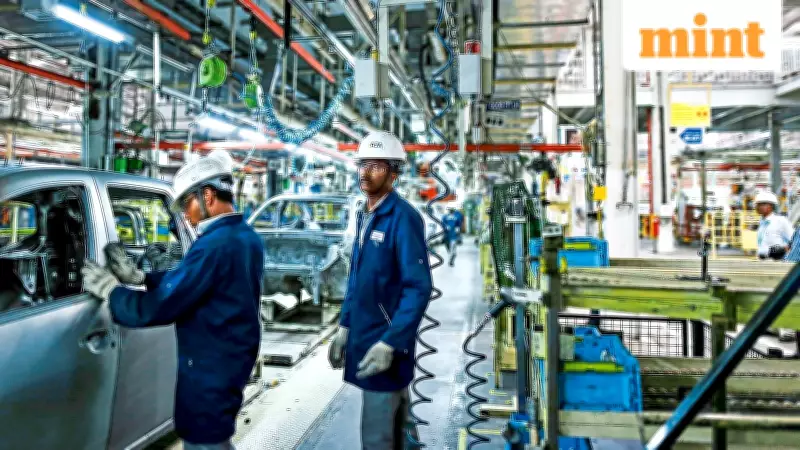
Budget 2026 Poised to Reset India's Industrial Policy Framework
India's forthcoming budget is anticipated to mark a significant philosophical shift in the government's approach to supporting the manufacturing sector. According to sources familiar with government discussions, the focus will move away from primarily offering incentives and tariff protections toward addressing systemic frictions that hinder business growth, innovation, and global competition.
From Subsidies to Systemic Solutions
The budget is likely to emphasize simpler regulations, expedited approvals, and a more predictable regulatory environment. This strategic pivot aims to assist manufacturers in ascending the value chain, enabling them to produce and sell higher-value products in international markets. One anonymous official stated that manufacturing needs to undertake more substantial responsibilities in India's long-term economic growth, as the services sector, despite strong performance, has inherent limitations in transforming the broader industrial ecosystem.
"The plan is to help the manufacturing sector move up in the value chain and improve India's share in global merchandise trade," the official revealed. This approach builds directly on the recent Economic Survey's call for a policy reset by reducing compliance costs, minimizing regulatory uncertainty, and fostering a trust-based system over excessive oversight.

Addressing Regulatory Cholesterol and Building Competitiveness
Experts suggest the budget may include announcements to tackle the 'regulatory cholesterol' highlighted in the Economic Survey. Key elements of a renewed industrial policy are expected to center on enhancing competitiveness, efficiency, and technological adoption. Additionally, the budget could feature measures concerning semiconductors, critical minerals, and supply chain resilience, viewing trade through both economic and national security lenses.
Industry executives currently grapple with multiple approvals across central and state agencies for factory expansions, environmental clearances, and quality certifications—processes that often delay projects by several months. While existing Production-Linked Incentive (PLI) schemes are unlikely to be rolled back, future support is expected to be more closely tied to productivity enhancements and technology upgrades.
Expert Insights on Productivity and Global Integration
Abhash Kumar, Assistant Professor of Economics at Delhi University, emphasized that India's export challenge has evolved from scale to capability. "Without steady gains in productivity and technology depth, India risks remaining stuck in low and mid-value export segments even as global trade becomes more standards- and knowledge-driven," Kumar noted. He added that clear, predictable regulations and faster approvals are as crucial as financial incentives in helping firms upgrade products, integrate into global value chains, and compete on quality rather than price alone.
Rumki Majumdar, an economist at Deloitte India, stated that a sustained improvement in investor sentiment hinges on a definitive reset in ease of doing business. Simplifying compliance, accelerating approvals, and reducing regulatory overlap can lower fixed costs for companies, freeing up capital and management bandwidth for expansion. According to a June 2025 TeamLease RegTech report, manufacturing MSMEs in India face a substantial compliance burden, with annual costs ranging between ₹13-17 lakh and over 1,450 regulatory obligations.
Focus on MSMEs and Infrastructure Development
A third source indicated the budget will likely make rules easier and more predictable, particularly for smaller enterprises. The focus will be on enabling smoother operations for manufacturers by simplifying compliance, improving access to factories and infrastructure, and encouraging MSMEs in labor-intensive sectors to formalize without incurring additional costs—all while supporting the broader objective of boosting exports.

Majumdar also highlighted that continued infrastructure development can widen labor-market access, create new consumption hubs, and allow firms to position production closer to emerging demand and export nodes. "Accelerating industrial corridors, logistics parks, and multimodal hubs in these regions would further lower supply-chain costs and improve delivery reliability," she explained.
Quality Control and Supply Chain Resilience
The Economic Survey advocated for a more balanced application of Quality Control Orders (QCOs) to support domestic manufacturing without disrupting supply chains. Experts anticipate the budget will provide clearer direction on alleviating these frictions, with the recent withdrawal of QCOs on approximately 50 products seen as an early indicator of this shift.
Rajnish Gupta, Partner in the Tax and Economic Policy Group at EY India, remarked, "India is in a sweet spot with strong economic growth and widespread recognition of our long-term potential. To convert this interest into sustained investment, it must become easier for businesses to enter, operate, and even exit." He acknowledged government efforts in easing labor, environmental, and sectoral regulations but stressed that deeper reforms—especially at the state level, including land and building approvals—are critical for improving the operational landscape.
Gupta pointed to recent events, such as export restrictions on rare earth magnets, underscoring the importance of supply chain resilience. With India facing a merchandise trade deficit of $280 billion, he emphasized the need for focused plans to build domestic capacity in key areas like electronics, electrical equipment, and chemicals.
This policy reset arrives as major economies worldwide explore new trade alliances and adjust their strategies in response to global shifts, positioning India to enhance its manufacturing prowess through regulatory clarity and operational efficiency.