

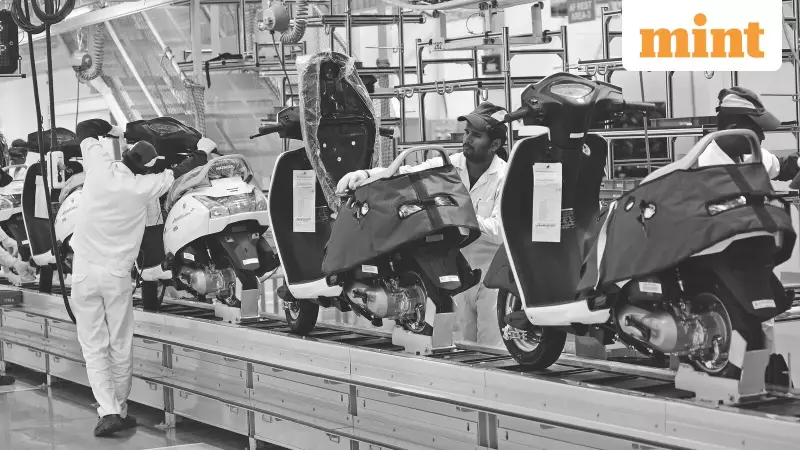
With less than 48 hours remaining until a proposed New Year deadline, the Indian government's plan to mandate anti-lock braking systems (ABS) for all two-wheelers from 1 January 2026 hangs in the balance. The country's leading motorcycle and scooter manufacturers have mounted significant pressure on the Centre to reconsider, leading to a last-minute rethink.
Industry Pushback Against Blanket Rule
Major players including Hero MotoCorp, Bajaj Auto, Honda Motorcycle, and TVS Motor have strongly advocated against a sudden, nationwide implementation. Through the Society of Indian Automobile Manufacturers (SIAM), the industry lobby, they have presented a trio of core arguments: severe supply chain constraints, increased costs for consumers, and a lack of global precedent for such a sweeping regulation.
Currently, the rules are split by engine capacity. Two-wheelers with an engine displacement below 125cc must have a Combined Braking System (CBS), while those above 125cc already require ABS. The proposed norm aimed to extend ABS coverage to the entire market, which is dominated by smaller vehicles. In FY25, a staggering 84% of India's 19 million-unit two-wheeler market consisted of vehicles below 125cc.

Executives privy to the discussions reveal that the government is actively weighing its options. "No large-scale orders for ABS and helmets have been issued yet. Notification of the norms would have come earlier if the government intended to implement this from 1 January," one executive stated, indicating a likely postponement.
The Core Arguments: Supply, Cost, and Data
The industry's resistance is rooted in practical and economic concerns. Manufacturers highlight that local ABS supplier capacity is limited, with key players like Bosch India, Continental, and Endurance Technologies unable to meet the sudden surge in demand for the entire sub-125cc segment overnight. This could force costly imports and create supply bottlenecks.
On the cost front, blanket ABS installation would inevitably raise prices for the most affordable, mass-market vehicles, potentially impacting sales. Perhaps more critically, automakers have questioned the foundational data. They argue there is no clear evidence presented during consultations that universal ABS adoption would materially reduce road accidents in India.
"During meetings with the Ministry of Road Transport and Highways, it was highlighted that there is no clear evidence that introduction of ABS for all two-wheelers will lead to fewer road accidents. Moreover, there isn't any global equivalent to such a sweeping norm," an executive added.
Proposed Alternatives and Government's Stance
Instead of an abrupt mandate, the industry has pitched for a phased rollout to allow supply chains to mature. As a technological alternative for lower-capacity vehicles, companies have suggested the adoption of more advanced versions of the existing CBS, which they argue is sufficient for most riding conditions.
While the government, led by Union Minister Nitin Gadkari, has been firm on its road safety agenda, the industry's concerted push appears to have softened its stance. Officials are still finalizing the rules, and no formal announcement of a delay has been made. However, the silence and lack of preparatory orders strongly signal a deferral.
Consulting experts like Subhabrata Sengupta of Avalon Consulting believe a delay of a few months is likely. He noted that while advanced CBS works in most scenarios, ABS remains superior in extreme conditions like rain. "Probably in 90% cases it is ok, but the remaining 10%—rain, for instance—is important," Sengupta said.
The parallel proposal for dealers to provide two helmets with every vehicle purchase also faces similar uncertainty, tied to the broader discussion on enforcement and practical implementation.






