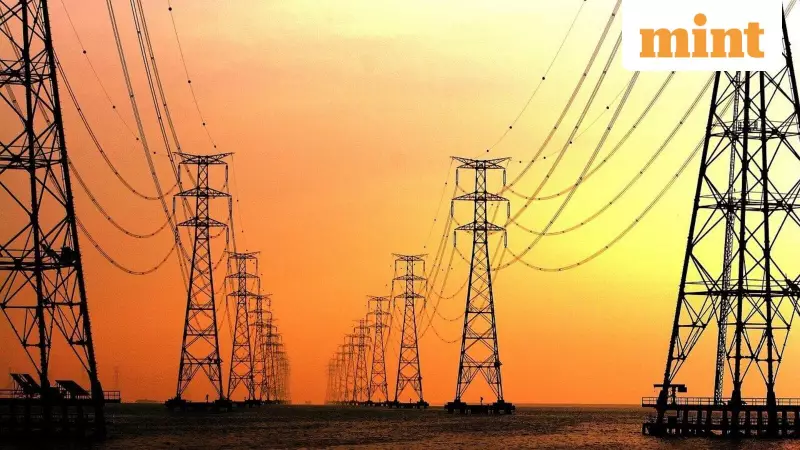
In a landmark judgment, the Supreme Court of India has delivered a major victory to Adani Power Ltd, ruling that customs duty cannot be imposed on electricity supplied from a Special Economic Zone (SEZ) to the domestic market. This decision overturns a 2019 Gujarat High Court verdict and absolves the company from paying the levy on power generated at its massive Mundra plant.
A Decade-Long Legal Battle Concludes
The legal dispute, which traces its origins back to 2010, involved customs duty collections amounting to approximately ₹458 crore, excluding interest. A bench comprising Justices Aravind Kumar and Prasanna B. Varale declared that the levy lacked the authority of law. Consequently, the court directed customs authorities to refund all duties collected from Adani Power. The jurisdictional Commissioner of Customs has been instructed to complete the verification process and issue refunds within eight weeks from the date of the judgment.
The court firmly stated that once a levy is found to be illegal, the government cannot retain money collected under it, making a refund a necessary outcome. The detailed written judgment was awaited at the time of the initial reports.

Chronology of the SEZ Power Duty Dispute
The controversy began in February 2010 when the central government amended customs rules to impose a duty on electricity supplied from an SEZ to the Domestic Tariff Area (DTA). Authorities attempted to apply this levy retrospectively from June 2009, despite the fact that electricity imported into India from foreign countries attracted nil customs duty.
Adani Power challenged this move in the Gujarat High Court, which in July 2015 ruled partially in the company's favour. The High Court granted an exemption from customs duty, but only for a limited period between June 2009 and September 2010. The Supreme Court later declined to interfere with this 2015 decision.
However, post-2015, customs authorities continued to raise demands based on subsequent notifications issued in 2010 and 2012, which altered the duty rate. Adani Power ceased payments and sought refunds, arguing that the 2015 judgment had settled the legal principle. The authorities contended the relief was time-bound.
In June 2019, the Gujarat High Court rejected Adani Power's fresh plea, stating the earlier exemption was specific and could not be extended. This 2019 decision has now been overturned by the Supreme Court.
Adani Power's Expansion and the Mundra Plant
Adani Power operates a colossal coal-based thermal power plant inside the Mundra Special Economic Zone in Gujarat's Kutch district. The facility, with a total installed capacity of 4,620 MW, is strategically located near Mundra Port. The electricity generated here is supplied under long-term power purchase agreements (PPAs) to distribution companies in Gujarat and Haryana, as well as to the utility serving the Mundra SEZ itself.
This legal win comes at a time when Adani Power is pursuing an aggressive expansion strategy across India. The company has been securing competitive power supply tenders in states like Uttar Pradesh, Bihar, Madhya Pradesh, and Assam. It has announced several ultra-supercritical greenfield power projects, including:
- A 1,500 MW plant in Uttar Pradesh ($2 billion)
- A 2,274 MW project in Bihar ($3 billion)
- A 1,600 MW plant in Madhya Pradesh (₹21,000 crore)
- A massive 3,200 MW greenfield project in Assam (₹48,000 crore)
According to reports, the company has significantly raised its long-term installed capacity target to 41.87 GW by FY32, backed by a committed capital expenditure of about ₹2 lakh crore. This marks one of the most ambitious private-sector expansion plans in India's thermal power industry, positioning the company to meet the nation's soaring electricity demand in the coming decades.
The Mundra power plant was originally owned by a special purpose vehicle, Adani Power (Mundra) Limited, which was merged with Adani Power Limited effective October 1, 2021.