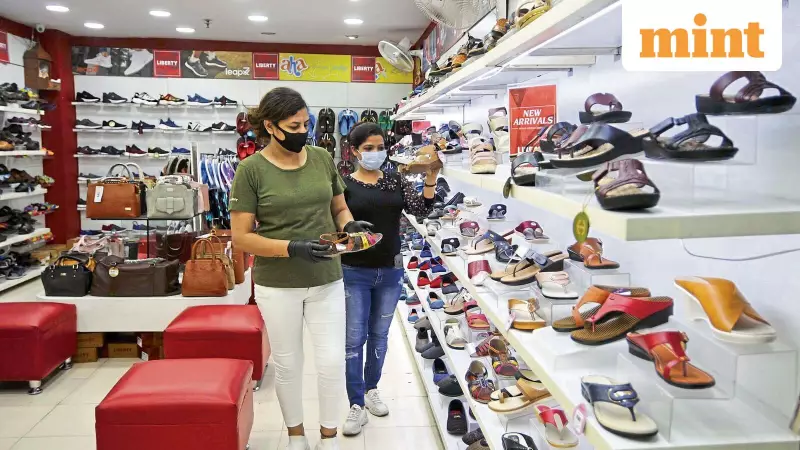
India's much-anticipated GST rate reductions have failed to deliver the expected consumption boost for the country's apparel and footwear sectors during the recent festive season. Despite government efforts to stimulate spending through tax rationalization, weak discretionary spending and unseasonal weather conditions combined to create a disappointing performance for retailers.
Tax Transition Disrupts Buying Patterns
The uncertainty surrounding GST rate changes led to significant deferral in purchasing decisions, according to industry executives. Amit Aggarwal, CFO of Bata India Ltd, the country's largest listed footwear retailer, highlighted how the transition period from mid-August announcement to September 22nd rollout created market uncertainty.
"There was a delay in buying because of the planned rate rationalization," Aggarwal stated, describing the transition window as "very, very long." Many channel partners postponed purchases to avoid input tax credit mismatches that could arise during the tax changeover period.

Bata responded proactively by reducing prices and launching incentive schemes early, becoming one of the first movers to pass on GST-related benefits effective the first week of September. However, this came at the cost of gross margins. The company believes that without these disruptions, revenue would have been "at least flat" rather than the 4% decline actually reported.
Mixed Impact Across Price Segments
The GST overhaul simplified tax structures for both footwear and apparel sectors. For footwear costing up to ₹2,500, the GST rate fell from 12% to 5%, while the apparel sector saw similar rationalization with the price threshold for the lower 5% rate increasing from ₹1,000 to ₹2,500.
However, the changes weren't uniformly beneficial. Garments priced above ₹2,500 now attract 18% GST, up from the previous 12%, which negatively affected mid-premium and festive-wear categories. This created a complex scenario where budget segments benefited while premium segments faced higher tax burdens.
Satish Meena, founder of Datum Intelligence, explained that "GST helped only in certain price bands. The mid-premium segment benefited, which favoured brands like Metro and Pantaloons. But low-priced footwear didn't gain because demand itself is weak, not the tax rate."
Company Performance Reflects Sector Challenges
The financial results from major players tell a clear story of sector-wide challenges. Bata India reported a 4.2% year-on-year revenue decline to ₹801.33 crore in the September quarter, with net profit slipping dramatically from ₹51.97 crore to ₹13.89 crore.
Similarly, Khadim India Ltd saw September sales fall to ₹101 crore from ₹109 crore a year earlier. While the company's premium lines like British Walkers grew in double digits and products priced below ₹500 rebounded, the mid-segment continued to struggle.
V-Mart Retail echoed these sentiments, with managing director and CEO Lalit Agarwal stating that "we expected significant gains, but the consumer response was not as strong as anticipated." Tata Group-owned retailer Trent Ltd also cited muted sentiment, unseasonable rains, and the GST transition as factors keeping growth to low single digits.
Premium Segment Shows Resilience
In contrast to the broader sector challenges, premium footwear and apparel retailers demonstrated stronger performance. Companies like Metro Brands and Aditya Birla Fashion & Retail Ltd reported steadier demand and limited disruption from the GST transition.
Metro Brands CEO Nissan Joseph noted that consumers intentionally waited for the GST cut before shopping, and demand accelerated meaningfully once the new rates took effect. "The GST changes have been very positive for our business. We've seen as much as 11% reduction on footwear priced between ₹1,000 and ₹2,500 and around 6% for footwear under ₹1,000," Joseph explained.
The cuts benefited nearly 90% of Walkway and a large share of Metro and Mochi's portfolio, helping drive footfall and conversions. Joseph added that the broader consumption environment was normalizing, indicating that premium segments might be recovering faster than mass-market categories.

Multiple Factors Behind Disappointing Performance
According to industry analysts, several factors converged to create the lackluster festive season. Ritu Srivastava, associate professor of economics at K J Somaiya Institute of Management, noted that the benefit of lower GST was offset by thinner discounts offered by retailers.
"The benefit from the GST cut was offset by the reduction in discounts," she observed, adding that items above ₹2,500 saw no benefit due to unchanged higher tax rates. The spillover of Durga Puja into the previous quarter and an early Diwali led to fragmented spending, with retailers describing this as a "summer Diwali" effect that hurt heavier festive wear sales.
E-commerce has also reshaped shopping patterns significantly. Srivastava pointed out that "online marketplaces significantly influence timings and prices... consumers are buying well before the festival week," reducing the traditional festive season shopping rush.
Weather conditions further exacerbated the situation, with heavy rains in the East and cyclonic activity in Tamil Nadu and Andhra Pradesh pulling down footfall during key festive days. Retailers were forced to roll out deeper discounts early in the season to clear inventory, squeezing margins across the board.
Cautious Outlook for Recovery
While analysts expect some recovery in the third quarter, the outlook remains cautious. Karan Taurani, equity research analyst at Elara Capital, expects the benefit of GST cuts in apparel and footwear to materialize gradually. "It will be a very small positive impact, in a phased manner over the next one year," he predicted.
Taurani noted that consumer spending actually moved toward high-value items where savings were much higher, such as automobiles and white goods, rather than apparel and footwear. He expects growth to be "mildly better" but limited by competitive intensity and the relatively small wallet share for fashion categories.
The broader consumption slowdown appears to persist despite government interventions, suggesting that structural issues in consumer confidence and spending patterns may require more comprehensive solutions beyond tax adjustments. As the sector looks toward the remainder of the fiscal year, retailers are adopting cautious strategies while hoping for gradual improvement in consumer sentiment and spending patterns.