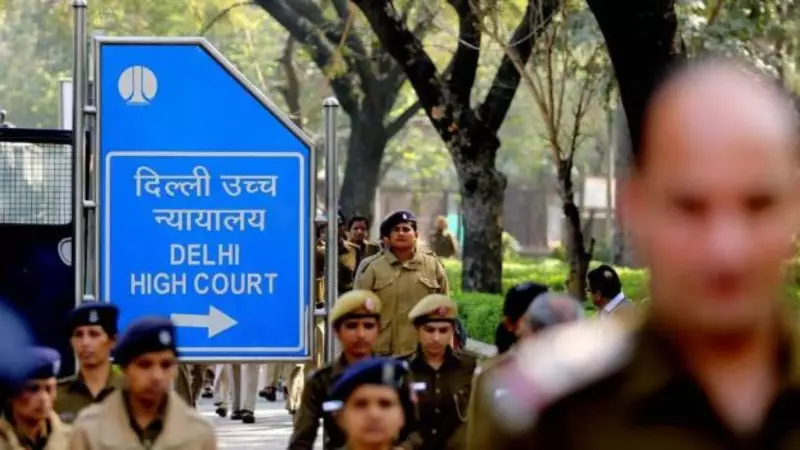
The Union government has strongly opposed a Public Interest Litigation (PIL) seeking a reduction in the Goods and Services Tax (GST) levied on air purifiers, cautioning the Delhi High Court that any judicial direction in the matter would violate the constitutional principle of separation of powers and "open up a Pandora's box."
Centre's Stance on Judicial Overreach
Appearing for the Centre, Additional Solicitor General (ASG) N. Venkataraman argued before a bench of Justices Vikas Mahajan and Vinod Kumar on Friday that the issue of tax rates falls squarely within the domain of the GST Council, a constitutional body. He asserted that the court stepping in to issue directions would amount to a breach of the Constitution's basic structure.
"We are scared from the constitutional perspective, it is the doctrine of separation of powers," ASG Venkataraman submitted. He emphasized that there is a well-defined legislative process for handling recommendations, including those from parliamentary standing committees, and for the GST Council to deliberate on proposals. "How can this process be scuttled through a court process?" he implored.

The PIL and the Court's Earlier Suggestion
The PIL, filed by advocate Kapil Madan, seeks a reduction in the GST on air purifiers from the current 18% to 5%. The petition argues that air purifiers should be classified as medical devices, referencing a February 2020 notification from the Ministry of Health and Family Welfare, which would bring them under a lower tax slab.
On December 24, a division bench headed by the Chief Justice had suggested the Centre consider convening the GST Council, possibly through a virtual meeting, to deliberate on the issue given the "emergent air pollution situation" in Delhi and the National Capital Region (NCR). The court had also instructed the Centre to seek instructions on when the Council could meet.
Why a Virtual GST Council Meeting is 'Not Possible'
Responding to the court's suggestion, ASG Venkataraman clarified that calling a virtual meeting of the GST Council would not be feasible. He cited Regulations 14 and 15 of the 'Procedure and Conduct of Business Regulations of the GST Council,' which detail how proposals are deliberated and voted upon, including through secret ballots. He stated that this process requires the physical presence of all Council members, who are the finance ministers of all states and union territories.
He further explained that the parliamentary standing committee report recommending a GST cut on air purifiers has been sent to the Environment Ministry, which will then seek an action-taken report from the Department of Revenue. This established procedure, he argued, must be followed.
Allegations of a 'Loaded' Petition and Market Motives
The Centre's opposition went beyond constitutional concerns. ASG Venkataraman questioned the bona fides of the PIL, calling it a "convoluted, loaded petition." He suggested the petition might be driven by undisclosed commercial interests rather than public welfare.
"This is not a PIL at all... GST is only a ruse," he told the court. "Please come to prayers, it has nothing to do with GST... Somebody wants a monopoly in air purifiers, we don't know. We are really concerned about it." He also pointed out that the Union Health Ministry, which would be central to classifying a device as medical, was not even made a party to the case.
Court's Concern for Affordability Amid Pollution
During the hearing, Justice Vikas Mahajan orally remarked on the court's primary concern: the high cost of air purifiers amidst dangerous pollution levels. He noted that prices range from Rs 10,000-12,000 to Rs 60,000, putting them out of reach for the common citizen.
"The court's only concern was... having regard to the pollution situation in Delhi and surrounding areas, why the GST should not be reduced," Justice Mahajan said. "Whatever way you want, you do it, find a way out for that."
The ASG responded that the GST Council involves collective decision-making where "each one (finance minister) perceives it very differently," implying that reaching a consensus requires due process.

Next Steps and Hearing Date
After considering the submissions, the bench allowed the Centre to file a formal counter-affidavit detailing its stance within ten days. The petitioner was also granted permission to file a rejoinder thereafter. The Delhi High Court will now hear the matter next on January 9.
The case highlights the ongoing tension between judicial intervention for public good in a health emergency and the strict boundaries of constitutional mandates governing fiscal federalism and legislative processes.