

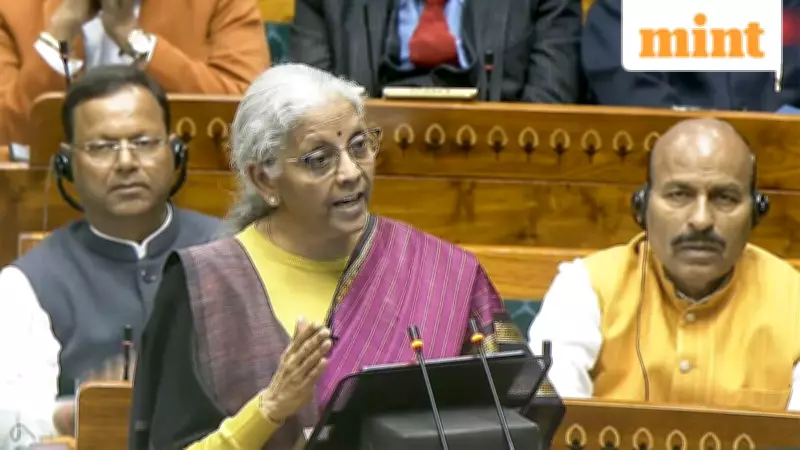
Union Budget 2026: The Real Economic Impact Lies Beyond Policy Headlines
The Union Budget for 2026-27, presented on 1 February 2026, offers a careful blend of reassurance and fiscal restraint. While the headlines focus on policy announcements, the true test of this budget will be how its measures translate into tangible outcomes on the ground. As economist Indira Rajaraman notes, we are navigating a complex global order where domestic actions will ultimately determine India's economic trajectory.
Navigating Fiscal Consolidation Amid Structural Changes
The budget arrives at a significant juncture, preceding by one month the release of advance GDP estimates based on a new series with 2022-23 as the base year, replacing the old 2011-12 series. This shift will alter sectoral weights and affect real growth estimates for the first two quarters, though nominal GDP may see minimal impact. The tentative advance estimate for the current year stands at ₹357.14 trillion, with the budget projecting nominal GDP for 2026-27 at ₹393 trillion, assuming 10% growth.
Two other critical changes frame this budget: the 16th Finance Commission report covering 2026-31, factored into budget figures while maintaining states' share of Union tax revenues at 41%, and the impending 8th Pay Commission report due in April 2027 with retrospective effect from January 2026. The latter will create an arrear bump-up in revenue expenditure in 2027-28, adding complexity to future fiscal planning.

The Fiscal Landscape: Deficit Management and Expenditure Quality
Fiscal consolidation remains firmly on track, with the provisional estimate for 2025-26 showing an absolute fiscal deficit of ₹15.58 trillion, slightly below the budgeted ₹15.69 trillion. For 2026-27, the deficit is projected at 4.3% of GDP, though the absolute figure of ₹16.96 trillion—representing a rise of ₹1.38 trillion—offers a more reliable metric given fluid denominator calculations.
This consolidation has been achieved despite a substantial increase in effective capital expenditure, which has risen from a pre-pandemic average of 2.7% of GDP to 3.9% for 2025-26 (provisional estimate) and 4.4% budgeted for 2026-27. Current revenue expenditure has borne much of the adjustment burden, dropping to 10.8% of GDP for 2025-26 and 10.5% budgeted for 2026-27, below the pre-pandemic average of 11.1%. This reduction is largely attributed to decreased subsidy leakages through direct benefit transfers.
Enhanced tax revenue and a significant ₹2.68 trillion dividend payout from the Reserve Bank of India have further bolstered the fiscal position. However, critical questions remain about expenditure quality and maintenance. As capital assets expand, corresponding revenue expenditure for maintenance must keep pace to prevent assets from becoming unproductive or hazardous. Are roads, sewage systems, and treatment plants receiving adequate budgetary support? Are regulatory bodies sufficiently staffed to function effectively? These implementation details will determine whether capital expenditure translates into sustainable growth.
Policy Environment and Targeted Reforms
The major fiscal instruments have largely been deployed, with income tax and GST rates already reduced in the current fiscal year. Monetary and trade policy are moving in concert, though the RBI has limited room for further repo rate reductions in its upcoming February announcement, as banks struggle to attract deposits.
On the trade front, the free trade agreement with the European Union, reached on 27 January, is expected to be operational by end-2026. While details—particularly regarding the Carbon Border Adjustment Mechanism—require further negotiation, the agreement presents significant opportunities.
The budget introduces several well-targeted reforms, three of which stand out:

- Expanded Trade Receivables Discounting System: This platform for discounting unpaid commercial dues addresses a critical need for small enterprises, improving their liquidity and operational stability.
- Comprehensive Skill Enhancement Programs: Including specialized training in geriatric and mental health care, these initiatives respond to pressing societal needs while creating employment opportunities.
- Support for Commercial Tree Crops: These promotion efforts align with reduced EU tariffs and anticipated demand boosts, creating synergies between agricultural policy and trade agreements.
Additionally, the new Income Tax Act effective from 1 April 2026 simplifies procedural requirements and reduces rates for tax deduction and collection at source. Cooperatives and IT service providers benefit from facilitated payment processes, while indirect tax provisions have been liberalized for exporters' imported input needs.
The Implementation Imperative
While the budget's policy directions warrant optimism, its ultimate success hinges on execution. The expanded trade bills discounting system, skill programs, and agricultural support measures address genuine needs, but their design must translate into effective delivery. Similarly, fiscal consolidation achievements must not come at the cost of essential maintenance expenditures or regulatory capacity.
In a challenging global environment, India's domestic policy choices will prove decisive. The Union Budget 2026 provides a framework, but its real economic impact will be determined not by headlines, but by how its provisions are implemented across the nation's diverse landscape.





