

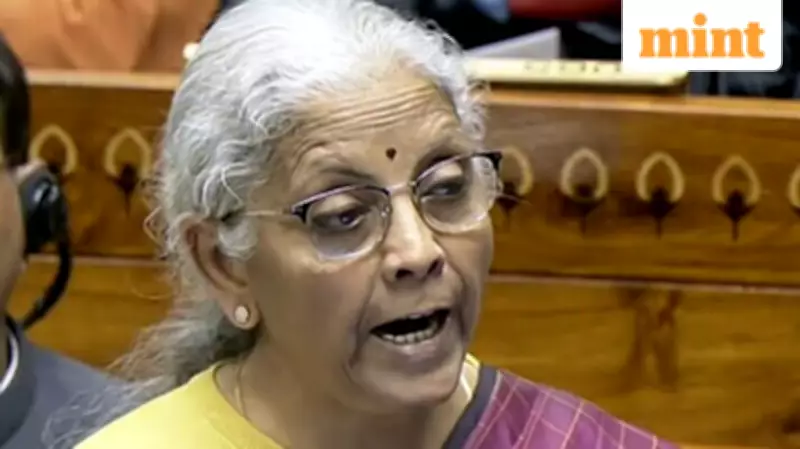
Union Finance Minister Nirmala Sitharaman presented the Union Budget for the fiscal year 2026-27 in the Lok Sabha on Sunday, outlining a series of measures aimed at bolstering key sectors of the Indian economy. The budget focused on enhancing manufacturing capabilities, supporting Micro, Small, and Medium Enterprises (MSMEs), and accelerating infrastructure development across the nation.
Key Announcements and Fiscal Targets
In a significant move, the government has increased the capital expenditure (capex) target to ₹12.2 lakh crore for the upcoming financial year, marking a substantial rise from the ₹11.2 lakh crore allocated in the current fiscal period. This boost is designed to stimulate economic growth and create a robust foundation for long-term development.
Political Reactions: Praise and Criticism
Prime Minister Narendra Modi praised the Union Budget 2026-27, describing it as a "strong foundation" for India's ambitious journey towards becoming a developed nation, or Viksit Bharat, by 2047. He emphasized that the budget would inject fresh energy and momentum into the country's ongoing reform initiatives, which he likened to a "reform express."

Opposition Leaders Voice Discontent
However, the budget faced sharp criticism from opposition leaders, who argued that it lacks innovative ideas and fails to address pressing economic challenges. Rahul Gandhi, the Leader of Opposition in the Lok Sabha, condemned the budget as "blind to India's real crises." He highlighted critical issues such as youth unemployment, declining manufacturing, capital flight, plummeting household savings, and farmer distress, all of which he claimed were ignored in the budgetary provisions.
Other opposition figures echoed similar sentiments:
- Congress MPs Shashi Tharoor and KC Venugopal expressed disappointment, noting that the budget allocated "nothing concrete" for Kerala, which is preparing for upcoming elections.
- West Bengal Chief Minister Mamata Banerjee accused the central government of withholding funds for her state and criticized the Goods and Services Tax (GST) framework. She dismissed announcements regarding economic corridors as "blatant lies" and highlighted state-level initiatives like the Jangalmahal Jangal Sundari project in Purulia, which involves an investment of ₹72,000 crore.
- TMC MP Shatrughan Sinha labeled the budget a "phenku and lapetu" budget, arguing that it neglects employment, national debt, and farmer welfare, and thus does not deserve a positive rating.
- Samajwadi Party chief Akhilesh Yadav criticized the budget for being incomprehensible to the poor and rural populations, claiming it fails to generate jobs and benefits only a small fraction of the country's citizens.
Industry Response: Mixed Reactions
The industry's reaction to the Union Budget 2026-27 was varied, with some sectors expressing disappointment while others offered praise.
Real Estate Sector's Concerns
The Confederation of Real Estate Developers' Associations of India (CREDAI), representing approximately 15,000 developers nationwide, expressed deep disappointment over the lack of concrete measures to boost affordable housing. CREDAI National President Shekhar Patel stated that the budget offers "nothing concrete for affordable housing," which could hinder demand and supply in this critical sector. Despite this, the association welcomed the government's emphasis on infrastructure development, recognizing its potential benefits for the realty industry.
CII Applauds Fiscal Discipline
In contrast, the Confederation of Indian Industry (CII) lauded the budget for striking a balance between aggressive growth and financial stability. Chandrajit Banerjee, Director General of CII, commended the fiscal deficit target of 4.3% of GDP for FY27, noting that it aligns well with the glide path recommended by CII and reinforces confidence in India's macroeconomic management. He also appreciated the government's commitment to reducing the debt-to-GDP ratio to 50% by FY31.

Stock Market Reaction: Sharp Decline
The stock market reacted negatively to the budget announcements, with major indices experiencing significant declines. This downturn was primarily triggered by Finance Minister Nirmala Sitharaman's proposal to increase the Securities Transaction Tax (STT) on derivatives. The STT on futures contracts was raised to 0.05% from the current 0.02%, leading to a sell-off in the markets.
Key market movements included:
- The 30-share BSE Sensex plummeted by 2,370.36 points, or 2.88%, during afternoon trade, briefly falling below the 80,000-mark. It eventually closed at 80,722.94, down by 1,546.84 points, or 1.88%.
- The 50-share NSE Nifty plunged by 495.20 points, or 1.96%, ending the day at 24,825.45. During the trading session, it experienced a more severe drop of 748.9 points, or 2.95%, reaching a low of 24,571.75.
Overall, the Union Budget 2026-27 has sparked a wide range of reactions, from governmental optimism to opposition skepticism and market volatility, highlighting the complex economic landscape as India progresses towards its developmental goals.





