Bengaluru: Industries across Bengaluru, particularly micro, small and medium enterprises (MSMEs), are facing mounting pressure as commercial LPG prices have risen sharply over the past few months, significantly increasing production costs.
Sharp Rise in LPG Prices
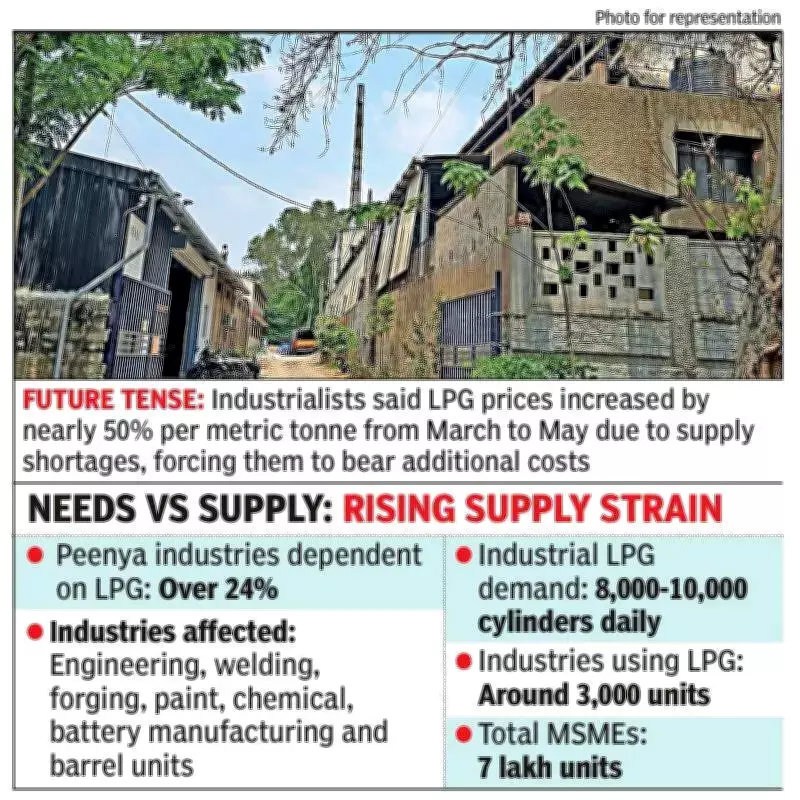
Industrialists said LPG prices increased by nearly 50% per metric tonne between March and May, while commercial cylinders in the open market are reportedly being sold for as high as Rs 4,500 due to supply shortages. The latest hike of Rs 991 has pushed the price of a 19-kg commercial LPG cylinder to Rs 3,153.
Manufacturers said most industries operate on annual contracts, leaving little room for immediate price revisions and forcing them to absorb the additional costs. Engineering units, welding workshops, battery manufacturers, barrel makers, paint units and several other industries in and around Bengaluru rely heavily on LPG during production.

Impact on Industrial Operations
S Shanmugam, a barrel manufacturer, said: "Before March, LPG prices were around Rs 75,000 per metric tonne. They surged to Rs 1.48 lakh in April and nearly Rs 1.68 lakh in May, severely impacting industries operating on fixed contracts. While steel price variations are covered, there is no provision for rising fuel costs, forcing manufacturers to absorb losses. LPG is critical across production stages, including paints and chemicals. Commercial cylinders that cost Rs 1,000 are now selling for nearly Rs 4,000 in the open market, pushing many industries to shift to PNG wherever infrastructure is available."
Industrial bodies in Peenya estimate that over 24% of industrial units directly depend on LPG, with sectors such as welding, forging, paints, chemicals and battery manufacturing among the worst affected.
Industry Associations Speak Out
DP Narendran, president of the Peenya Industries Association, said: "Commercial LPG cylinder prices have officially risen to around Rs 999, but private suppliers in the open market are charging nearly Rs 4,500 due to inadequate supply over the past month. Over 24% directly depend on it, while many others are impacted indirectly through welding and gas-based operations. Due to this, many are facing 20%-30% losses. We have repeatedly sought a separate industrial LPG quota but nothing has been done."
Balakrishna MG, former president of the Federation of Karnataka Chambers of Commerce and Industry and an LPG supplier, said industries are gradually shifting towards piped natural gas (PNG) wherever possible. "At present, at least 300 industries in and around Bengaluru depend on LPG. High-volume users are shifting to GAIL gas to cut logistics costs, but non-pipeline areas still depend on LPG. The PNG transition will take 5-10 years due to infrastructure challenges and need for state support. Currently, 8,000-10,000 LPG cylinders are supplied daily for industrial use in Bengaluru as demand remains strong," he said.
MSMEs Mull Transition to PNG
Impacted by the crisis, a few are also exploring PNG and GAIL gas options for shift. Balakrishna said, "Some industries are exploring PNG and GAIL gas connections, but there are major limitations. The infrastructure cost is very high and natural gas does not provide the same heating capacity as LPG, especially for operations requiring temperatures of 1,400-1,500 degrees Celsius. In several industrial areas, there is still no proper pipeline connectivity, making the transition difficult. We met GAIL officials last week but negotiations are still ongoing, as the infrastructure cost is very high."
Meanwhile, Federation of Karnataka Chambers of Commerce and Industry (FKCCI) has written to the Centre seeking relief measures and support for MSMEs facing mounting losses. The apex body represents over 6 lakh MSMEs and 12 lakh traders in Karnataka.
Uma Reddy, president, FKCCI, said: "LPG hike is too steep and engineering industries are badly hit as production costs have almost doubled overnight. There will be a trickle-down effect and food prices have already increased in hotels. Many Bengaluru industries, especially welding and battery units, continue to depend on LPG."

Relief Measures Sought
Industries have sought urgent relief similar to the Covid period, including guaranteed credit support for MSMEs. They cite export payment delays due to war-related shipping disruptions, straining cash flows across the supply chain. They have also demanded a six-month deferment of EMIs and GST payments without penalties or credit impact, and an extension of repayment tenures.
Industry In Numbers
- Peenya industries dependent on LPG: Over 24%
- Industries affected: Engineering, welding, forging, paint, chemical, battery manufacturing and barrel units
- Industrial LPG demand: 8,000-10,000 cylinders daily
- Industries using LPG: Around 3,000 units
- Total MSMEs: 7 lakh units