AICCTU Report Warns Labour Codes Will Strip Workers of Fundamental Rights
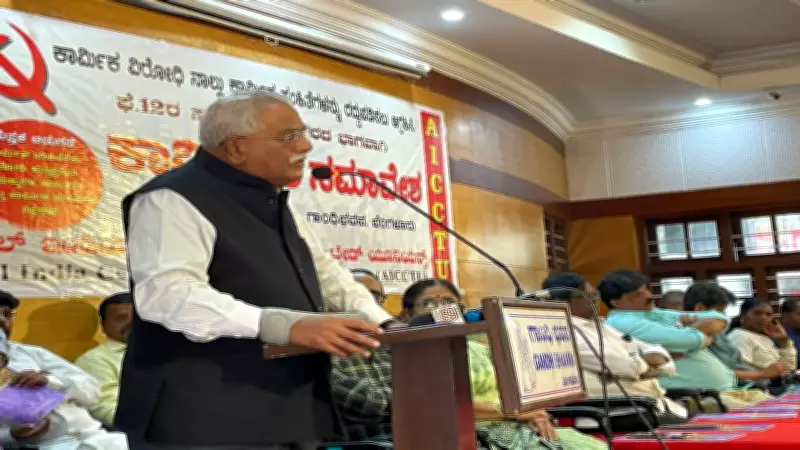
The All India Central Council of Trade Unions (AICCTU) has released a scathing report condemning the Central Government's recently implemented labour codes, warning that they threaten to transform workers into powerless pawns in the economic system. The report was unveiled at a significant Worker Convention held at Bengaluru's Gandhi Bhavan on February 1, 2026, setting the stage for a major general strike scheduled for February 12.
Former Supreme Court Justice Delivers Strong Condemnation
At the convention, former Supreme Court judge Justice V Gopala Gowda delivered a powerful address, sharply criticizing the labour codes that were passed by Parliament in November 2025. "Forget about achieving equality through these measures," Justice Gowda declared. "These labour codes have been specifically designed and implemented to turn workers into mere pawns, systematically denying them access to minimum wages, genuine job security, and essential social security protections."
He went further to draw a parallel with recent historical protests, stating, "If there is to be any hope of withdrawing these detrimental codes, the entire working class must prepare for a sustained and determined struggle, similar in scale and resolve to the farmers' protest against the controversial farm laws at the Delhi borders." This stark warning underscores the deep concerns among labour leaders about the codes' potential impact.

Report Details Systematic Erosion of Worker Protections
The AICCTU report, titled "Debunking Modi's Lies on Labour Codes" (with the Kannada edition named "Karmika Samhitegalu: Modi Kattuttiruva Sullugala Anavarana"), provides a detailed critique of multiple aspects of the new legislation. Among its key findings:
- The codes impose significant restrictions on workers' fundamental right to strike for improved working conditions and fair treatment.
- Gig and platform workers face particular vulnerability, as they are explicitly excluded from coverage under the Employees' State Insurance (ESI) scheme.
- Instead of robust protections, these workers are merely granted the right to register, with no concrete social security benefits guaranteed as a legal right.
The report elaborates: "All the codes do is promise to eventually roll out vague schemes with unspecified benefits, without detailing the actual content of these benefits or providing any clear timeline for their implementation. Crucially, the rights that workers previously held under longstanding acts like the Employees' State Insurance Act of 1948 and the Employees Provident Funds Act of 1952 are not strengthened; they are substantially diluted."
Gig Workers Protest Across Major Cities
In a related development that highlights growing unrest, gig workers organized simultaneous protests in Bengaluru, Mumbai, Delhi, and Kolkata on Tuesday. Their grievances centered on precarious working conditions and the arbitrary cancellation of their accounts on the digital platforms they depend on for livelihood.
In Bengaluru, approximately 40 gig workers gathered at Freedom Park to voice their frustrations. A coordinator from the Gig and Platform Service Workers Union explained the challenges: "Companies frequently block our IDs without providing any valid reason or explanation. The rating systems they use are opaque and unclear, and there is absolutely no job security. They label us as 'partners,' but this partnership offers none of the benefits or protections that term should imply."
The coordinator added, "When these platforms implement new policies or change terms, they never seek our consent or input. The attitude is dismissive and threatening: 'if you want to work, then work under our conditions; otherwise, leave the platform entirely.'" This sentiment reflects a broader anxiety about diminishing worker agency under the new regulatory framework.

Broad Coalition of Workers and Leaders Mobilizes
The Bengaluru convention saw participation from a diverse array of Karnataka-based workers, including employees from Hindustan Aeronautics Limited (HAL) and irrigation department workers, indicating wide-reaching concern across sectors. Key speakers included AICCTU national president V Shankar and vice-president Clifton Rozario, who addressed the gathering and emphasized the need for collective action.
As the February 12 general strike approaches, the AICCTU's report and the accompanying protests signal a mounting confrontation between labour groups and the government over the future of worker rights in India. The criticism focuses on fears that the labour codes prioritize corporate flexibility at the expense of fundamental worker protections, potentially reshaping the employment landscape for millions.