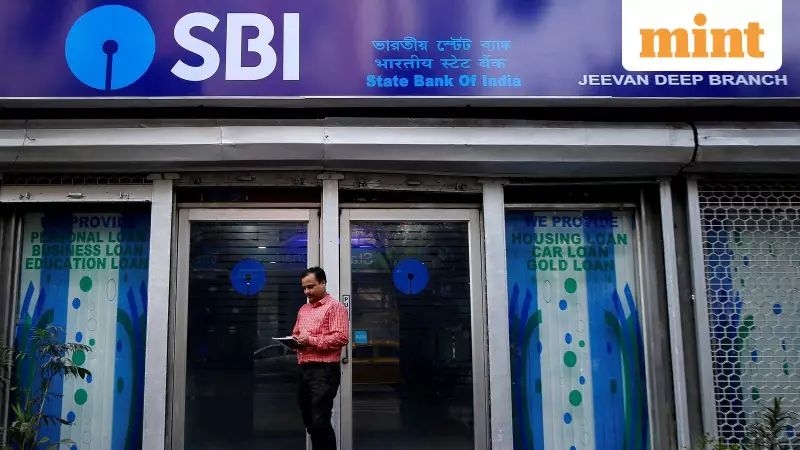
SBI Creates History with ₹9 Trillion Market Cap Milestone
State Bank of India, the country's largest public sector lender, achieved a historic milestone on Monday by becoming the first government-owned bank to cross the ₹9 trillion market capitalization mark. The banking giant's shares reached a new lifetime high of ₹976.80 during the previous trading session, though the stock traded relatively flat on Tuesday, November 18, as investors digested the record-breaking performance.
Impressive Returns Across All Time Frames
SBI's stock has demonstrated remarkable strength across multiple time periods. The bank has delivered multibagger returns of 286 percent over the last five years, cementing its position as one of the most rewarding investments in the banking sector. More recently, the stock has gained 21 percent in the past year, 23 percent over six months, 17.5 percent in three months, and more than 9 percent in just the last month.
Strong Q2 Financial Performance
The bank's consolidated financial results for the second quarter of FY26 showed continued growth momentum. Consolidated net profit increased by 6.4 percent to ₹21,504.49 crore compared to ₹20,219.62 crore in the same quarter last year. On a standalone basis, profit grew by 10 percent to ₹20,159.67 crore from ₹18,331.44 crore year-on-year.

Net interest income climbed 3.28 percent year-on-year to ₹42,984 crore from ₹41,620 crore in Q2FY25. While domestic net interest margin saw some compression, declining by 18 basis points to 3.09 percent, the bank's asset quality showed significant improvement. The net NPA ratio dropped 11 basis points to 0.42 percent, and gross NPA fell 40 basis points to 1.73 percent.
Analysts Divided on Near-Term Prospects
Market experts have expressed mixed views on SBI's immediate future trajectory. Anand James, Chief Market Strategist at Geojit Investments, noted that while the stock broke above a seven-day trading range, oscillators are showing negative divergences. "This discourages us from being too bullish at this stage, and would rather play for limited upside, with expectations of volatility setting in, once in the vicinity of 1000," he cautioned.
In contrast, Amruta Shinde of Choice Broking maintained a bullish stance, noting that SBI is trading at ₹973.35 with strong bullish momentum. She highlighted that the stock has maintained a higher-high, higher-low structure and remains above its key moving averages. Her analysis suggests potential upside to ₹1032 with support near ₹964.
Consolidation in Public Sector Banking
The banking behemoth has also been in the spotlight for its stance on further consolidation among public sector banks. Chairman Challa Sreenivasulu Setty indicated in a recent Bloomberg News interview that "some further rationalisation might make sense" among smaller, sub-scale banks. He suggested that another round of consolidation "may not be a bad idea" as policymakers work to build scale and support financing needs in one of the world's fastest-growing major economies.
Brokerage Outlook and Price Targets
Phillip Capital has maintained its Buy rating on SBI while significantly revising its target price upward from ₹900 to ₹1100, representing a 13 percent potential upside from current levels. The brokerage highlighted SBI's strong sanction pipeline, which supports its loan growth guidance of 12-15 percent. Disciplined loan pricing and better liability management have helped the bank deliver margin performance in a challenging environment.
The firm noted that stable asset quality and high provision buffers provide confidence for moderate credit costs, enabling SBI to generate +1 percent ROA on a sustainable basis. Phillip Capital models earnings growth of 9 percent and 3 percent for FY26E and FY27E, respectively.
Disclaimer: The views and recommendations made above are those of individual analysts or broking companies, and not of Mint. We advise investors to check with certified experts before making any investment decisions.