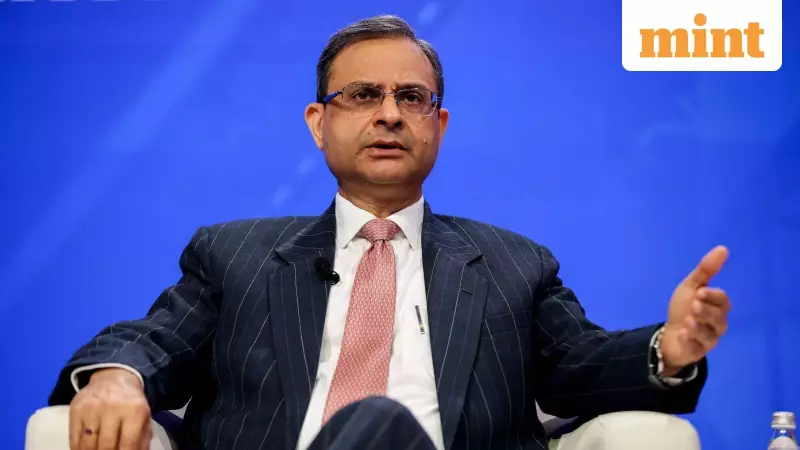
India will maintain a cautious approach toward cryptocurrencies and stablecoins while aggressively promoting homegrown digital payment systems like UPI, NEFT, and the central bank digital currency, according to Reserve Bank of India Governor Sanjay Malhotra. Speaking at the Delhi School of Economics on Thursday, the central bank chief outlined India's distinctive position in the global payments landscape.
India's Robust Payment Infrastructure vs Crypto
Governor Malhotra emphasized that India's existing digital payment rails effectively address the gaps that advanced economies are attempting to fill with new cryptocurrency regulations. "Our country is different from the US in the sense that we have a very sound system of payments," Malhotra stated. "We have the UPI, we have the NEFT and the US does not have to the extent and scale that we have."
The RBI governor highlighted that domestic payment issues faced by countries like the United States simply don't exist in India due to the comprehensive digital infrastructure already in place. Despite this robust system, the central bank continues to warn about risks associated with private crypto assets, including volatility and potential systemic spillovers.

Digital Rupee Advancement and Final Policy Decisions
Even as the RBI expresses concerns about private cryptocurrencies, the central bank is actively scaling trials of its own digital rupee. "We are promoting and experimenting with the CBDC (central bank digital currency), which is backed by the central bank, the RBI, as an alternative for payments in our country, and more importantly, for full-value and cross-border payments," Malhotra explained.
However, the ultimate decision on how India handles private crypto assets rests with the political leadership. "The government has to take a view... they will take a final call as to how, if at all, crypto is to be handled in our country," the governor clarified, indicating that the final policy framework would be determined by elected representatives.
Rupee Movement and Economic Resilience
Addressing concerns about the Indian rupee's recent depreciation, Malhotra pushed back against intervention theories, stating that the currency's movement reflects genuine market forces. "We do not target any level... It's for the markets to decide," he asserted, explaining that exchange rate movements are primarily driven by dollar demand from trade and capital flows.
The Indian rupee has weakened approximately 5% against the US dollar over the past year, currently trading around ₹88.7-88.8. Malhotra attributed recent pressure partly to expectations stemming from tariff adjustments and their potential impact on the current account.
Despite these challenges, the RBI governor expressed confidence in India's external resilience, pointing to the country's substantial foreign exchange reserves of approximately $690 billion. He suggested that a favorable trade deal with the US could help relieve current account pressures moving forward.
Inflation Targeting and Regulatory Evolution
Malhotra reaffirmed that India's flexible inflation targeting framework, operating within a 2-6% band, remains appropriate for an economy susceptible to food-price shocks. "We have a band. We do not have a point target with a band," he noted, explaining that the wider corridor is necessary due to the high component of food and price volatility in the Indian economy.
A significant portion of Malhotra's address focused on the RBI's evolving regulatory approach, which aims to transition from rigid rule-making to principle-based oversight while maintaining supervisory clarity. The governor described this as an iterative process: "We start small. We make humble beginnings. We take baby steps," citing the pilot of the expected credit loss framework with non-banking finance companies as an example.
To prevent regulatory stagnation, the RBI has embedded periodic reviews into its system, with regulations being reassessed every five to seven years to ensure they remain relevant and effective in India's rapidly evolving financial landscape.