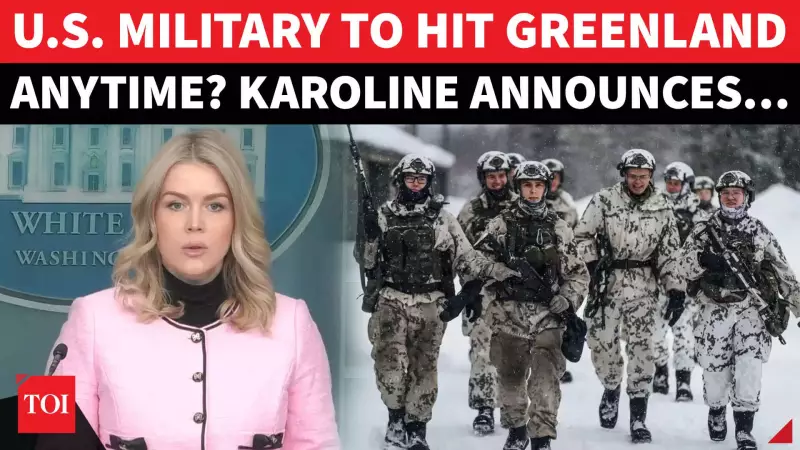
The White House has stirred a fresh international controversy after Press Secretary Karoline Leavitt indicated that the use of American military force remains a viable option in President Donald Trump's renewed pursuit to acquire Greenland. The statement, made on January 8, 2026, has reignited debates over sovereignty and aggressive expansion.
Military Force Not Ruled Out In Arctic Push
Karoline Leavitt, addressing the media, explicitly stated that the U.S. military is "always an option" regarding the Arctic island. This aligns with President Trump's longstanding refusal to dismiss the potential use of force. The President has consistently framed the acquisition of Greenland as a critical national security priority, citing the island's strategic location in the increasingly contested Arctic region.
The revelation suggests a significant escalation in the administration's approach, moving beyond mere diplomatic or financial offers. The notion of rushing US troops into a sovereign territory like Greenland, which is an autonomous constituent country within the Kingdom of Denmark, has drawn sharp criticism and concern from allies and geopolitical analysts alike.

Greenland's Strategic Value and Past Interest
This is not the first time President Trump has set his sights on Greenland. His interest in purchasing the world's largest island was widely reported during his first term, an idea that was swiftly and firmly rejected by the Danish government. The renewed and more forceful posture indicates a "final" plan, as disclosed by Leavitt, which appears to be a cornerstone of Trump's second-term foreign policy agenda.
The administration's argument hinges on the rapidly changing geopolitics of the Arctic. With melting ice opening new shipping routes and access to vast natural resources, the United States, Russia, and China are vying for influence. Controlling Greenland would offer the US a dominant position in the North Atlantic and Arctic, complete with advanced military and surveillance capabilities.
Global Repercussions and Regional Tensions
The White House's stark declaration is likely to have immediate and severe diplomatic consequences. It directly challenges the sovereignty of Denmark and the self-determination of Greenland's population. Furthermore, it signals a potentially more unilateral and confrontational US foreign policy stance, where territorial acquisition through coercion is considered a legitimate tool.
This development occurs against a backdrop of other high-stakes military actions by the Trump administration, as highlighted in the original report. These include the capture of Venezuelan leader Nicolás Maduro, operations against Colombian guerrillas in Venezuela, and heightened tensions with Iran and China. The Greenland statement fits a pattern of leveraging military power to achieve geopolitical objectives, unsettling the established international order.
The key facts from the report remain central: the statement was made by Press Secretary Karoline Leavitt on January 8, 2026; President Trump views Greenland as a national security imperative; and the use of US military force is explicitly on the table. The world now watches to see if this "final plan" moves from rhetoric to action, potentially triggering one of the most significant territorial disputes of the 21st century.