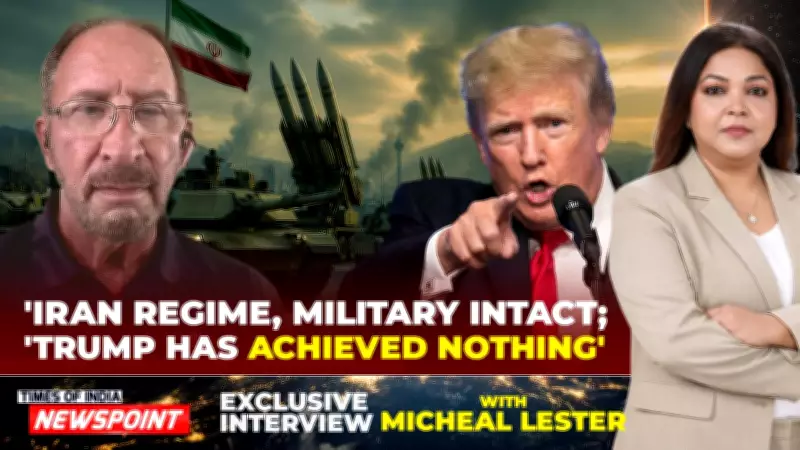
‘America Failed In Iran, Achieved No Goal’: U.S. Military Veteran Blasts Trump’s War Strategy
In a revealing interview on TOI Newspoint, former United States Marine Corps combat pilot and author Michael Lester delivered a scathing assessment of the ongoing military conflict between the United States and Iran. With more than 50 days of warfare yielding no significant breakthrough, Lester argues that the situation has devolved into a dangerous strategic stalemate where neither Washington nor Tehran can afford to back down.
The Strategic Deadlock Explained
According to Lester, the United States has fundamentally failed to achieve its primary objectives in Iran, leaving key military and political goals unmet. "America failed in Iran, achieved no goal," Lester stated bluntly, criticizing the Trump administration's approach to the conflict. He emphasized that for Washington, withdrawing without accomplishing these objectives would represent a significant geopolitical defeat.
Conversely, Lester explained that Tehran faces its own impossible dilemma. Any form of capitulation or concession could potentially destabilize Iran's internal political structure, creating vulnerabilities that the regime cannot risk. This mutual inability to retreat has created what Lester describes as a perfect storm of diplomatic paralysis.

The Critical Role of the Strait of Hormuz
Lester provided detailed analysis of how control over the Strait of Hormuz has become the central flashpoint in the conflict. Both nations are asserting dominance over this crucial maritime passage in fundamentally different ways, creating what he calls "a deadlock that is systematically blocking all negotiation attempts."
The strategic importance of this narrow waterway cannot be overstated:
- It serves as a critical global oil transit route
- Control represents significant geopolitical leverage
- Both sides have deployed substantial military assets to the region
- The standoff has disrupted international shipping lanes
Broader Implications and Expert Perspectives
Lester's analysis comes amid growing concern from other foreign policy experts about the direction of the conflict. Recent commentary has highlighted various dimensions of the ongoing tensions, including the breakdown of Tehran-Washington talks and broader regional implications.
The interview reveals several critical insights about the current military situation:
- The conflict has entered a phase of diminishing returns for both sides
- Diplomatic channels remain effectively frozen due to mutual intransigence
- Regional stability continues to deteriorate as the stalemate persists
- International efforts to mediate have proven ineffective thus far
Lester's military background provides unique perspective on the tactical and strategic dimensions of the conflict. As a former combat pilot, he understands firsthand the complexities of modern warfare and the challenges of achieving clear objectives in politically volatile environments.
The full interview offers comprehensive analysis of why this particular conflict has proven so resistant to resolution, examining historical context, current military deployments, and potential pathways forward. Lester's critique represents a growing chorus of voices questioning the strategic wisdom of continued military engagement without clear objectives or exit strategies.