US Military Bolsters Presence in West Asia with Marine Deployment
In a significant escalation of military readiness, the United States is dispatching thousands of additional Marines and sailors to West Asia, according to three anonymous US officials who spoke on Friday. While no decision has been made to send troops directly into Iran, this deployment is designed to enhance the capacity for potential future operations across the volatile region.
Details of the Deployment and Strategic Implications
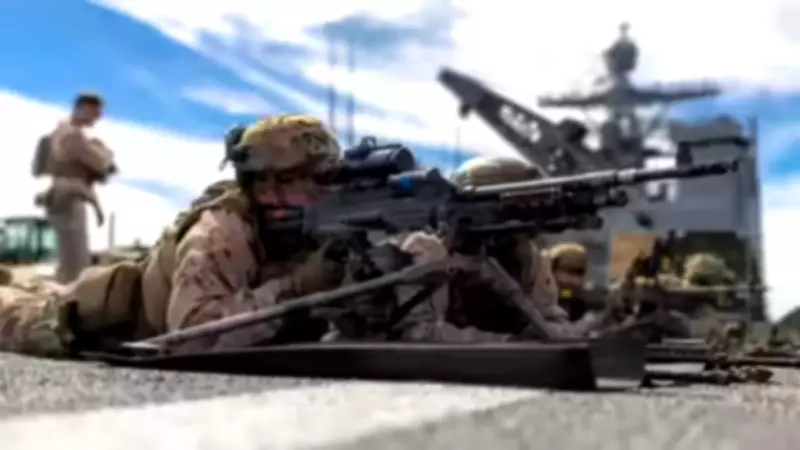
One official confirmed that the USS Boxer, along with two other amphibious assault ships, is en route to West Asia from its home port in San Diego. These vessels are carrying approximately 2,500 Marines from the 11th Marine Expeditionary Unit. Two other US officials verified the ships' deployment, though they did not specify the exact destination. Notably, the troops are departing the United States about three weeks ahead of their original schedule, indicating a heightened sense of urgency.
The White House and Pentagon have not responded to requests for comment on this matter. This new deployment will supplement the already substantial force of 50,000 US troops stationed in West Asia, effectively bringing two Marine Expeditionary Units to the area. These units, typically composed of around 2,500 Marines each, are versatile assets capable of executing a range of missions, including conducting strikes using aircraft from the ships or deploying on land for ground operations.

Escalating Military Actions in the Strait of Hormuz
Concurrently, US military efforts are intensifying in the strategic Strait of Hormuz. US officials reported that warplanes and attack helicopters are ramping up assaults against Iranian drones and naval vessels in an ongoing campaign to clear these contested sea lanes. General Dan Caine, chair of the Joint Chiefs of Staff, stated on Thursday that low-flying Air Force A-10 Warthog planes are actively "hunting and killing fast-attack watercraft" operated by Iran's Revolutionary Guard.
Caine further revealed that some regional allies, which he did not name, are utilizing Apache helicopter gunships to counter one-way attack drones—a key weapon in Iran's arsenal for striking targets across the Persian Gulf. In a related development, Axios reported on Friday, citing four sources, that the US is considering plans to occupy Iran's Kharg Island as a strategic move to pressure Iran into reopening the Strait of Hormuz.
Broader Context and Diplomatic Moves
This military buildup occurs against a backdrop of heightened tensions, including recent conflicts such as the Israel-Iran war, where Israel has conducted strikes on Tehran during Nowruz celebrations, and defensive responses from UAE and Kuwait to missile barrages. Iran has also claimed a strike on a US F-35 Lightning 2, highlighting the escalating nature of the conflict.
In a separate diplomatic development, the US lifted sanctions on Thursday against three Belarusian companies involved in producing a crucial fertiliser ingredient. This decision, made in exchange for Minsk releasing 250 political prisoners, aims to address soaring fertiliser prices exacerbated by the war, which threaten farmers' livelihoods globally.
Overall, the US military's increased deployment and aggressive actions in West Asia underscore a proactive stance in a region fraught with geopolitical risks, as tensions with Iran continue to simmer and broader conflicts unfold.