US Accelerates B-21 Raider Stealth Bomber Production Amid Iran Conflict
The United States Air Force is significantly expanding production of its next-generation stealth bomber, the B-21 Raider, following a crucial funding agreement with defense contractor Northrop Grumman. This strategic move is designed to accelerate the delivery timeline of the advanced aircraft and substantially reinforce the nation's long-range strike capabilities.
Funding and Production Increase
The Department of the Air Force has announced it will utilize $4.5 billion allocated under the fiscal year 2025 reconciliation legislation, often referred to as the "One Big Beautiful Bill," to enhance the bomber's production capacity by approximately 25%. This initiative aims to shorten delivery schedules while rigorously maintaining established cost and performance benchmarks.
This decision emerges against a backdrop of escalating geopolitical tensions and mounting concerns regarding US weapons stockpiles as conflicts intensify across the Middle East. Military officials assert that ramping up production of sophisticated platforms like the B-21 is essential to ensure the United States maintains credible deterrence and rapid strike capabilities in volatile regions.

"This is what disciplined acquisition delivers," stated Gen. Dale R. White, director of Critical Major Weapon Systems. "This decision reflects our confidence in the program's performance and the stability of the industrial base. By increasing production capacity now, we are responsibly accelerating delivery of a critical, combat-effective capability to the warfighter."
Capabilities and Strategic Role of the B-21 Raider
The B-21 Raider is currently undergoing comprehensive flight testing and is engineered to operate effectively in highly contested and adversarial environments. It integrates cutting-edge stealth technology, resilient networking systems, and a modern command-and-control architecture, enabling it to penetrate deep into defended territories to strike high-value targets.
This aircraft is projected to form the foundational backbone of the US Air Force's future bomber fleet, supporting a dual mission profile that encompasses both conventional and nuclear operations. As a developmental penetrating strike bomber, the B-21 Raider is capable of delivering a wide array of munitions, including precision-guided conventional weapons and nuclear payloads.
With a projected wingspan of approximately 140 feet, the B-21 is notably smaller than its predecessor, the B-2 Spirit, which has a 172-foot wingspan. The Air Force plans to acquire a minimum of 100 B-21 Raiders to systematically replace its aging fleet of 45 B-1 Lancers and 20 B-2 Spirits over the coming decade.
The overarching objective of the B-21 program is to enhance mission effectiveness and joint interoperability within advanced threat environments, thereby solidifying US deterrence posture and securing a strategic advantage over potential adversaries.
Public Fascination and Broader Defense Production Push
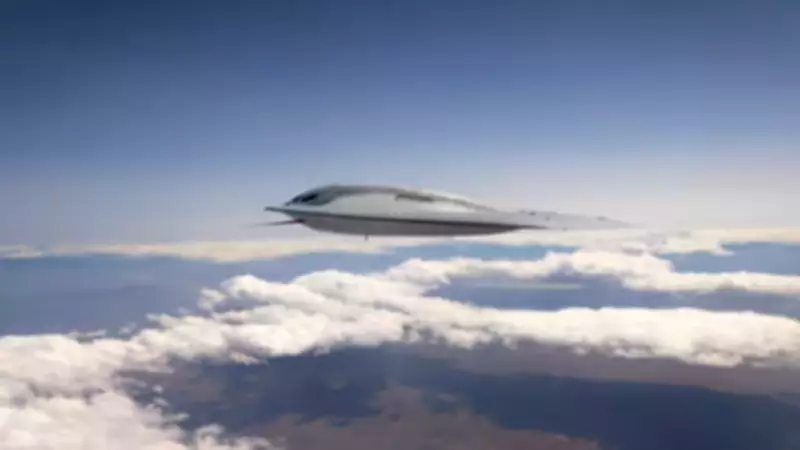
The B-21 Raider has captivated public imagination with its futuristic, almost otherworldly appearance and formidable capabilities. Images of the bomber in flight have sparked widespread commentary, with observers likening it to alien technology due to its sleek, angular design and state-of-the-art engineering. This comparison underscores the bomber's advanced nature and the significant technological leaps achieved by the US Air Force.
Initial operational aircraft are scheduled for delivery to Ellsworth Air Force Base in South Dakota by 2027, according to official Air Force statements.
This production acceleration aligns with broader discussions between US President Donald Trump and major defense contractors regarding a comprehensive boost to weapons manufacturing. Executives from leading companies, including BAE Systems, Boeing, Honeywell Aerospace, L3Harris Technologies, Lockheed Martin, Northrop Grumman, and RTX Corporation, recently convened and agreed to substantially increase production of advanced weapon systems.

This collective effort aims to replenish US military stockpiles and prepare for potential prolonged conflicts, ensuring readiness and resilience. "We just concluded a very good meeting with the largest US Defense Manufacturing Companies where we discussed Production and Production Schedules. They have agreed to quadruple Production of the 'Exquisite Class' Weaponry," President Trump remarked.
"Expansion began three months before the meeting, and Plants and Production of many of these Weapons are already under way," he added, highlighting the proactive steps already taken to scale up manufacturing capabilities across the nation.