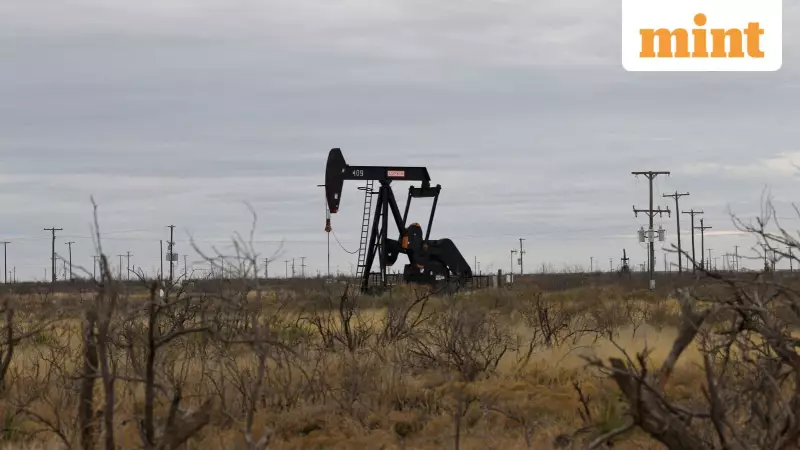
The United States' most prolific oil field, the Permian Basin, is facing a geological crisis of its own making. Shale drillers in West Texas and New Mexico have created a subterranean pressure cooker, where the relentless injection of toxic wastewater is now causing the ground to literally burst, birthing expensive and hazardous saltwater geysers.
A Region Under Pressure
Producers in the Permian Basin, responsible for roughly half of the nation's crude oil output, extract massive amounts of brine alongside the oil. For years, the standard solution was to pump this polluted water back deep underground. However, this practice has led to a dangerous buildup of pressure. According to a Wall Street Journal analysis of data from the University of Texas at Austin's Bureau of Economic Geology, pressure in injection zones in a prime part of the basin has reached 0.7 pound per square inch per foot.
Texas regulators have warned that when pressure exceeds 0.5 psi per foot, the liquid can find a pathway to the surface, threatening underground drinking water sources. This is precisely what's happening. "It's one of the many things that keep me up at night," said Greg Perrin, general manager of a groundwater-conservation district in Reeves County, Texas, a major injection site.

Unintended Consequences and Costly Cleanups
The crisis is a direct result of regulatory shifts. After deep wastewater disposal triggered hundreds of earthquakes—some over magnitude 5—the Railroad Commission of Texas cracked down in 2021. Companies then pivoted to shallower reservoirs, which now absorb about three-quarters of the billions of barrels injected annually. While this reduced earthquakes, it created new problems.
Mounting pressure is now forcing wastewater up through ancient, decaying wellbores in a costly game of whack-a-mole. A stark example occurred in 2022 in Crane County, Texas, where a 100-foot column of saltwater erupted from an abandoned well owned by Chevron. Plugging that leak cost roughly $2.5 million over 53 days. Scientists believe bottling up that geyser simply repressurized the subsurface, leading to another leak nearby nearly two years later.
Landowners are caught in the middle. In May, a well on Laura Briggs's Pecos County property began spraying saltwater "like a fire hydrant," taking four months and about $350,000 to plug. Ranchers like Brad Gholson fear contamination of groundwater critical for livestock. "It could put you out of business overnight," he warned.
Regulatory Balancing Act and an Uncertain Future
The Railroad Commission faces a monumental challenge: curtailing a industry vital to Texas's economy is not an option, but letting the situation fester risks turning supportive communities against it. The commission has adopted a more proactive stance, using satellite data to track pressure and recently imposing limits on injection volumes. It also secured $1.3 million to hire an investigation team and an additional $100 million to plug leaky wells.
Internally, researchers have been critical. A preliminary proposal from the Bureau of Economic Geology, obtained by the Journal, stated that operators were injecting wastewater with little concern for its underground travel or impact on pressure, behavior that "inexorably causes waste" and reduces the value of the injection resource.
For oil companies, the glitchy geology means higher costs—fortifying wells, adding casing, and protecting against corrosion. Scott Neal, a director at Chevron, acknowledged the added complexity and cost, though he said it hasn't caused material disruption. Some operators, like Pecos Valley, have even sued water-handling companies, alleging that injected water migrated into and flooded their oil-and-gas reservoirs.
The industry is exploring long-term solutions like evaporating, desalinating, and releasing treated water into rivers. However, researchers like Katie Smye of the Bureau of Economic Geology stress that these alternatives won't solve the near-term need for injection. She argues for a science-based approach to identify safe zones for disposal, posing the critical question: "If we say no to deep injection due to earthquakes, and we say no to shallow injection due to surface flows... then what?"

The future of the Permian Basin, a region also hoping to attract data centers and become a carbon-capture hub, now hinges on managing the very waste its success produces. The pressure is on, both underground and above.