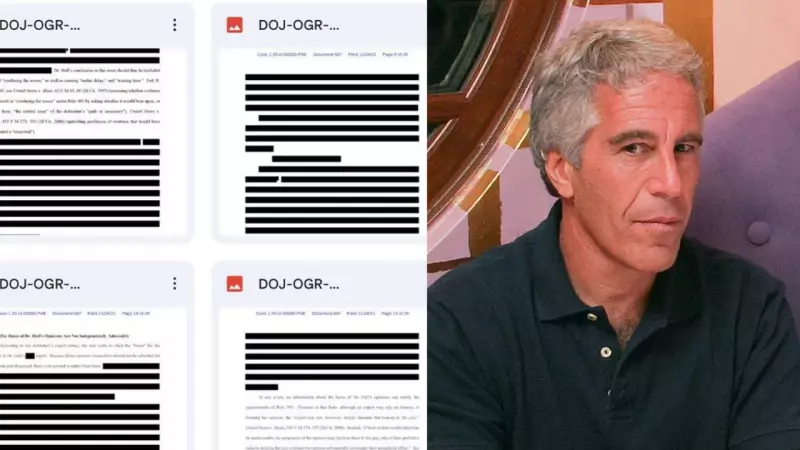
The United States Justice Department has firmly rejected accusations that it deliberately concealed the identities of politicians in a massive trove of documents related to the late convicted sex offender Jeffrey Epstein. The department insists that any blacked-out sections in the files are strictly mandated by law and are intended to safeguard the privacy of victims, not protect powerful figures.
Legal Mandate or Lack of Transparency?
In a public statement on the social media platform X, the Justice Department categorically denied shielding any political personalities or sexual predators. "The Justice Department is not redacting the names of any politicians," the statement declared. Deputy Attorney General Todd Blanche reinforced this position, clarifying that "The only redactions being applied to the documents are those required by law — full stop." He further explained that, in line with the statute, names of individuals or politicians are only withheld if they are identified as victims.
This defence comes in response to significant backlash following the initial batch of documents released last Friday under the Epstein Files Transparency Act. This law mandates the full publication of all unclassified records connected to Epstein by a specific deadline, making any partial or incomplete release technically illegal. The rollout was also marred by technical glitches, as thousands of users simultaneously attempted to access the files, causing the government website to crash and leaving many in digital queues.

Lawmakers and Public Express Disappointment
Politicians from across the aisle have labelled the document release as unsatisfactory. Indian-origin Congressman Ro Khanna, who co-sponsored the transparency law with Republican Thomas Massie, stated that the disclosure failed to comply with the legislation's terms. "The DOJ’s document dump of hundreds of thousands of pages failed to comply with the law authored by Rep Thomas Massie and me," Khanna posted on X. He highlighted a specific instance where a 119-page document containing Grand Jury testimony was entirely redacted.
Public scrutiny quickly focused on specific high-profile names. Many users questioned the absence of mentions of former President Donald Trump in the database searches. Political commentator Brian Tyler Cohen expressed being "shocked" at finding no reference to him. Others reported practical difficulties, such as an inability to scroll through documents or encountering completely blank files.
Allegations of a Systematic Cover-Up
Influencer Harry Sisson amplified these concerns by sharing a video showing documents with what he called "blank" pages. He made a bold claim: "So Trump’s DOJ just completely removed him and any photos of him with Epstein from the files. We are witnessing one of the most brazen and disgusting cover-ups in American history."
A prevailing sentiment among critics is that the redactions seem designed to protect perpetrators rather than victims. One viral social media post argued, "They did not release the full Epstein files. What they just released is heavily redacted in order to protect the child sex traffickers that they should be prosecuting." In response to these allegations, the Justice Department maintains that its redaction rules are applied uniformly to everyone named in the files—be they politicians, celebrities, officials, or victims—as legally required. The debate over transparency versus privacy continues as the public and lawmakers demand fuller disclosure.