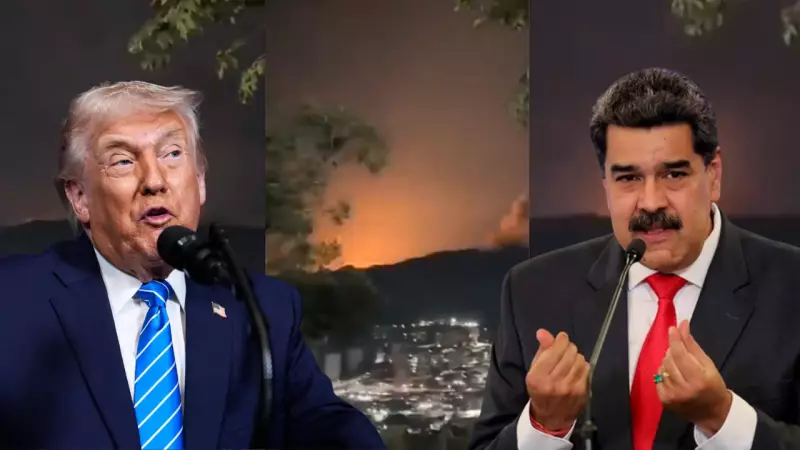
In a dramatic escalation that has sent shockwaves across Latin America, US President Donald Trump announced that American forces executed a "large-scale strike" in Venezuela, leading to the capture of the country's long-standing leader, Nicolás Maduro, and his wife, who were reportedly flown out of the nation.
An Operation Without Modern Parallel
If officially confirmed, this action represents the extraordinary removal of a sitting president from his own capital city without a declared war or a full-scale invasion, an event with few equivalents in recent history. Senior security experts have immediately drawn comparisons to the US captures of Iraqi dictator Saddam Hussein and Al-Qaeda chief Osama bin Laden, missions that fundamentally altered geopolitical landscapes.
Venezuelan authorities have stated they currently lack confirmation regarding Maduro's fate and have publicly demanded "proof of life" from the United States. Beyond the immediate claim, the strike forces a critical, larger question: if Maduro is truly gone, what future awaits Venezuela and the wider region?

A Capture Echoing History, Yet Uniquely Bold
Analysts point to the 1989 US operation to seize Panamanian strongman Manuel Noriega as the closest historical parallel. Both Noriega and Maduro claimed victory in elections widely disputed, faced drug trafficking accusations from Washington, and were under intense American pressure before their removal. However, Noriega's capture followed a short, conventional war that swiftly overwhelmed Panamanian defenses.
This time, the scale and methodology appear radically distinct. Based on available analysis, extracting a president and his spouse from the heart of Caracas without a ground invasion would mark this operation as "even more ambitious in its scope" than the Noriega arrest. While details are scarce, the implication is of a precision raid conducted deep within a heavily fortified capital.
CNN's chief international security correspondent, Nick Paton Walsh, described the development as "utterly startling," likening it to the bin Laden and Hussein operations. He termed it the most forceful foreign military intervention of Trump's presidency, showcasing "the level of freedom with which President Trump believes he operates globally."
Legal Justifications and Immediate Aftermath
Offering some clarity, US Senator Mike Lee stated that Secretary of State Marco Rubio informed him no further action in Venezuela is anticipated. Lee posted on X that Rubio confirmed Maduro's arrest to face US criminal charges, clarifying that the overnight kinetic operation was solely to protect personnel executing the arrest warrant.
Lee further elaborated that the strike falls under the President's "inherent authority" to protect U.S. personnel from an "actual or imminent attack." Meanwhile, some commentators suggested that Venezuela's current Vice President, Delcy Rodríguez, could be announced as interim president.
Maduro has been indicted since 2020 in the Southern District of New York on charges including narco-terrorism and cocaine trafficking. Washington steadily increased pressure, raising the bounty on his arrest to $50 million after Trump's return to office and designating the Cartel de los Soles as a foreign terrorist organization.
Chaos and Fear Grip Caracas
The impact on the ground in Venezuela's capital was immediate and visceral. Residents reported at least seven explosions across Caracas. People rushed into the streets or sought shelter indoors as smoke rose from military installations, parts of the city lost power, and armed civilian militias loyal to the government mobilized in some neighborhoods.
"The whole ground shook. This is horrible," said Carmen Hidalgo, a 21-year-old office worker. "We heard explosions and planes. We felt like the air was hitting us."
What Comes Next for Venezuela?
Should Maduro's forcible removal be verified, the consequences inside Venezuela remain highly unpredictable. Proponents of US intervention argue it could pave the way for a democratic transition, potentially allowing opposition figures like María Corina Machado or the 2024 opposition candidate, Edmundo González, to assume power.

However, the country is a complex web of armed colectivos, criminal gangs, Colombian guerrilla factions, and drug-trafficking networks. These entrenched structures will not vanish overnight. The most probable outcome is neither instant democracy nor outright civil war, but a turbulent transition characterized by instability, internal power struggles, and difficult negotiations with military elites.
The removal of Nicolás Maduro may conclude one volatile chapter, but it unquestionably opens another filled with profound uncertainty, crossing a line unseen in Latin America for over three decades.