
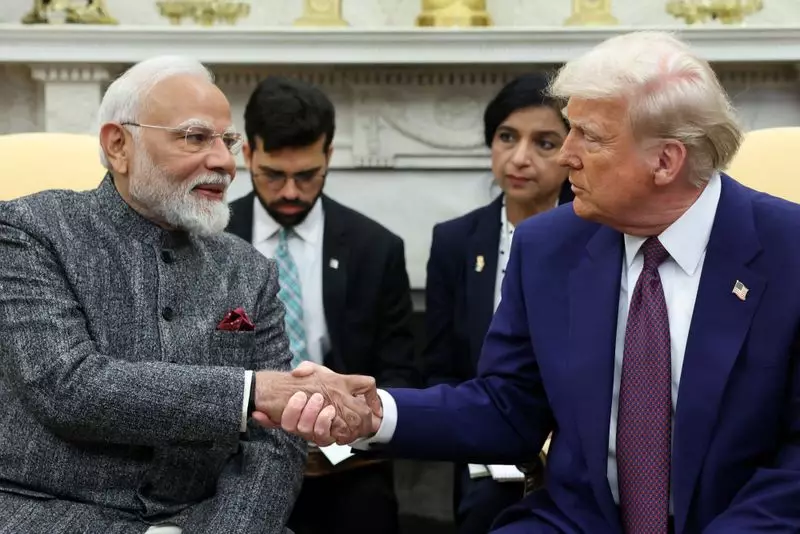
In a significant move for global geopolitics, outgoing President Donald Trump has given his final approval to a crucial annual defence policy bill that explicitly calls for a substantial enhancement of the United States' strategic partnership with India. The National Defense Authorization Act (NDAA) for Fiscal Year 2021, signed into law on January 1, 2021, carries a powerful legislative mandate for Washington to deepen cooperation with New Delhi, with a specific focus on the Indo-Pacific region and through the framework of the Quad grouping.
A Legislative Push for Stronger Indo-US Strategic Bonds
The newly enacted law is not merely suggestive but includes concrete provisions. It formally establishes a US-India Initiative for Critical and Emerging Technology (ICET), a mechanism designed to foster joint development and cooperation in vital technological domains. This initiative is seen as a cornerstone for future collaboration in areas like artificial intelligence, quantum computing, and cybersecurity, moving the bilateral relationship beyond traditional defence hardware.
Furthermore, the NDAA requires the US Secretary of State to submit a detailed report to Congress. This report must outline a comprehensive strategy for expanding and deepening the US partnership with India. The strategy is expected to cover a wide spectrum, including defence trade, military interoperability, and shared security objectives in the maritime domain. The legislative push underscores a bipartisan consensus in Washington on viewing India as a pivotal 'Major Defense Partner'.
Quad Receives Formal Backing in US Defence Legislation
One of the most notable aspects of the bill is its explicit endorsement of the Quadrilateral Security Dialogue, commonly known as the Quad. The legislation formally encourages enhanced cooperation among the Quad member states: the United States, India, Japan, and Australia. This marks a significant elevation of the informal grouping's status within official US policy frameworks.
The bill's text directs the US government to engage with Quad partners to promote a free, open, inclusive, and rules-based order in the Indo-Pacific. This is widely interpreted as a collective counterbalance to China's growing assertiveness in the region. By mandating engagement via the Quad, the US Congress has effectively institutionalized a key pillar of its Indo-Pacific strategy, with India playing a central role.
Implications for Regional Security and Bilateral Ties
The signing of the NDAA sends a strong signal of continuity in US strategic priorities, even during a presidential transition. For India, the law represents a robust and enduring commitment from the United States at the highest legislative level. It provides a firm foundation for the incoming Biden administration to build upon, ensuring that the momentum in defence and strategic ties is not lost.
The implications are multifaceted:
- Defense Modernization: It paves the way for smoother transfer of advanced US military technology to India.
- Maritime Security: It mandates greater naval cooperation and information-sharing in the Indian Ocean Region.
- Strategic Alignment: It formally aligns US and Indian interests in maintaining a stable balance of power in Asia.
Experts view this development as a culmination of years of diplomatic effort, transforming a once-cautious relationship into a comprehensive global strategic partnership. The inclusion of India-specific provisions in the must-pass annual US defence bill highlights the country's irreplaceable position in American foreign policy calculus. As geopolitical tensions simmer in the Indo-Pacific, this legislative anchor for the US-India partnership and the Quad is likely to shape regional dynamics for years to come.