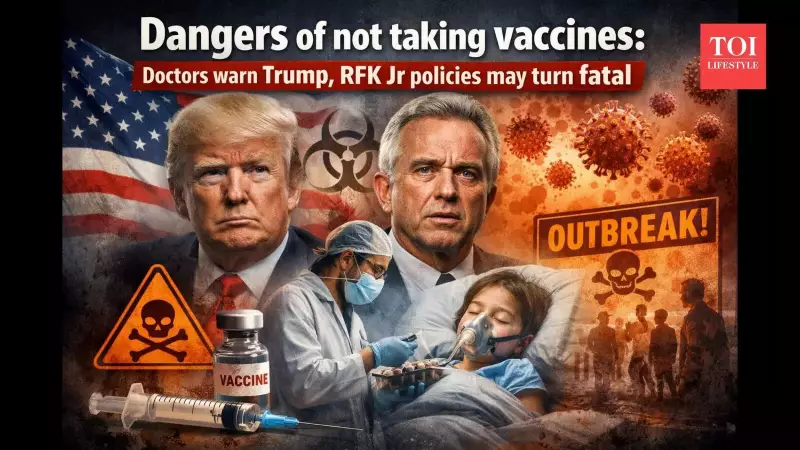
In a major policy shift that has sent shockwaves through the global medical community, the United States has dramatically scaled back its universal vaccine recommendations for children. The new guidelines, released on January 5, 2026, by the Centers for Disease Control and Prevention (CDC), mark a stark departure from decades of established public health practice.
A Significant Rollback in Recommendations
The revised federal vaccine guidelines, rolled out under the Trump administration with influential input from Robert F. Kennedy Jr., have reduced the number of diseases for which vaccines are universally recommended for all children. The count has dropped from 17 to 11. Several vaccines previously standard for every child have been moved into more selective categories, primarily a process called “shared clinical decision-making.”
This means vaccines for influenza (flu), Covid-19, rotavirus, hepatitis A and B, respiratory syncytial virus (RSV), and certain meningococcal strains are no longer broadly advised for all. Instead, they are recommended only for high-risk groups or after individual discussion between parents and doctors. The schedule also reduces the recommended HPV doses from two or three to just one in many cases.

Medical Experts Voice Grave Concerns
The move has drawn sharp criticism from paediatricians and public health leaders worldwide, who argue it prioritises political ideology over science. They warn it will create confusion, weaken vaccine uptake, and lead to a resurgence of preventable diseases.
In an interview, Dr. Amal Hejab, an American Board-Certified Internist at Bahrain Royal Hospital, stated, “The current changes in vaccination schedules are made arbitrarily, there is no new evidence to support the recommended minimisations.” She warned that the catastrophic consequences of increased infections and organ damage would be witnessed in the coming years.
Echoing this concern from an Indian perspective, Dr. Amit Gupta, Senior Consultant, Paediatrics and Neonatology at Motherhood Hospitals in Noida, highlighted the existing gaps. “Few children are missing their vaccinations and falling sick due to vaccine-preventable diseases... and may become seriously ill,” he said. He emphasised that vaccines often unavailable in government setups, like for chickenpox, flu, and typhoid, are equally crucial.
Jason Goldman, President of the American College of Physicians, publicly criticised the CDC's changes, warning they could “seriously undermine the vaccine programme in the United States and put patients and the public at risk.” He stressed that the policy was not based on science or peer review and fails to account for the realities of the US healthcare system.
The Proven Science Versus a Risky Shift
The policy shift stands in direct contrast to established global health consensus. Organisations like the World Health Organization (WHO) and the CDC itself have decades of data proving vaccines are safe and effective. Peer-reviewed research consistently shows:
- Vaccines save lives and prevent disease outbreaks.
- Live vaccines, like for polio and measles, reduce overall child mortality beyond their target diseases.
- Herd immunity protects the most vulnerable in society.
Experts caution that when vaccination rates fall, the results are predictable and dangerous: outbreaks of measles, polio, and whooping cough, overwhelmed healthcare systems, and needless suffering. Historical examples, like Samoa's 2019 measles epidemic, underscore how quickly progress can reverse.
The bottom line remains clear: Vaccines are one of medicine's safest and most effective tools. While policy language may cloud judgment, the scientific evidence is unwavering. Trusted clinicians worldwide continue to recommend routine immunisation to protect individual children and public health at large.
Note: The information provided in this article is for educational purposes only and is not intended as medical advice. Always consult with a qualified healthcare professional for medical decisions.