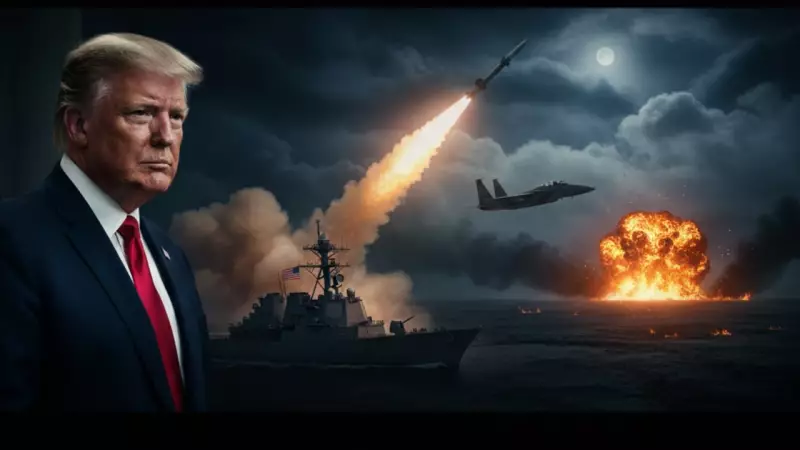
In a significant escalation of its counterterrorism operations in West Africa, the United States carried out coordinated air and missile strikes against Islamic State (ISIS) targets in northwestern Nigeria on Christmas Day. The operation, directly authorized by President Donald Trump, marks a sharp shift in Washington's military posture in the region and was framed as a response to the militant group's alleged slaughter of Christians.
Trump's Justification and the Christmas Day Operation
President Donald Trump announced the military action on December 25, stating that the United States had launched "powerful and deadly" attacks against ISIS militants. He accused the terrorists of specifically targeting and killing innocent Christians in Nigeria. The strikes were executed in coordination with the Nigerian military.
In a post on Truth Social, Trump wrote, "Tonight, at my direction as Commander in Chief, the United States launched a powerful and deadly strike against ISIS Terrorist Scum in Northwest Nigeria... I have previously warned these Terrorists that if they did not stop the slaughtering of Christians, there would be hell to pay, and tonight, there was." He praised the Pentagon for executing "numerous perfect strikes."

Senior US officials, including War Secretary Pete Hegseth, echoed the President's rationale. Hegseth stated on social media that "The President was clear last month: the killing of innocent Christians in Nigeria (and elsewhere) must end... so ISIS found out tonight."
How the Strikes Were Executed and Their Immediate Impact
According to a US military official speaking anonymously, the operation involved more than a dozen Tomahawk cruise missiles fired from a US Navy vessel in the Gulf of Guinea. The missiles struck two Islamic State camps located in Nigeria's northwestern Sokoto state, near the border with Niger.
US Africa Command (AFRICOM) confirmed the strikes in an official statement, reporting that its initial assessment indicated "multiple" ISIS operatives were killed. General Dagvin Anderson, commander of US Africa Command, emphasized that the goal was to protect Americans and disrupt violent extremist organizations. Analyst Caleb Weiss of the Long War Journal noted the strikes targeted areas where the Islamic State's Sahel branch is active.
The timing followed a period of heightened intelligence gathering. Since late November, American forces had been conducting surveillance flights over Nigeria, identifying militant camps. The decision to strike also came after Trump had instructed the Pentagon in November to prepare military options for Nigeria, warning of potential action if attacks on Christians continued.
Complex Reality of Violence and Nigeria's Response
While President Trump has repeatedly characterized the violence in Nigeria as a targeted campaign against Christians, the situation on the ground is more multifaceted. Nigeria's population of approximately 220 million is nearly evenly split between Muslims and Christians. Insecurity stems from overlapping conflicts involving jihadist insurgencies, criminal banditry, and ethnic clashes.
Nigerian authorities and many security analysts argue that armed groups target both Muslims and Christians. Data from the Armed Conflict Location and Event Data Project indicates that over 12,000 people were killed by various violent groups in Nigeria in this year alone.
Following the US strikes, Nigeria's Ministry of Foreign Affairs confirmed the operation was conducted in coordination with Nigerian authorities. In a statement on X, the ministry said the cooperation resulted in "precision hits on terrorist targets in Nigeria by air strikes in the North West" and was carried out with respect for Nigeria's sovereignty and international law.
The statement added, "Terrorist violence in any form whether directed at Christians, Muslims, or other communities remains an affront to Nigeria's values." President Bola Ahmed Tinubu has previously pushed back against characterizations of Nigeria as religiously intolerant, asserting the country's constitutional guarantees for all faiths.

Broader Context and What Comes Next
The Nigeria strikes occurred just days after the US conducted one of its largest recent military operations against ISIS in Syria on December 20, hitting over 70 targets. Together, these actions signal a broader shift toward more aggressive, high-profile military action against Islamic State affiliates under the current US administration.
President Trump has indicated the Nigeria operation may not be isolated. In his Christmas Day message, he warned, "...MERRY CHRISTMAS to all, including the dead Terrorists, of which there will be many more if their slaughter of Christians continues." This suggests the possibility of further US military action if attacks persist.
However, US military officials have privately expressed doubts that airstrikes alone can resolve Nigeria's deep-rooted security crisis, citing the decentralized nature of militant groups and the complex blend of ideological and criminal violence. The path forward hinges on sustained cooperation and a comprehensive strategy addressing the drivers of conflict.