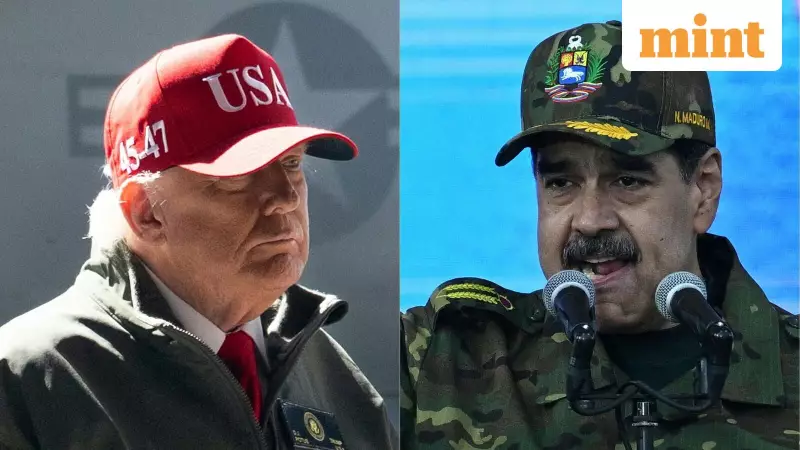
In a dramatic escalation of tensions, United States military forces conducted a large-scale strike inside Venezuela early on Saturday, leading to the capture of the country's President, Nicolas Maduro, and his wife, Cilia Flores. US President Donald Trump announced the operation, accusing Maduro of running a "narco terrorist organisation." The couple has been indicted by a New York grand jury on charges related to terrorism and drugs.
Operation Details and Immediate Fallout
The capture marks a sharp turn after weeks of speculation and a months-long US military buildup in the Caribbean, as reported by the New York Times. President Trump, at a press conference, justified the action by blaming Venezuela for stealing US oil interests, stating Washington would take them back and planned to run the country for an unspecified period. US Attorney General Pam Bondi declared on social media that the defendants "will soon face the full wrath of American justice on American soil in American courts."
However, the move has been met with immediate and severe criticism. The New York Times, in an editorial on Saturday, labelled Trump's attack as 'illegal and unwise'. It cited a recent United Nations report detailing over a decade of killings, torture, and arbitrary detention by Maduro's forces against political opponents. Despite these allegations, the legality of the US operation has prompted even Trump's allies to suggest it violated international law.

A Breach of International Law?
Legal experts globally are questioning the operation's foundation. The action appears to contravene Article 2(4) of the UN Charter, which obliges all members to refrain from the threat or use of force against the territorial integrity of any state. Geoffrey Robertson KC, a former president of the UN war crimes court for Sierra Leone, told The Guardian that America has "committed the crime of aggression, which the court at Nuremberg described as the supreme crime."
Experts speaking to Reuters noted the Trump administration muddled legal issues by framing the mission as both a law enforcement action and a potential prelude to long-term control. "You cannot say this was a law enforcement operation and then turn around and say now we need to run the country," said Jeremy Paul, a constitutional law professor at Northeastern University. International law professors Elvira Domínguez-Redondo and Susan Breau concurred, with Breau stating the attack could only be lawful with a UN Security Council resolution or in self-defence, for which "there is just no evidence whatsoever."
Domestic and Historical Precedents
Within the US, the operation has raised constitutional questions. The NYT editorial argued Trump is pushing the country toward an international crisis without valid reasons and must seek Congressional approval for such actions. Secretary of State Marco Rubio confirmed Congress was not notified before Saturday's operation, contradicting past statements by Trump's Chief of Staff Susie Wiles about needing Congressional approval for "activity on land" in Venezuela.
Historically, the US has captured suspects abroad, like Libya, but with local consent. The capture of Panama's General Manuel Noriega in 1989 on drug charges offers a parallel, though Washington then cited the protection of US citizens. The case of former Honduran President Juan Orlando Hernández, extradited and convicted on drug charges in 2022 but later pardoned by Trump in December, was also highlighted by the NYT as a contradictory action by the US President.
The United Nations stated on Saturday that President Trump's move sets a dangerous precedent for the world. As Maduro and his wife face prosecution in New York, the international community grapples with the ramifications of a unilateral military intervention that many legal authorities deem a clear violation of the foundational principles of the post-World War II international order.