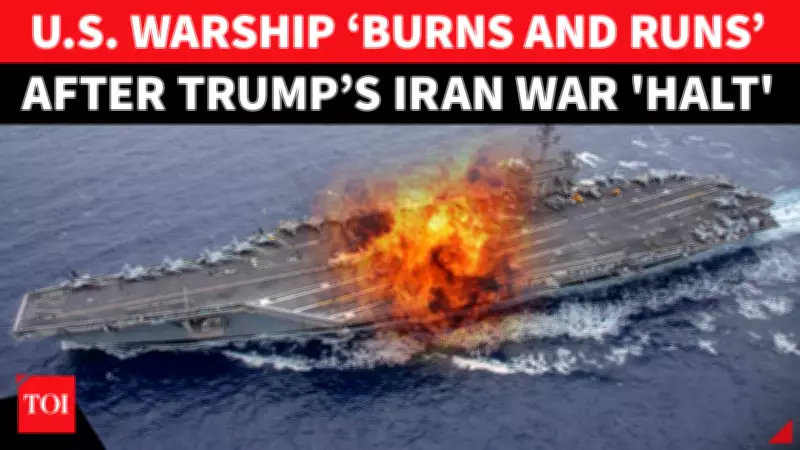
US Navy's Premier Aircraft Carrier Withdraws from Middle East Following Serious Fire
The USS Gerald R. Ford, recognized as the United States Navy's most formidable and technologically advanced aircraft carrier, has officially exited the volatile Middle Eastern theater. This strategic withdrawal comes in the aftermath of a substantial fire that erupted aboard the vessel, compelling its relocation for repairs and assessment.
Significant Onboard Fire Leads to Operational Pause
The incident involved a fire that burned relentlessly for over thirty hours on the warship. This emergency situation resulted in considerable disruption for the crew, with approximately six hundred sailors losing their sleeping quarters. These personnel were forced to utilize tables and floors as makeshift beds during the crisis. One individual required medical evacuation due to the event, though the Navy maintained that the ship retained full operational capability throughout the ordeal.
Following the fire, the USS Gerald R. Ford docked at Naval Support Activity Souda Bay in Crete. After initial assessments, the decision was made for the carrier to return to the United States for comprehensive repairs. Military officials have indicated that the vessel is not anticipated to redeploy to the Middle East region following this maintenance period.

Coinciding with a Shift in US-Iran Military Posture
The departure of this primary strike platform from Operation Epic Fury unfolds during a notable, albeit temporary, shift in US military actions against Iran. The administration of President Donald Trump has implemented a five-day pause on strikes targeting Iranian energy infrastructure. This halt has been publicly framed as the outcome of productive diplomatic conversations with Tehran.
This development marks a contradictory phase in the administration's messaging regarding the Iran conflict, occurring within a tense seventy-two-hour period. President Trump, while authorizing this pause, has simultaneously reiterated that he is not pursuing a formal ceasefire agreement, creating a complex and nuanced strategic landscape.
Broader Context of Regional Tensions
The withdrawal of the USS Gerald R. Ford occurs against a backdrop of heightened regional instability. Recent weeks have seen escalated hostilities involving Iranian-backed groups, including rocket and drone attacks by Hezbollah targeting northern Israel. Additionally, pro-Iranian Iraqi resistance factions have intensified assaults on US and Israeli interests.
Iranian military officials have issued stark warnings and revealed new capabilities, such as advanced drones and concealed missile sites, while threatening punitive measures against the United States. The temporary reduction in US kinetic operations, coupled with the removal of its most powerful naval asset from the immediate area, introduces a new dynamic into an already volatile security situation in the Middle East.