

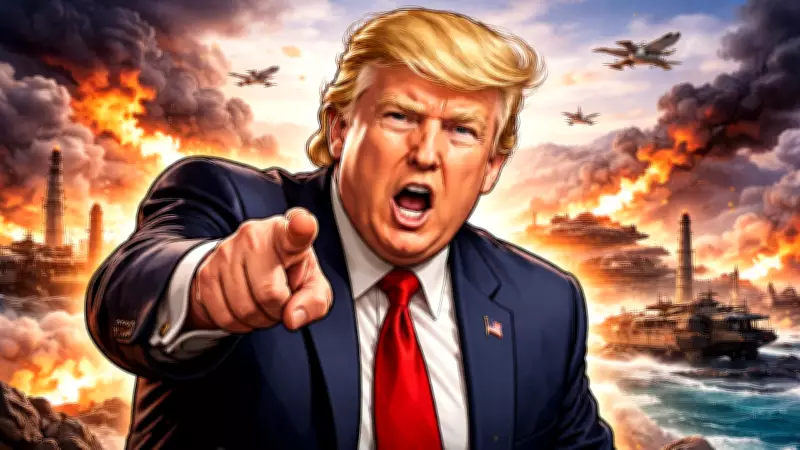
Trump Declares Temporary Ceasefire with Iran Amid Escalating Tensions
In a dramatic development that caught global observers by surprise, US President Donald Trump announced a two-week ceasefire with Iran. This declaration came mere hours before a self-imposed deadline that had placed the international community on high alert. The sudden pause in hostilities follows weeks of intensifying conflict that began on February 28, when US-Israeli airstrikes resulted in the death of Iran's supreme leader, Ayatollah Khamenei.
The military escalation had sent shockwaves through global markets, with oil prices surging by an alarming 60% and creating widespread economic uncertainty. Trump's ceasefire announcement arrived after days of relentless missile strikes, drone attacks, and explicit threats to 'obliterate' Iranian cities. This development has sparked crucial debate among foreign policy analysts: is this a calculated strategic pause, or a contemporary application of the controversial 'Madman Theory' in international diplomacy?
Explicit Threats Precede Ceasefire Declaration
In the days leading up to the ceasefire, President Trump unleashed a barrage of expletive-laden threats through social media platforms and interviews. He explicitly warned that the United States would destroy Iran's critical infrastructure—including power plants, bridges, and transportation networks—unless Tehran immediately reopened the strategically vital Strait of Hormuz.

"Subject to the Islamic Republic of Iran agreeing to the COMPLETE, IMMEDIATE, and SAFE OPENING of the Strait of Hormuz, I agree to suspend the bombing and attack of Iran for a period of two weeks. This will be a double-sided CEASEFIRE!" Trump declared in a characteristically bold social media post.
The temporary cessation of hostilities has successfully reopened the crucial shipping route, bringing immediate relief to global markets. Iran has cautiously accepted the ceasefire terms while emphasizing that any permanent resolution would require additional concessions from the United States. According to analysis from The Conversation, these extreme threats formed a central component of Trump's strategic approach: projecting an image of unpredictability and danger to compel rapid negotiations from adversaries.
Understanding the Madman Theory
The Madman Theory represents a significant concept in international relations, most famously employed by President Richard Nixon during the Vietnam War era. The fundamental premise is straightforward: if a national leader can convince opponents that he possesses irrational, volatile tendencies and is willing to undertake extreme actions—including potentially nuclear escalation—adversaries might approach negotiations with greater caution or capitulate to demands more readily.
Historical analysis reveals three critical elements that traditionally made this strategy effective:
- Controlled unpredictability: Nixon's advisors meticulously limited information flow, preventing enemies from immediately discerning the credibility behind his threats.
- A rational opponent: The opposing side needed to genuinely fear miscalculation and respond with cautious deliberation.
- Credibility from restraint elsewhere: The leader's typically disciplined behavior made occasional extreme threats appear more believable and dangerous.
In a notable 1969 example, Nixon placed US military forces on heightened nuclear alert specifically to intimidate North Vietnam into negotiation tables. This tactic generated substantial uncertainty about how far the American president might escalate, thereby increasing pressure on his adversaries.
Trump's Contemporary Application of the Strategy
President Trump's approach toward Iran echoes this historical strategy while incorporating distinct modern adaptations. By delivering expletive-laden threats publicly through social media channels, interviews, and official posts, he deliberately aimed to frighten Tehran and pressure Iranian leadership into accepting ceasefire terms.

International law experts recognize these threats as highly aggressive yet potentially strategic. Professor Al Gillespie from Waikato University explained in an interview with RNZ: "The Madman Theory involves behaving in an irrational, erratic manner, and threatening to go to extreme lengths to end a war. The idea is that you don't know whether the person will or won't do it, and the opposition will be scared into making a deal."
However, this strategy fundamentally depends on the opposition genuinely fearing the threats. Gillespie highlighted a crucial limitation: "In the case of autocratic regimes like Iran, they often don't fear such threats. Iran feels emboldened by Mr Trump's increasingly extreme rhetoric... I think they almost want it right now."
The Unpredictability Doctrine in Modern Foreign Policy
President Trump has transformed unpredictability into a formal component of his political methodology, sometimes termed the "Unpredictability Doctrine." Analysts argue that he employs erratic behavior not merely to intimidate adversaries but also to pressure allies into concessions, as reported by the BBC.
Peter Trubowitz, professor at the London School of Economics, observed: "Trump has made his own unpredictability a key strategic and political asset. He has elevated unpredictability to the status of a doctrine. And now the personality trait he brought to the White House is driving foreign and security policy."
Notable examples include pressuring European allies to increase defense spending, demanding favorable resource deals from Ukraine, and making bold territorial threats regarding Greenland and the Panama Canal.
Strategic Limitations in the Digital Age
The Madman Theory achieves optimal effectiveness when opponents demonstrate rationality, information remains limited, and threats appear genuinely unusual. In today's hyperconnected digital landscape, news disseminates instantly, and extreme threats frequently face public mockery or detailed analysis. Consequently, unpredictability can rapidly lose its coercive power.
Julie Norman, professor of politics at University College London, explained this dynamic: "It is very hard to know what's coming from day to day... but because this unpredictability is consistent, it can actually become expected. Once expected, it loses force."
Similarly, experts caution that Iran may interpret Trump's threats as predictable bluster rather than credible danger, potentially accelerating its nuclear ambitions as a deterrent measure.
Strategic Theater or Genuine Diplomacy?
Trump's ceasefire with Iran illustrates both the potential applications and inherent limitations of the Madman Theory. His threats and erratic behavior may secure short-term pauses and capture international attention, but they cannot guarantee compliance from opponents who have prepared for volatility.
As Professor Trubowitz summarized: "Trump's unpredictability has changed the way allies and enemies perceive the United States. It is driving foreign policy, but it is a double-edged sword—effective in some ways, but risky and unpredictable in others."
The fundamental question persists: can the Madman Theory produce lasting diplomatic results, or does it merely represent temporary theatrical displays of power that fail to address underlying geopolitical complexities?





