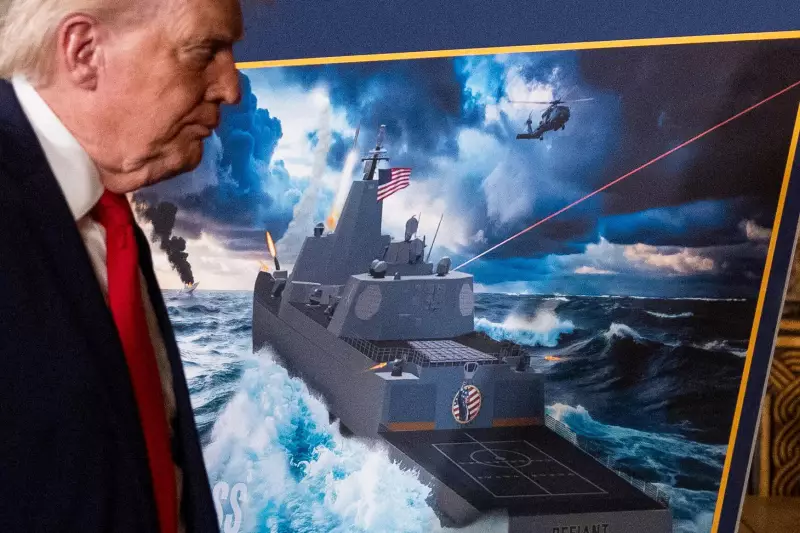
Former US President Donald Trump has unveiled ambitious plans for a new class of colossal, missile-heavy warships, which he has branded the "Trump-class." He declared these vessels would form the centerpiece of a newly envisioned "Golden Fleet" aimed at restoring American naval dominance, explicitly to counter the rapid maritime expansion of China.
The Vision: A '100 Times More Powerful' Battleship
Surrounded by renderings of sleek warships at his Mar-a-Lago estate, Trump announced the first ship, to be named the USS Defiant. He claimed it would be "100 times more powerful than any battleship ever built." The announcement comes amid concerns over the US Navy's declining ship count and aging fleet. "We're desperately in need of ships," Trump stated. "Some of them have gotten old and tired and obsolete, and we're going to go in the exact opposite direction."
According to naval documents and reports from USNI News, the envisioned Trump-class supercombatants are massive. They are planned to be 880 feet long and displace between 30,000 to 40,000 tons—roughly twice the size of current Arleigh Burke-class destroyers. Their proposed armament is staggering, designed to pack unprecedented firepower:

- 12 cells for hypersonic nuclear-capable missiles.
- 128 vertical launch tubes for Tomahawk cruise missiles, anti-ship missiles, and interceptors.
- Advanced rail guns and directed-energy lasers.
- Two 5-inch guns (not the massive cannons of old battleships).
- AI-driven combat systems requiring a reduced crew of 650–850 sailors.
Trump promised construction would begin "almost immediately," with each ship taking about two and a half years to build. However, industry insiders and analysts are deeply skeptical, suggesting a realistic timeline is closer to 7–10 years, especially if new shipyards need to be developed.
Strategic Signal or Strategic Misstep?
Trump framed the Golden Fleet as a crucial deterrent against Beijing. "They'll help maintain American military supremacy, revive the American shipbuilding industry and inspire fear in America's enemies," he said. The move is a direct response to China's People's Liberation Army Navy (PLAN), which now boasts a larger fleet in raw numbers and is building ships at a faster pace.
Retired Navy captain Carl Schuster underscored the threat to CNN, stating, "The PLAN is nearing the ability to challenge our access to the Western Pacific, a direct and clear threat to our national security." He added that the US would need strong alliances with partners like Japan and South Korea.
Yet, many naval experts and critics warn that the plan is fundamentally flawed. They argue that in an era defined by long-range precision missiles, drone swarms, and hypersonic weapons, concentrating immense value and firepower on a few giant platforms is dangerously outdated. China's DF-26 'carrier killer' missile is specifically designed to target large US warships from vast distances, posing a severe threat to aircraft carriers—and potentially to these new battleships.
Retired Rear Admiral Mark Montgomery was blunt in his criticism to the Wall Street Journal, calling the Golden Fleet "exactly what we don't need." He argued, "We do not need ships that are not optimized to provide lethality against the Chinese threat. These battleships will achieve none of the tactical goals necessary in a modern fight."
Instead, analysts like Yu Jihoon from the Korea Institute for Defense Analyses advocate for a distributed fleet of smaller, cheaper, and unmanned vessels. "The advantages of small battleships and unmanned systems are that the quantity can be increased at a relatively low cost and viability can be increased by dispersing risk across multiple platforms," Yu told CNN.
The Daunting Industrial Reality
The most significant hurdle for Trump's vision may not be strategic but industrial. The US shipbuilding base has atrophied, facing a crisis of capacity, workforce, and cost overruns. A CNN report highlights chronic delays: the aircraft carrier USS John F. Kennedy is two years late, the Constellation-class frigate program was cancelled after a three-year slip, and the Zumwalt-class destroyer program was slashed from 32 to just 3 ships.

Navy Secretary John Phelan delivered a grim assessment to Congress in June: "All of our programs are a mess. Our best ship is 6 months late and 57% over budget." The workforce challenge is equally severe, with shipyard jobs struggling to compete with sectors like logistics and services.
Key technologies for the Trump-class, like rail guns, also face major hurdles. The Navy's rail gun program was axed in 2021 after over $500 million in development costs, due to issues with power consumption and reliability. While directed-energy lasers are more promising, they are still years away from widespread warship deployment.
Furthermore, deploying nuclear-capable cruise missiles at sea could violate existing arms control agreements with Russia, adding a diplomatic complication.
The bottom line is that Trump's Golden Fleet is a bold, personally branded gambit that blends military ambition with political theater. Supporters see it as a way to revive American naval power and its industrial base. Critics view it as a costly, nostalgic bet on the wrong kind of warfare, potentially becoming a $300 billion gamble that yields impressive-looking but vulnerable symbols rather than effective deterrents.
The world will now watch key developments: whether a skeptical Congress funds the program, if the moribund US shipbuilding industry can be revived in time, and how China responds to this direct challenge to its maritime ambitions. Until the USS Defiant actually sails, the debate rages on—is this a turning point for naval power, or a monumental strategic misstep?