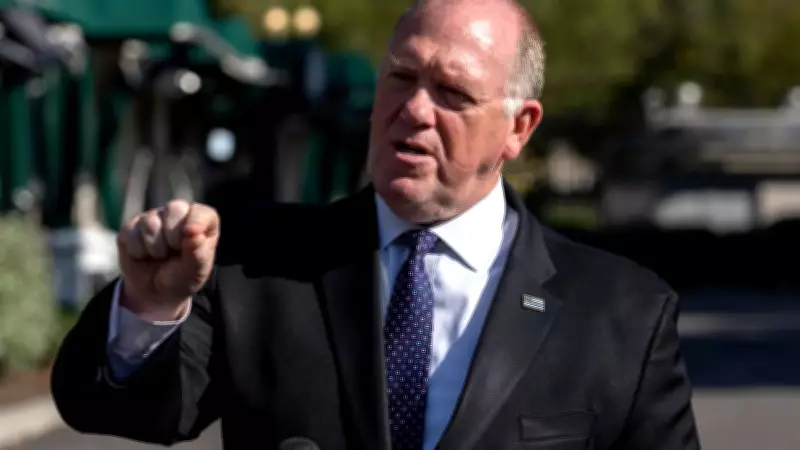
In a significant development, US border czar Tom Homan has indicated that federal immigration enforcement operations in Minnesota might be scaled back, but this potential drawdown is strictly contingent upon enhanced cooperation from state and local authorities. This statement comes at a time when protests and political pressure are intensifying against the Trump administration's aggressive immigration crackdown, highlighting the complex dynamics between federal and state jurisdictions.
Context of Homan's Remarks Amid Rising Tensions
Homan's comments were made just days after a federal immigration officer fatally shot a protester in Minneapolis, marking the second deadly encounter involving federal agents in the state this month. These incidents have sparked nationwide outrage and renewed scrutiny of Immigration and Customs Enforcement (ICE) tactics, putting the administration's enforcement strategies under the microscope.
Zero Tolerance for Protesters and Call for Cooperation
Speaking to reporters in Minneapolis, Homan emphasized a "zero tolerance" approach towards protesters who assault officers or interfere with their duties, dismissing many demonstrators as "agitators." He clarified that immigration enforcement would not ease until local officials actively cooperate with ICE, particularly by granting access to detainees held in county jails. "Give us access to illegal aliens, public safety threats in the safety and security of a jail," Homan asserted, arguing that transferring immigrants to ICE custody while already detained is safer for officers and reduces the need for street operations.

Shift Towards Targeted Enforcement Strategies
Homan also signaled a shift in enforcement strategy, stating that ICE would focus on "targeted, strategic enforcement operations" that prioritize immigrants posing public safety threats or with criminal records. This aligns with an internal ICE memo reviewed by Reuters, which advises officers to avoid unnecessary engagement with agitators and limit arrests to those with criminal charges, a departure from earlier tactics involving random street stops. "We can do better," Homan noted, suggesting progress towards cooperation and hinting at significant changes in the city.
Contrasting Tones from the White House
Despite Homan's conciliatory tone, tensions remain high. President Donald Trump had earlier warned Minneapolis Mayor Jacob Frey on Truth Social about "playing with fire" by refusing to assist in federal immigration enforcement. Meanwhile, Attorney General Pam Bondi reported the arrest of 16 people in Minnesota for allegedly assaulting or impeding law enforcement, underscoring the ongoing crackdown.
Judicial Scrutiny and Legal Challenges
Adding to the controversy, a federal judge in Minneapolis accused ICE of flouting court orders during the enforcement surge. U.S. District Judge Patrick Schiltz cited at least 96 federal court orders violated in 74 cases, remarking that "ICE has likely violated more court orders in January 2025 than some federal agencies have violated in their entire existence." This judicial criticism highlights concerns over the rule of law and accountability in immigration operations.
Fatal Shootings Fuel Public Outrage
The Twin Cities have been on edge since Trump deployed roughly 3,000 ICE and Border Patrol agents for Operation Metro Surge. Public anger escalated after the fatal shootings of Renee Good, a 37-year-old mother of three, on January 7, and Alex Pretti, a 37-year-old intensive care nurse, during a confrontation with agents. Administration officials initially labeled both victims as "domestic terrorists," but videos verified by Reuters contradicted these claims, showing Pretti holding only a phone when shot, despite having a legal permit to carry a firearm.

Political Fallout and Congressional Standoff
The unrest has spilled into Congress, where Senate Democrats are threatening to block funding for the Department of Homeland Security, potentially triggering a partial government shutdown unless new restrictions on ICE are implemented. Senate Democratic leader Chuck Schumer stated that Democrats would not provide votes until ICE is "reined in and overhauled," demanding measures such as agents removing masks, wearing identification, using body cameras, and obtaining warrants for arrests. Minnesota Senator Tina Smith emphasized the need for accountability, noting that "these lawless ICE agents should be following the same rules that your local police department does."
Republican Divisions and Negotiations
Republicans remain divided on the issue, with some open to separating Homeland Security funding for further debate, while others warn against Democratic "political stunts." As negotiations continue, it remains uncertain whether Homan's assurances of a potential drawdown in Minnesota will suffice to defuse both street protests and the looming fiscal showdown in Washington.
This evolving situation underscores the delicate balance between federal enforcement priorities and state-level cooperation, with significant implications for immigration policy and public safety in the United States.