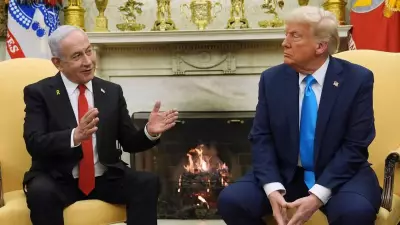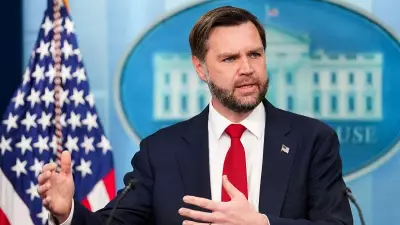
The foundational principle of the rule of law in the United States is facing an unprecedented assault during the first year of President Donald Trump's second term, according to a stark analysis. Legal scholar Aziz Huq argues that the administration's actions are systematically dismantling the predictability and official accountability that underpin democratic governance.
A Presidency Unbound by Law
The core of the crisis, as outlined, is the Trump administration's refusal to be constrained by statutory law. The Justice Department has explicitly stated it will not routinely comply with orders from federal courts. Furthermore, the administration treats laws passed by Congress, including spending mandates, as optional rather than obligatory.
The rhetorical justification for this stance is Trump's claim of a public "mandate" from his slender election victory in November 2024. This claim directly challenges the constitutional system where presidential authority is exercised within legal bounds. The administration's approach threatens both pillars of the rule of law: the predictability offered by written law and the principle that officials are equally bound by it.

Enablers in the Judiciary and Congress
The analysis points out that this erosion is not solely the president's doing. It has been significantly enabled by other branches of government meant to provide checks and balances. With Congress under unified Republican control, oversight is minimal. However, the most critical enabler identified is the Supreme Court under Chief Justice John Roberts.
The Court's conservative majority has repeatedly sided with the administration. In 21 out of 23 emergency appeals in the first nine months, the Court affirmed presidential power to act, often despite existing law. Most alarmingly, the justices allowed the administration to ignore congressional spending mandates, gutting a key legislative check on executive power.
This judicial licensing of a "lawless presidency" is historically novel and has caused unprecedented disquiet among lower-court judges from both parties. The Court's upcoming docket includes pivotal cases that could further expand presidential power, such as those concerning the firing of protected officials and the definition of "emergency" under laws like the International Emergency Economic Powers Act.
Escalating Force and the Threat to Democratic Process
The consequences of weakened legal constraints are already manifesting in increased state violence and intimidation. The administration has aggressively used agencies like Immigration and Customs Enforcement (ICE) and deployed the National Guard in Democratic-led cities like Chicago, where agents have used tear gas and arrested reporters and local officials.
Internationally, the US military has engaged in unprecedented actions, such as sinking boats allegedly used by Venezuelan drug smugglers—a move critics label extrajudicial killing. The concern is that this logic of indiscriminate force could eventually be turned inward, further blurring lines between law enforcement and military occupation.
Simultaneously, the administration is working to cement its power through the electoral process. Trump has encouraged gerrymandering in Republican states like Texas and Missouri to secure future advantages. More directly, a March 2025 executive order on election "integrity" contains provisions, such as banning late-arriving ballots, that critics warn are tools to disenfranchise opponents and contest unfavourable results.
The ultimate danger, as framed by Huq, is the rejection of a shared political community governed by law over time. If a president can discard laws at will, legislation loses its purpose and democracy becomes a series of disconnected moments without lasting force. The administration's vision of a permanent mandate, enforced through executive orders, gerrymandering, or troops, represents a fundamental repudiation of the American democratic experiment. The year 2026 may determine whether this vision is fully realized.