Trump Warns Iran: Make a Deal or Face Consequences as US Military Builds Up
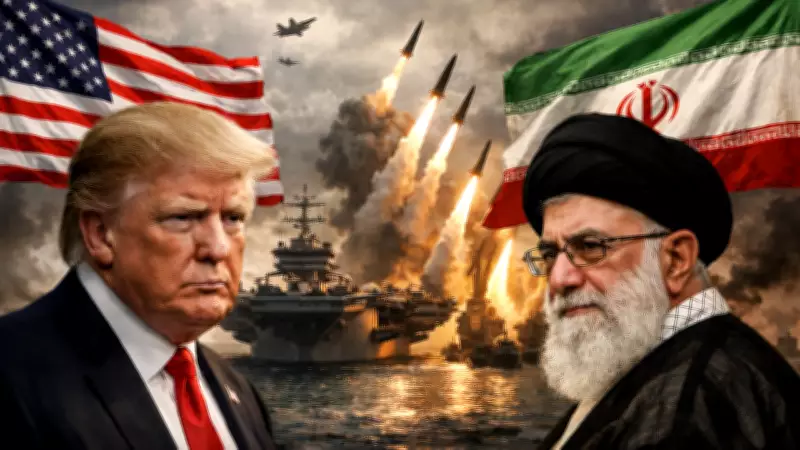
Donald Trump has issued a blunt warning to Iran, urging the nation to make a deal or face "bad things", with hints that consequences could unfold within days. Simultaneously, in the waters and skies surrounding the Persian Gulf, the United States has discreetly assembled one of its most substantial military postures in recent years. This deployment includes aircraft carriers, stealth aircraft, and layered missile defenses strategically moving into position.
The Deliberate Contrast: Threats and Military Readiness
The contrast between Trump's rhetoric and the military buildup is intentional. Trump's language signals a clear willingness to strike, while the military build-up ensures Washington has credible options if deterrence fails. For Iran, the message is stark and unambiguous: this situation has escalated beyond a mere war of words into a tangible threat of action.
Yet, beneath the surface of threats and troop movements lies a deeper military reality. A direct conflict between the US and Iran would not resemble a conventional war between equals. Instead, it would pit overwhelming American firepower against Iran's long-honed strategy of missiles, proxies, and asymmetric retaliation. This balance has defined the Middle East's most dangerous rivalry for decades.

The Military Balance: Dominance vs. Disruption
On paper, the military balance between the United States and Iran is among the most unequal in the world. In practice, it is one of the most complex, representing a clash between dominance and disruption.
The Big Gap: Power on Paper
The US remains the world's most powerful military force, spending close to $900 billion annually on defense, operating across continents, and dominating air, naval, and space domains. In contrast, Iran's defense budget is estimated at a mere $15–20 billion, a fraction of the US expenditure, and its conventional forces lag far behind technologically. However, Iran has never attempted to match the US tank-for-tank or jet-for-jet. Its strategy is built around deterrence through denial, rather than seeking battlefield victory.
Iran's Playbook: Swarm and Saturate with Missiles
At the center of this equation are missiles. Iran lacks a modern air force, with its aging American- and Soviet-era aircraft struggling to survive against US stealth fighters. Instead, Tehran has invested heavily in ballistic missiles, cruise missiles, and drones.
Iran is believed to possess the largest ballistic missile arsenal in the Middle East, estimated at more than 3,000 missiles, alongside long-range drones such as the Shahed series. In recent years, it has shifted towards solid-fuel missiles that can be launched with little warning and manoeuvrable warheads designed to complicate interception.
The logic is saturation. Iranian planners assume US and allied missile defenses are technologically superior but expensive. By launching large numbers of relatively cheap drones and missiles simultaneously, they aim to overwhelm defenses and allow some strikes to get through.
US Strategy: Layered Defense and Precision Offence
Washington, meanwhile, relies on a multi-layered missile shield. Patriot systems counter short-range threats, THAAD intercepts medium-range ballistic missiles, and Aegis-equipped destroyers provide sea-based coverage.
On offence, the US prioritizes speed, precision, and pre-emption. Tomahawk cruise missiles launched from submarines, stealth bombers such as the B-2, and fifth-generation fighters like the F-35 are designed to destroy launch sites, radar systems, and command nodes before Iran can fire.
By early 2026, the US had reinforced the region with multiple aircraft carrier strike groups, underlining its ability to respond quickly and decisively.
Air, Land, and Sea: No Symmetry in Capabilities
Beyond missiles, the imbalance is stark across all domains:

- Air Power: The US operates over 13,000 aircraft, including hundreds of stealth platforms. Iran has roughly 550 aircraft, many of them decades old.
- Naval Power: The US Navy fields 11 aircraft carriers and dozens of nuclear-powered submarines. Iran has none, instead relying on fast-attack boats, naval mines, and coastal missiles to threaten chokepoints such as the Strait of Hormuz.
- Ground Forces: Iran has significant manpower and ideologically driven units like the IRGC and Basij, but they are structured for territorial defense and attrition, not expeditionary warfare.
This asymmetry explains why Tehran avoids direct confrontation.
The Proxy Factor: Iran's Real Strength
Iran's most effective military tool is not its army, navy, or air force. It is its network of allies and militias, often referred to as the "Axis of Resistance". Built since the 1980s, this network allows Iran to project power without direct engagement.
In Iraq and Syria, Iran-backed militias regularly target US bases with rockets and drones, keeping American forces under constant pressure. In Yemen, the Houthis have used Iranian-supplied technology to attack Red Sea shipping, disrupting global trade routes. In Lebanon, Hezbollah long served as Iran's main deterrent against Israel, with a vast rocket arsenal aimed at raising the cost of any regional war.
Through these groups, Iran practices forward defense, keeping conflict away from its own territory while maintaining plausible deniability.
A Weakened but Active Axis
Since late 2023, this proxy network has suffered significant blows. Israeli and US strikes in 2024 and 2025 eliminated senior commanders and destroyed major stockpiles, particularly within Hezbollah. The fall of the Assad regime in Syria also severed Iran's key land corridor for supplying Lebanon.
Even so, the network is far from neutralized. The Houthis remain capable of disrupting shipping, and Iraqi militias continue to pose risks to US personnel. Iran's asymmetric threat, though diminished, remains potent.
What a War Would Look Like: Three Possible Paths
Military planners broadly see three possible paths if tensions escalate:
- A Limited US Strike: This is the most likely scenario, targeting missile sites or nuclear-linked infrastructure without full-scale invasion.
- A Full-Scale Invasion: Widely viewed as improbable and prohibitively costly, given Iran's terrain and mobilization capacity.
- A Prolonged Shadow Conflict: The most realistic outcome, marked by missile exchanges, proxy attacks, cyber operations, and economic pressure over time.
In a conventional fight, the United States would dominate Iran in the air and at sea. But Iran's strategy is not about winning that war. It is about raising the cost of confrontation through missiles, proxies, and persistence, ensuring that any conflict remains asymmetric and costly for all involved.