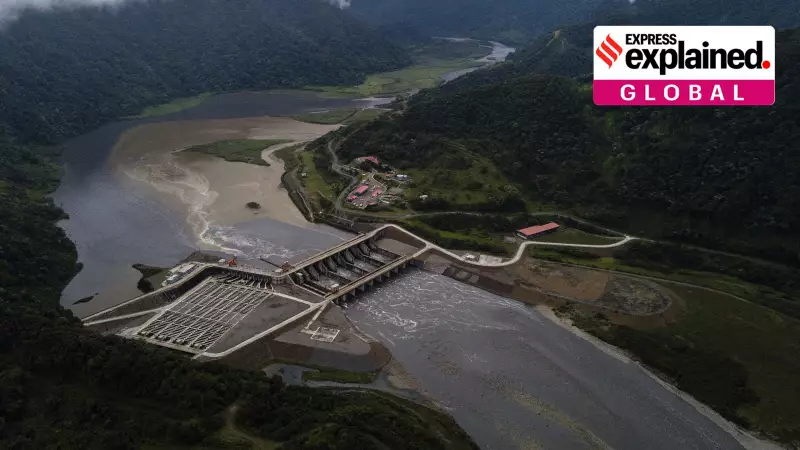
In a bold strategic shift, US President Donald Trump is directly challenging China's formidable economic stronghold across Latin America. This new focus, underscored by recent military action in Venezuela, threatens to disrupt a two-decade-long period where China quietly expanded its influence through colossal trade deals, enormous loans, and strategic infrastructure investments.
China's Deep-Rooted Economic Empire
China's transformation in the region is staggering. From negligible engagement twenty years ago, bilateral trade with Latin America soared to over $500 billion in 2024. Chinese companies are now embedded in the continent's economic fabric: extracting copper from Peru, lithium from Argentina, and powering cities with their utilities. They control crucial shipping infrastructure and ports across the Pacific.
For everyday consumers, Chinese brands are ubiquitous. Mexicans drive Chery and MG cars, Brazilians use Didi for rides and Meituan for food delivery, and Peruvians favour Xiaomi smartphones. This commercial penetration is backed by staggering financial heft. Between 2000 and 2023, China provided an estimated $303 billion in financing to the region, making it Latin America's largest official source of credit, according to AidData research.
Trump's Aggressive Counter-Strategy
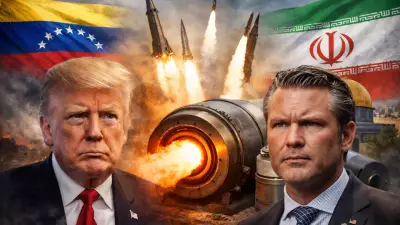
President Trump's strategy represents a frontal assault on this status quo. The recent military operation in Venezuela, a key Chinese oil partner, directly targets a nation where China is owed roughly $10 billion, repaid through oil shipments exceeding 768,000 barrels per day last year. But Trump's vision extends far beyond Venezuela.
He has threatened to "take back" the Panama Canal, accusing its Hong Kong-based port operator of being a Chinese Communist Party extension. He labelled Mexico a "backdoor" for Chinese goods and proposed a 50% tariff on Brazil to curb Chinese investment. A recent national security strategy explicitly vowed to deny "competitors" from outside the hemisphere control over "strategically vital assets."
Uncertain Future and Regional Dilemmas
The sudden geopolitical shift has put Chinese businesses on alert. A consortium developing a major copper mine in Ecuador has already paused its project, citing political volatility. Analysts like Tao Zhigang, a Chinese economist, warn that Chinese investment now "faces a lot of uncertainty."
However, completely unwinding China's influence will be a herculean task. As noted by Henrietta Levin of the Center for Strategic and International Studies, China holds such a powerful economic position that countering it effectively would require a massive, Marshall Plan-style aid program from the US—something the Trump administration may not be prepared to deliver.
Furthermore, Latin American nations face a difficult choice. While many might prefer deeper ties with the US, their immense developmental funding needs have been largely met by China for years. Cui Shoujun of Renmin University notes that the region cannot simply walk away from China, asking, "Who will Latin America sell its soybeans and corn to?" The coming months will reveal whether Trump's power play can loosen Beijing's well-financed grip or if China's deep economic roots will prove too strong to displace.