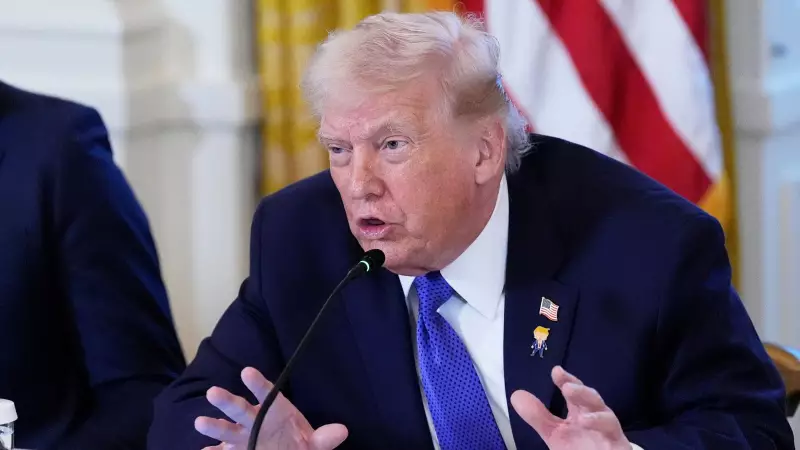
Former United States President Donald Trump has once again thrust the world's largest island into the geopolitical spotlight, asserting that America should acquire Greenland to prevent strategic gains by Russia and China. This controversial proposition, which first emerged during his presidency, was reiterated by Trump in a recent interaction, underscoring his persistent view of the territory as a vital chess piece in global power dynamics.
The Strategic Rationale Behind the Proposal
Donald Trump's argument hinges on the rapidly changing strategic landscape of the Arctic. He explicitly stated that the primary motivation for such an acquisition would be to halt the expanding influence of both Russia and China in the resource-rich and militarily crucial region. Trump framed the potential purchase not as a colonial ambition but as a large-scale "real estate deal" crucial for national security.
The context for this statement is significant. During his term in the White House from 2017 to 2021, Trump's administration reportedly explored the idea of buying Greenland, an autonomous territory of the Kingdom of Denmark. The proposal was swiftly and firmly rejected by the Danish government, which labeled the idea "absurd." This diplomatic friction led Trump to postpone a planned state visit to Denmark. His recent comments confirm that the idea remains a fixed point in his strategic thinking, likely to feature in his campaign for the 2024 presidential election.

Global Reactions and Geopolitical Stakes
The renewed suggestion has drawn immediate reactions from involved parties. A spokesperson for the Greenland government reiterated the island's unambiguous stance: "Greenland is not for sale. Greenland is not Danish. Greenland belongs to Greenland." This statement reinforces the territory's pursuit of greater independence and its control over its vast natural resources.
The geopolitical backdrop is the accelerating great power competition in the Arctic. Russia has been significantly modernising its military bases along its northern coastline, while China, declaring itself a "near-Arctic state," has been investing heavily in scientific research and infrastructure projects in the region, including in Greenland. The melting ice caps are opening new shipping routes and access to untapped reserves of oil, gas, and minerals, making the Arctic a zone of intense interest.
Trump's comments reflect a transactional and security-focused approach to foreign policy, where territorial control is seen as the ultimate solution to strategic challenges. This perspective often clashes with the diplomatic norms of alliance management and respect for the sovereignty of partners.
Implications for Future US Policy
The revival of this idea signals its potential return as a formal policy proposal should Donald Trump win a second term. It highlights a continuing thread in his political agenda: a willingness to pursue unconventional and dramatic moves to assert American dominance, particularly against perceived rivals like China and Russia.
For Denmark and Greenland, the statement is a reminder of persistent external pressures on their sovereignty and the delicate balance they must maintain. For America's allies in Europe, it may raise concerns about the unpredictability and unilateral nature of Trump's potential future foreign policy. The episode underscores how the remote Arctic has become a central theatre for 21st-century geopolitical rivalry, with small nations and territories finding themselves at the heart of disputes between global superpowers.
Ultimately, while the literal purchase of Greenland remains a political and practical impossibility, the discussion itself reveals the high-stakes game being played over the future of the Arctic. Trump's framing of the issue amplifies the narrative of a new Cold War-style contest, where control over geography is paramount in the struggle for global influence.