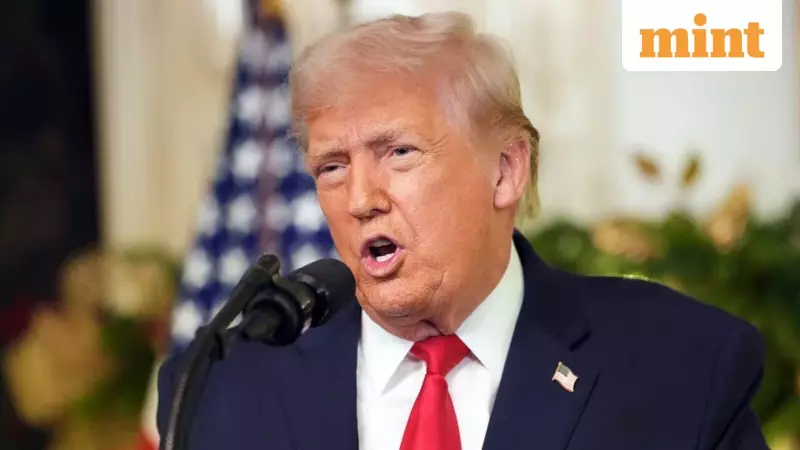
Former US President Donald Trump has made a striking declaration, positioning the United States as the world's true peacekeeper. In a recent public address, he stated that America is the "real United Nations" and took credit for halting numerous international conflicts, including a specific ceasefire between Thailand and Cambodia.
Trump's Bold Assertion on Global Peacekeeping
Speaking to his supporters, Trump presented a revisionist view of his foreign policy achievements. He claimed direct responsibility for de-escalating tensions and stopping wars in various global hotspots. The most specific claim involved a ceasefire between Thailand and Cambodia, a long-standing territorial dispute centered around the Preah Vihear temple.
"We are the real United Nations," Trump asserted, suggesting that American power and diplomacy under his administration were more effective than the multilateral body based in New York. He framed his approach as one of decisive action, contrasting it with what he often describes as the UN's bureaucratic inefficiency.

The Claim of Eight Averted Wars
Beyond the Southeast Asian example, Trump made an even broader claim. He stated that his interventions prevented eight separate wars from erupting worldwide. While he did not provide a detailed list of all eight conflicts, the implication was that his "America First" foreign policy, often characterized by direct dealings with national leaders, successfully averted major military confrontations.
This narrative builds on Trump's long-standing political persona as a dealmaker who can solve complex international problems through sheer force of will and personal diplomacy. The claims are likely aimed at bolstering his image as a strong leader on the global stage as he campaigns for a return to the White House.
Context and Historical Background
The border dispute between Thailand and Cambodia over the Preah Vihear temple complex has simmered for decades, with occasional deadly clashes. The International Court of Justice ruled on the matter in 1962, awarding the temple to Cambodia, but the surrounding land remained contested. Significant flare-ups occurred in 2008 and 2011, involving artillery exchanges and troop mobilizations.
While tensions have eased in recent years through bilateral and ASEAN-led efforts, Trump's claim of single-handedly engineering a ceasefire adds a new, unverified layer to the history. Analysts note that the path to reduced hostilities involved multiple regional actors and prolonged negotiations.
Trump's speech did not specify when this alleged intervention occurred or the precise mechanisms used. The lack of detail is consistent with his rhetorical style, which often emphasizes grand outcomes over procedural specifics. The remarks have ignited discussions among foreign policy experts about the verification of such claims and the nature of diplomatic credit.
Political Repercussions and the Road Ahead
These statements are more than historical commentary; they are a core part of Trump's 2024 campaign messaging. By portraying himself as a unique peacemaker, he seeks to appeal to voters weary of foreign entanglements while simultaneously showcasing strength. The message is clear: a Trump-led America actively shapes world events to its advantage and prevents chaos, acting as a more potent force than traditional international institutions.
The "real United Nations" framing is particularly potent, tapping into sentiments of national pride and skepticism towards global governance. It reinforces his administration's previous actions, such as withdrawing from several UN agencies and questioning the value of multilateral alliances.
As the election season intensifies, foreign policy achievements and claims will remain a critical battleground. Trump's latest assertions set a high bar for his record and promise a continuation of an unconventional, America-centric approach to world affairs if he is re-elected. The international community, from Southeast Asia to other conflict zones he mentioned, will be watching closely to see how these proclamations translate into future policy.