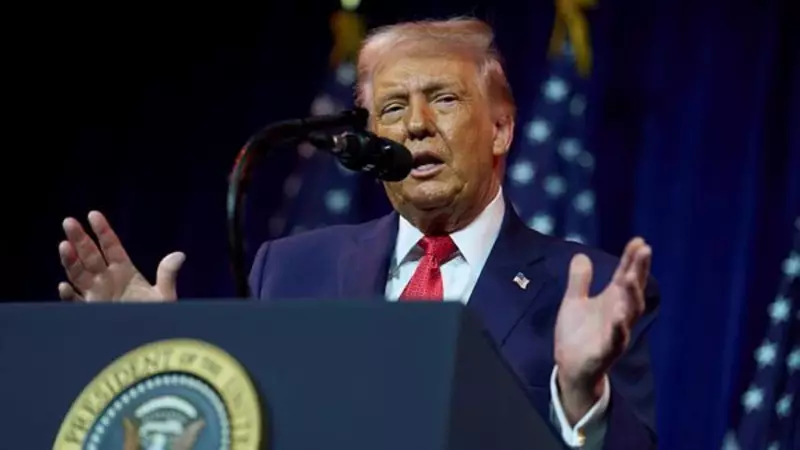
Former US President Donald Trump has made a significant statement regarding the tense situation around Taiwan, suggesting that the decision on Beijing's actions rests solely with Chinese leader Xi Jinping. This comment, made during a recent interview, marks a notable shift in rhetoric from the Republican presidential candidate and has stirred discussions on the future of US policy towards the self-ruled island.
Trump's Comments and the Context
In an interview with Bloomberg Businessweek, Donald Trump was asked about the possibility of China taking military action against Taiwan. His response was direct and placed the onus on Beijing. "It's really up to Xi Jinping," Trump stated, referring to the Chinese President. He elaborated by saying, "I can't imagine he'd want to do that. I can't imagine. It's up to him."
This stance appears to diverge from his previous position during his presidency, where his administration approved multiple arms sales to Taiwan and increased diplomatic engagement, actions that consistently angered Beijing. Trump's latest remarks suggest a more hands-off approach, framing the Taiwan issue as an internal matter for China's leadership to resolve.

Analysis of a Strategic Shift
Political analysts are scrutinising these comments for what they might signal about a potential second Trump term. By stating that the decision is "up to Xi," Trump seems to be stepping back from the traditional US role of being Taiwan's strongest security guarantor. This aligns with his long-stated 'America First' foreign policy, which often questions the cost of US commitments abroad.
The timing is critical, as tensions in the Taiwan Strait remain high. China views Taiwan as a breakaway province and has not ruled out using force to achieve reunification. The United States, under a policy of "strategic ambiguity," has long been committed to providing Taiwan with the means to defend itself, without explicitly stating it would intervene militarily if China attacked.
Trump's comments could be interpreted as a move towards even greater ambiguity or a potential weakening of that commitment. This has raised concerns among security experts who believe a clear US stance acts as a crucial deterrent against Chinese aggression.
Reactions and Geopolitical Implications
The immediate reaction has been one of concern from Taiwan's supporters and analysts of Indo-Pacific security. Framing the issue as a decision purely for Xi Jinping removes agency from Taiwan's democratically elected government and its 23 million people. It also potentially undermines decades of bipartisan US policy that has helped maintain stability in the region.
For China, the remarks might be seen as a favourable signal, suggesting a future Trump administration could be less likely to challenge Beijing's core interests. However, Trump is also known for his unpredictable nature, and his administration maintained a tough stance on trade and technology against China.
The broader implication is a potential recalibration of great-power dynamics. If the US signals a retreat from its traditional security role in Asia, it could embolden China and trigger a regional arms race as other nations, including Japan, South Korea, and the Philippines, reassess their own defence postures.
As the US presidential election campaign heats up, foreign policy towards China and Taiwan will remain a pivotal issue. Donald Trump's latest interview has undoubtedly added a new layer of complexity to an already volatile geopolitical flashpoint, leaving allies and adversaries alike to ponder what a change in Washington's leadership could mean for the future of the Taiwan Strait.