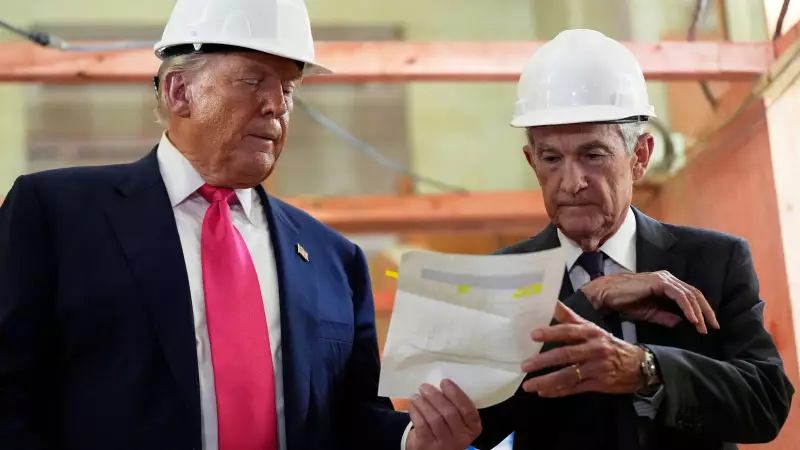
In a striking confluence of political pressure and institutional spending, the United States Federal Reserve finds itself at the centre of a dual controversy. Former President Donald Trump has launched a fresh, aggressive campaign against Fed Chair Jerome Powell, while simultaneously, the central bank's massive, multi-million dollar headquarters renovation project is drawing intense scrutiny for its ballooning costs.
The Escalating Feud: Trump's Renewed Attacks on Powell
The political landscape is heating up with former President Donald Trump's pointed criticisms of Federal Reserve Chair Jerome Powell. Trump, who originally appointed Powell to the position in 2018, has now positioned him as a potential target if he wins the November presidential election. He has openly suggested that he might demote Powell from his role as chair, though Powell's term on the Fed's Board of Governors lasts until 2028.
Trump's grievances stem from his belief that Powell will attempt to boost the economy through interest rate cuts to aid the current Biden administration in the election. Trump has labelled Powell as "political" and hinted at taking action against him, though the legal mechanisms for such a move remain complex. This public pressure creates an unprecedented environment for the traditionally independent central bank.

The Marriner Eccles Building: A $432 Million Renovation Saga
Parallel to the political drama, the Federal Reserve's physical home is undergoing a transformation of its own. The Marriner Eccles Building in Washington, D.C., a historic landmark completed in 1937, is in the midst of a long-planned but increasingly expensive renovation. The project, initially budgeted at $376.2 million, has seen its costs soar to approximately $432 million, according to the Fed's latest update.
This renovation is not a mere aesthetic update. Officials describe the building's state as "deteriorated" and "obsolete," with critical systems like plumbing, electrical wiring, and air conditioning failing. The goal is a complete modernization to ensure the building can functionally serve the Fed for another 50 years. Key upgrades include seismic retrofitting, removal of hazardous materials like asbestos and lead paint, and improved security and sustainability features.
Controversy and Justification of the Costs
The project's escalating price tag has not gone unnoticed. Republican lawmakers, particularly members of the House Oversight Committee, have demanded detailed justifications for the spending. In response, Fed Vice Chair Philip Jefferson defended the renovation in a letter, stating the work is essential and that costs have been carefully managed. He emphasized that no taxpayer money is being used; the project is funded entirely from the Fed's own earnings from services provided to financial institutions.
Despite this, critics argue the sum is exorbitant. The renovation cost now significantly exceeds the initial estimates, raising questions about project management and fiscal responsibility at an institution tasked with overseeing the nation's economic stability.
Converging Pressures: Independence Under Fire
These two storylines—the political attacks on its leadership and the criticism of its capital spending—converge to pose a significant challenge to the Federal Reserve's prized independence. The institution is designed to operate free from short-term political influence to make unbiased decisions on monetary policy. Trump's rhetoric directly threatens this principle.
Simultaneously, the controversy over the building's renovation feeds into narratives of governmental waste and elitism, potentially undermining public trust. As the Fed navigates complex decisions on interest rates in a sensitive election year, its every move is under a microscope.
The coming months will be critical. The renovation project is slated for completion in 2027, and its budget will likely face continued oversight. More immediately, the spectre of political interference looms large, setting the stage for a potential constitutional and economic showdown should Trump return to the White House and follow through on his threats against Jerome Powell.