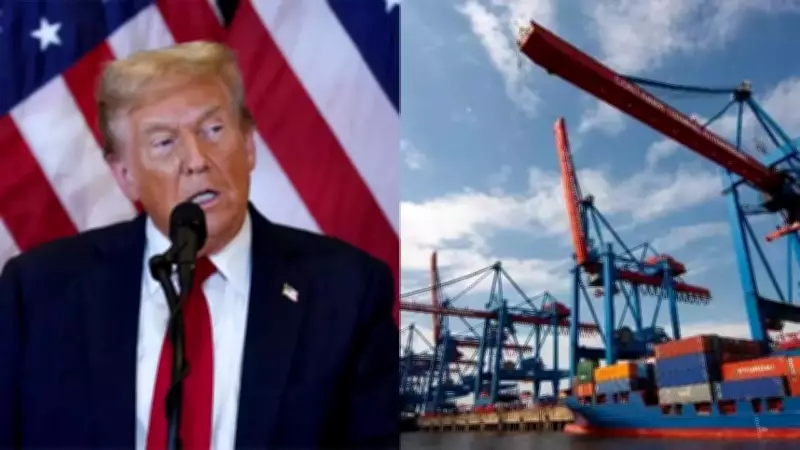
Trump Directs US Navy to Escort Tankers in Hormuz, Offers Insurance Amid Escalating Crisis
In a significant move to address the deepening Middle East crisis, former US President Donald Trump on Tuesday ordered the United States Navy to begin escorting oil tankers through the Strait of Hormuz if necessary. He also directed a federal agency to provide political risk insurance for maritime trade in the Gulf, pledging to protect global energy supplies as tensions rise.
Immediate Measures Announced via Social Media
In a post on Truth Social, Trump declared that these measures would take effect immediately and apply to all shipping lines operating in the region. He stated, "Effective IMMEDIATELY, I have ordered the United States Development Finance Corporation (DFC) to provide, at a very reasonable price, political risk insurance and guarantees for the Financial Security of ALL Maritime Trade, especially Energy, traveling through the Gulf. This will be available to all Shipping Lines. If necessary, the United States Navy will begin escorting tankers through the Strait of Hormuz, as soon as possible."
Trump emphasized the United States' commitment to ensuring the free flow of energy worldwide, asserting, "No matter what, the United States will ensure the FREE FLOW of ENERGY to the WORLD. The United States’ ECONOMIC and MILITARY MIGHT is the GREATEST ON EARTH — More actions to come." The Pentagon has not released operational details on when naval escorts would begin or specific triggers for deployment, but the directive indicates preparations could be activated swiftly based on commercial requests or intelligence assessments.

Strait of Hormuz Shut for Fourth Consecutive Day
This announcement comes as the Strait of Hormuz remained effectively closed for a fourth consecutive day. Shipping reports indicate that at least five oil tankers were hit in the waterway amid escalating hostilities following US and Israeli strikes on Iran and Tehran's retaliation. An oil tanker, the Palau-flagged Skylight, was attacked off the coast of Oman near the strategic chokepoint, injuring four crew members and forcing a full evacuation. Oman’s Maritime Security Centre confirmed the vessel was targeted about five nautical miles north of Khasab Port in Musandam Governorate, with all 20 crew members, including 15 Indian nationals and five Iranian nationals, evacuated safely.
Iran’s Islamic Revolutionary Guard Corps declared via radio transmissions that the Strait of Hormuz was closed to international navigation, although Tehran has not formally announced a full blockade. Multiple vessels reportedly received VHF warnings stating that "no ship is allowed to pass the Strait of Hormuz." The British Navy noted such orders were not legally binding but advised caution. The strait, connecting the Persian Gulf to the Gulf of Oman, carries roughly 20 percent of global oil supply and significant volumes of liquefied natural gas, making it a critical maritime choke point.
Widespread Disruption in Shipping and Energy Markets
Satellite imagery showed vessels backing up near Fujairah in the United Arab Emirates as tanker owners and oil majors suspended crude and LNG shipments. German shipping company Hapag-Lloyd halted transit through Hormuz, while French group CMA CGM instructed ships to seek shelter. Consultancy Kpler reported that at least 14 LNG tankers had slowed, stopped, or reversed course. Marine insurers have withdrawn coverage for voyages through the area, exposing operators to significant risk premiums and further disrupting trade.
The crisis has triggered wider ripple effects across the Gulf, with Qatar shutting down gas production operations and a Saudi Arabian refinery halting operations in response to the instability. Iran has also struck energy facilities in Qatar and Saudi Arabia and launched retaliatory drone attacks, including one targeting the US Embassy in Saudi Arabia. Oil markets reopened with speculation that Brent crude could approach $100 per barrel, levels last seen after Russia’s invasion of Ukraine in 2022.

Benchmark US crude jumped 8.6 percent to $77.36 a barrel, while Brent crude rose 6.7 percent to $81.29 a barrel. Analysts warned that a prolonged halt in Hormuz could block up to 20 million barrels per day, roughly 20 percent of global supply. Barclays analysts stated that extended disruption could severely constrain global energy markets.
Impact on Consumers and Global Response
The impact is already being felt by consumers, with the average price for a gallon of gasoline in the United States rising 11 cents overnight to $3.11, according to AAA. In some locations, prices approached or exceeded $4 per gallon. Anne Dulske, filling up in Jackson, Mississippi, said she paid $15 more than usual, noting, "It’s going to affect everything in our lives. It’s very scary, and it does hit closer to home than people think." Patrick DeHaan, head of petroleum analysis at GasBuddy, commented, "We are knee-deep into the gas price increases," adding that while further increases were possible, prices reaching $4 nationally remained "quite improbable based on the current developments."
President Trump addressed the spike in remarks from the Oval Office, stating, "We have a little high oil prices for a little while, but as soon as this ends, those prices are going to drop, I believe, lower than even before." In Europe, drivers queued at petrol stations amid fears of further disruption, with diesel prices reaching about 1.846 euros per litre in a Paris suburb. Abdelilah Khalil remarked, "With Iran and the Strait of Hormuz effectively blocked, it is causing alarm everywhere and driving up oil prices. It’s panic on board, everyone is worried, and I think that’s why many people are rushing to gas stations to fill up."
Strategic Calculus Behind US Moves
Trump’s directive to the Development Finance Corporation to offer political risk insurance appears aimed at stabilizing maritime trade by reducing the financial exposure of shipping companies and insurers. Political risk insurance typically protects businesses against losses resulting from war, expropriation, currency inconvertibility, and other sovereign risks. By making coverage available "at a very reasonable price," the administration encourages shipping lines to continue operating despite heightened security.
The potential deployment of US naval escorts through the Strait of Hormuz represents a significant military commitment to ensure freedom of navigation in a sensitive waterway. Previous tanker escort missions in the Gulf have required complex coordination and carried risks of confrontation with Iranian forces or allied militias. The Pentagon has not confirmed additional naval asset repositioning, but US officials describe the current military posture in the Middle East as one of the largest concentrations of American warships and aircraft in decades.
Uncertain Path Ahead for Global Energy
With the strait effectively closed, energy infrastructure under threat, and global markets rattled, the situation remains volatile. Shipping traffic has slowed to a trickle, insurers have withdrawn cover, and governments are scrambling to manage economic fallout. Treasury Secretary Scott Bessent and Energy Secretary Chris Wright are expected to outline measures to address the oil price spike and mitigate domestic impact.
The Strait of Hormuz has long been a flashpoint in regional geopolitics, and any sustained disruption threatens Gulf producers and major energy importers in Asia, Europe, and North America. Trump’s pledge to ensure the free flow of energy signals readiness to use economic tools and military force to keep the corridor open. Whether naval escorts and insurance guarantees will calm markets and deter further attacks remains uncertain, as the global energy system braces for continued turbulence from the Middle East conflict.