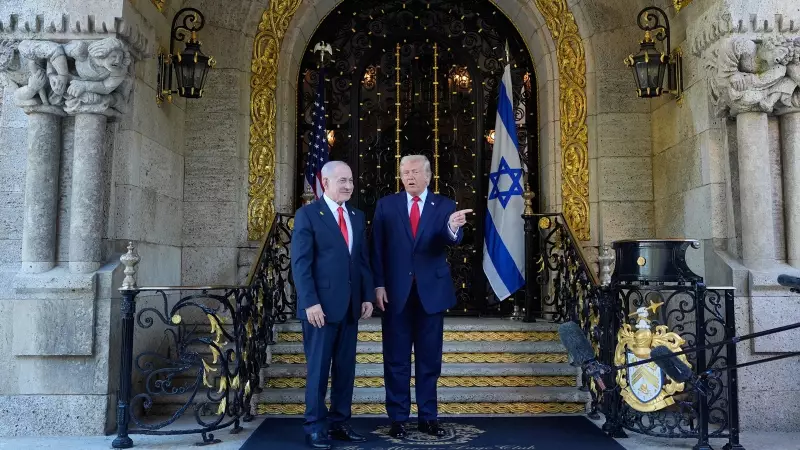
Former United States President Donald Trump and Israeli Prime Minister Benjamin Netanyahu held a significant meeting in Florida on Monday, focusing on the ongoing conflict in Gaza and its potential future trajectory. The discussion, described as centering on the "next phase" of the war, underscores the enduring political alliance between the two leaders, even as both navigate complex domestic landscapes.
A Strategic Discussion on Gaza's Future
The meeting took place at Trump's Mar-a-Lago resort in Palm Beach, Florida. This was their first face-to-face interaction since the devastating Hamas-led attacks on Israel on October 7, 2023, which triggered the current war. According to a statement from Netanyahu's office, the two leaders engaged in a "lengthy and warm conversation" about the latest developments in the fighting.
Central to their talks was the formulation of plans for what comes after the intense military operations. Netanyahu's office stated they discussed "the need to complete the destruction of Hamas's battalions, including in Rafah, and to achieve all the war's objectives." This aligns with Israel's stated goal of dismantling Hamas's military and governing capabilities in the Gaza Strip.

Trump's campaign spokesperson, Steven Cheung, confirmed the meeting, noting that the two "discussed the war against Hamas and Israel's justified goal of achieving total victory." The emphasis from both sides highlights a shared hardline stance on the military campaign's objectives.
Political Undertones and Timing
The timing of this meeting is politically charged for both figures. Benjamin Netanyahu is under immense pressure domestically, facing criticism over the security failures of October 7 and the handling of the war and hostage crisis. His coalition government is fragile, and public protests demanding his resignation and a new election are growing.
For Donald Trump, the presumptive Republican nominee for the 2024 US presidential election, the meeting serves as a powerful visual of his foreign policy engagement and his strong support for Israel. It draws a clear contrast with the current Biden administration, which has been increasingly vocal about its concerns over civilian casualties in Gaza and the humanitarian crisis, and has urged caution regarding a major ground operation in Rafah.
This gathering at Mar-a-Lago is seen by many analysts as an effort by Netanyahu to reinforce his position by showcasing unwavering support from a potential future US president. Similarly, Trump aims to solidify his pro-Israel credentials among his voter base and donors.
Broader Implications and the Path Forward
The discussion between Trump and Netanyahu goes beyond immediate military tactics. It touches on the profoundly challenging question of Gaza's governance and security in a post-Hamas scenario—a topic that has seen little concrete progress internationally. Israel has yet to present a comprehensive plan for the "day after," and the United States has advocated for a revitalized Palestinian Authority to eventually assume control, an idea Netanyahu has rejected.
The meeting also occurs against the backdrop of strained relations between Netanyahu and President Joe Biden. While the US continues to provide military aid, Biden has openly criticized the Israeli government's approach, creating a notable diplomatic friction. Trump's unequivocal backing offers Netanyahu a political counterweight to this pressure.
The war, now in its fifth month, has resulted in over 31,000 Palestinian deaths, according to Gaza health officials, and has displaced most of the enclave's 2.3 million population. The humanitarian situation is dire, with widespread hunger and disease. The international community, including the US, is pushing for an immediate temporary ceasefire to facilitate hostage releases and aid delivery, but negotiations have stalled.

In conclusion, the Trump-Netanyahu meeting in Florida was a significant political event that reaffirmed a hawkish stance on the Gaza war. It highlighted the alternative foreign policy vision a potential Trump administration could bring, one marked by less public pressure on Israel regarding civilian welfare and war conduct. As the conflict grinds on with no clear endgame, such alignments could significantly influence future diplomatic and military decisions in the region.