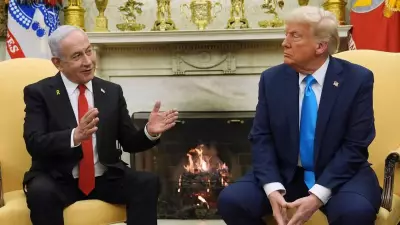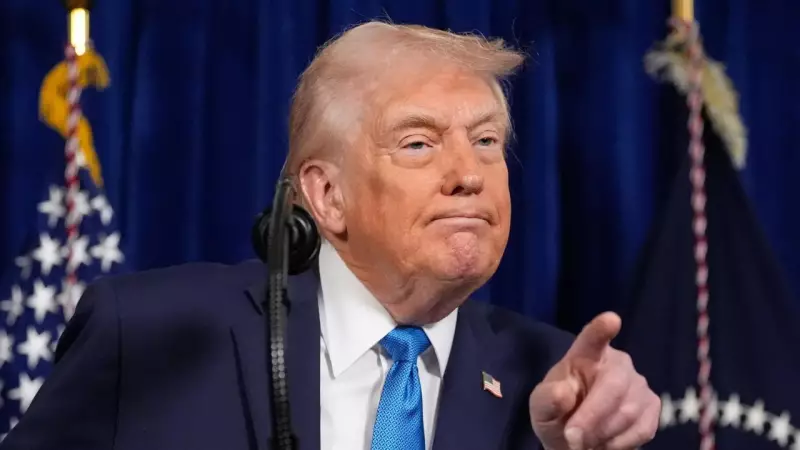
Approaching the one-year mark of his second presidential term, Donald Trump has steered the United States towards a markedly more aggressive military stance across several global regions. This shift persists even as the President occasionally voices themes of "peace." In a revealing interview with The New York Times, Trump pushed this narrative further, declaring that his "own morality" stands as the singular restraint on his authority to initiate military operations anywhere on the planet.
"I Don't Need International Law": Trump on Global Powers
The President's comments to the newspaper followed closely on the heels of a significant military campaign aimed at overthrowing Venezuelan leader Nicolas Maduro. Alongside this action, Trump issued threats against several other nations and even the autonomous territory of Greenland.
When questioned about potential limits to his global powers, Trump's response was unequivocal. "Yeah, there is one thing. My own morality. My own mind. It's the only thing that can stop me," he stated. He added, "I don't need international law. I'm not looking to hurt people." The Republican leader later appeared to temper this, saying he "does" need to abide by international law, but immediately qualified it by noting, "it depends what your definition of international law is."

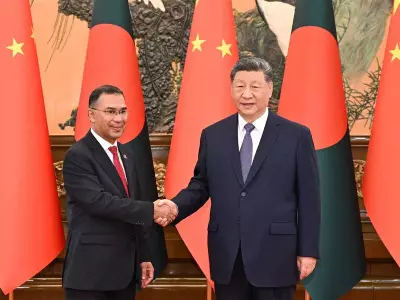
On the sensitive issue of China and Taiwan, Trump was asked about President Xi Jinping's view of Taiwan as a separatist threat. Trump responded, "That's up to him, what he's going to be doing. But, you know, I've expressed to him that I would be very unhappy if he did that, and I don't think he'll do that. I hope he doesn't." He expressed confidence that Xi would not take drastic steps, such as choking off the island, while he (Trump) remains in office, suggesting it might be a possibility "after we have a different president."
Greenland Ambitions and NATO Tensions
Explaining his controversial desire for the United States to possess Greenland, Trump told the NYT, "Because that's what I feel is psychologically needed for success. I think that ownership gives you a thing that you can't do with, you're talking about a lease or a treaty. Ownership gives you things and elements that you can't get from just signing a document."
His stance has created friction with NATO ally Denmark, which administers Greenland. When pressed on whether preserving the NATO alliance or acquiring Greenland was his priority, Trump ominously replied, "it may be a choice." He defended his record with Europe, claiming, "If it weren't for me, Russia would have all of Ukraine right now."
A String of Military Operations and Legal Challenges
Despite proclaiming himself a "peace president" and openly seeking the Nobel Peace Prize, Trump has overseen a series of military engagements during his second term. These include:
- Ordering attacks on Iran's nuclear program in June.
- Overseeing strikes in Iraq, Nigeria, Somalia, Syria, and Yemen over the past year.
- The most recent operation in Venezuela, which resulted in the capture of Nicolas Maduro.
Following Maduro's capture, a seemingly emboldened Trump has threatened other countries, including Colombia. His approach occurs in a context where the US is not a member of the International Criminal Court (ICC) and has repeatedly rejected rulings by the UN's International Court of Justice (ICJ).
Domestically, Trump's relationship with the law has been fraught. He has been impeached twice, faced federal charges related to conspiring to overturn the 2020 election—later dropped after his re-election—and was convicted for covering up a hush money payment.
Some members of Congress, including a handful of Republicans, have attempted to curtail the President's military authority. The Senate recently advanced a measure to limit presidential action in Venezuela, but it faces a likely veto from Trump if it reaches his desk.

In a separate revelation, Trump stated he no longer has an issue with his family conducting foreign business deals since his return to the White House, claiming he got "absolutely no credit" for prohibiting it during his first term.