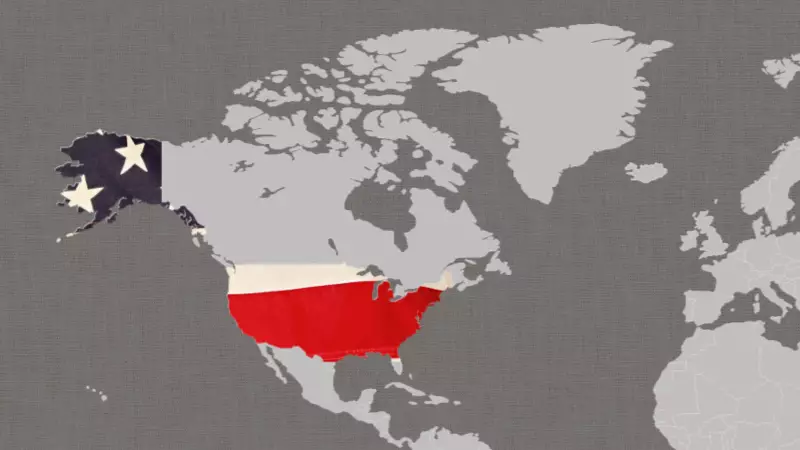
As the 2024 United States presidential election approaches, former President Donald Trump's potential agenda for a second term is coming into sharper focus. Beyond domestic policies, a striking geopolitical ambition is reportedly on the table: the expansion of American territory. Sources close to Trump's inner circle suggest that parts of Canada and the autonomous Danish territory of Greenland are being eyed as potential targets under a renewed "Make America Greater Again" doctrine.
The Rationale Behind the Expansionist Vision
The core idea, as per discussions with Trump advisors, is not necessarily a full-scale annexation but a form of integration that strengthens US strategic and economic interests. For Canada, the focus is reportedly on its vast natural resources, particularly timber, minerals, and oil. Proponents argue that bringing resource-rich Canadian provinces closer under the US umbrella would enhance energy security and economic dominance.
Regarding Greenland, the motivations are deeply strategic. The world's largest island is seen as a critical geopolitical asset in the Arctic, a region gaining immense importance due to climate change opening new shipping routes and access to untapped resources. Trump's interest in purchasing Greenland, first revealed during his presidency in 2019, was famously rebuffed by Denmark, which called the idea "absurd." However, the concept has not been abandoned. In a potential second term, this ambition could resurface, driven by the desire to counter Russian and Chinese influence in the High North.

Historical Context and Political Feasibility
This is not the first time American expansionism has targeted the north. The US attempt to purchase Greenland dates back to 1867, and the idea of integrating Canada has flickered in the background of American political thought for over a century. Trump's version, however, is framed through a lens of nationalist revival and great-power competition.
Politically, the feasibility of such moves is widely questioned by experts. Any attempt to integrate Canadian territory would face fierce opposition from the Canadian government and its citizens, violating longstanding sovereignty treaties and alliances like NATO. Similarly, acquiring Greenland would require negotiation with the Kingdom of Denmark and, crucially, the consent of Greenland's own population, which has moved towards greater independence.
Implications for Global Order and India's Perspective
The mere discussion of such expansionist plans sends ripples through the international system. It challenges the post-World War II norm of respecting territorial integrity and could destabilize relations with key allies. For a rising global power like India, these developments are significant. A US administration actively pursuing territorial growth would represent a major shift in foreign policy focus, potentially affecting Washington's commitments in the Indo-Pacific region aimed at countering China.
Furthermore, such unilateral actions could undermine the rules-based international order that India has engaged with for decades. It also raises questions about the future of diplomatic channels if force or coercive economic measures are prioritized over negotiation. Indian foreign policy analysts would be watching closely to see how this impacts global trade dynamics, energy security, and strategic partnerships.
In conclusion, while the practical execution of Donald Trump's reported ambitions towards Canada and Greenland faces monumental legal, political, and diplomatic hurdles, their emergence as discussion points signals a potential dramatic turn in US foreign policy. The "Make America Greater Again" slogan, in this context, takes on a literal, territorial meaning that, if pursued, would redefine North American geopolitics and have profound consequences for allies and competitors worldwide, including India.