Donald Trump: The Expansionist, Warmonger, and Freedom Crusher in American History
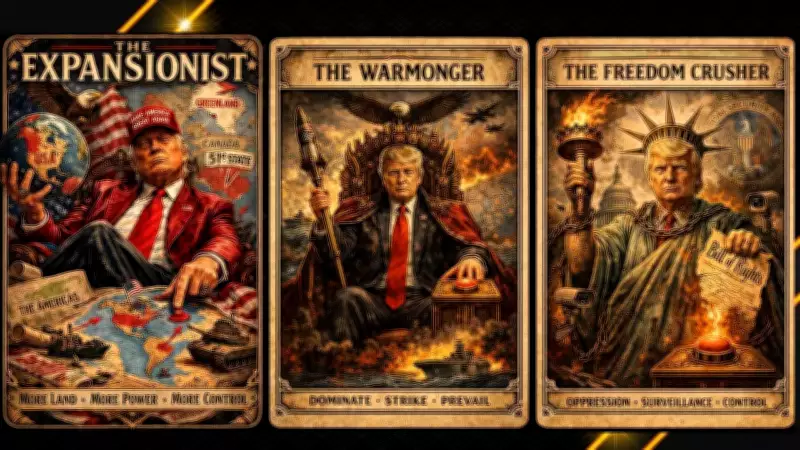
In the vast ocean of commentary surrounding Donald Trump, one might assume he represents a unique aberration in the American political system—a figure antithetical to the nation's core values. However, a closer examination reveals that Trump is not an anomaly but rather a Jungian composite sketch of past American presidents, embodying the archetypes of the Expansionist, the Warmonger, and the Freedom Crusher.
The Expansionist Archetype
When Trump expressed desires to annex Greenland or humorously referred to Canada as the 51st state, many commentators reacted with shock, overlooking the deep-seated expansionist tendencies ingrained in American history. The United States began as thirteen colonies along the Atlantic coast and, through a series of strategic moves, expanded its territory by approximately 360%, reaching nearly 3.8 million square miles.
Key historical expansions include:

- In 1803, Thomas Jefferson's Louisiana Purchase doubled the nation's size.
- Andrew Jackson's Indian Removal Act of 1830 displaced 100,000 Native Americans, leading to the tragic Trail of Tears.
- The concept of Manifest Destiny in the 1840s justified territorial expansion across North America, culminating in the Mexican-American War and the acquisition of California, Nevada, and other regions.
- Beyond the continent, the Spanish-American War resulted in the United States gaining Puerto Rico, Guam, and the Philippines, while the annexation of Hawaii in 1898 further extended American influence.
Trump's slogan, "Make America Great Again," echoes this historical trajectory, where greatness was often achieved through territorial acquisition and imperial ambition. His actions reflect 250 years of American muscle memory, not a departure from tradition.
The Warmonger Archetype
America's relationship with war is deeply embedded in its identity, with the presidency wielding unprecedented power to initiate conflicts without formal declarations. Trump inherited this war machine and, despite pre-election promises of change, continued the legacy of military intervention.
Historical precedents of American warmongering include:
- Harry Truman's involvement in the Korean War without a congressional declaration.
- Lyndon Johnson's escalation of the Vietnam War, involving some of the most destructive bombing campaigns in history.
- George W. Bush's pre-emptive invasion of Iraq based on false claims of weapons of mass destruction.
- Barack Obama's use of drone strikes across Yemen, Pakistan, and Somalia.
Trump's operations, such as those targeting Iran's nuclear program, follow this pattern. Unlike his predecessors, who often cloaked their actions in doctrines of protection or democracy, Trump dispenses with such justifications, presenting war through a lens of meme culture and video-game aesthetics.
The Freedom Crusher Archetype
While America prides itself on upholding freedom and liberty, history shows that these ideals are often the first casualties of power. From Abraham Lincoln suspending habeas corpus during the Civil War to Franklin D. Roosevelt interning Japanese-Americans during World War II, the erosion of liberties has been a recurring theme.
The post-9/11 era under George W. Bush saw the establishment of the Patriot Act and warrantless surveillance, a framework preserved and extended by Barack Obama. Trump's use of executive power to threaten institutions and test constitutional norms is not an innovation but a continuation of this long tradition, where liberty contracts whenever power feels threatened.
The Tyler Durden Analogy
Trump's worldview, shaped by his background in real estate, treats global geopolitics as prime property to be acquired and controlled. This perspective, combined with his refusal to apologize for his actions, mirrors the character Tyler Durden from Fight Club—a figure who embodies unrestrained id without moral pretense.

The most unsettling aspect is the possibility that Trump's actions stem from a reality constructed entirely in his own mind, yet with real and catastrophic consequences for the world. As in Harry Potter, where Dumbledore notes that events in one's head are still real, Trump's internal narrative has tangible impacts on global stability.
In conclusion, Donald Trump is not an aberration but a manifestation of historical American archetypes. His presidency highlights the enduring patterns of expansionism, warmongering, and liberty suppression that have shaped the nation's history, now performed with a raw, unembarrassed intensity that challenges traditional diplomatic norms.