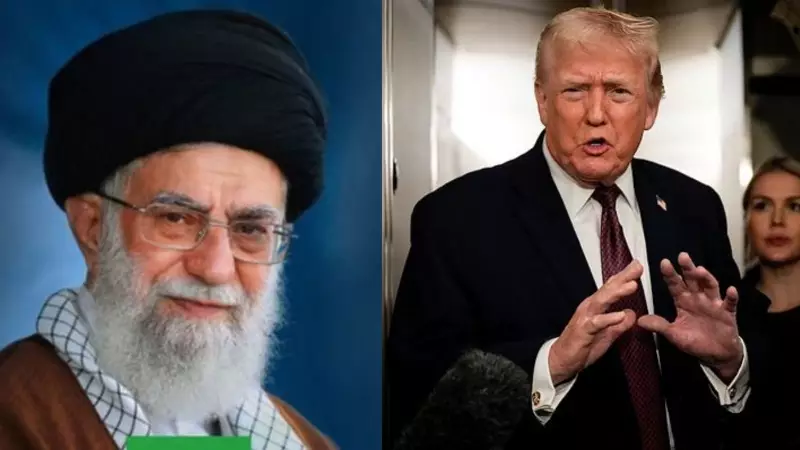
Former United States President Donald Trump has publicly called on Iran's leadership to return to the negotiating table. This appeal comes with a pointed reminder of his administration's decisive actions during the 2022 nationwide protests that shook the Islamic Republic.
Trump's Warning and the 2022 Protest Fallout
In a recent statement, Trump highlighted a critical moment from his presidency. He revealed that in 2020, he sent a stark message to the Iranian regime through Swiss intermediaries. The message was a clear threat: if Iran executed protesters who were demonstrating against the government, the United States would respond by targeting 52 specific Iranian sites, a symbolic number representing the American hostages taken in 1979.
Trump claims this direct and severe warning had a tangible effect. He asserts it was a primary reason the Iranian government showed relative restraint during the widespread protests that erupted in 2022 following the death of Mahsa Amini. The 22-year-old woman died in custody after being arrested by the morality police for allegedly violating Iran's strict hijab laws. Her death ignited months of furious demonstrations across the country, with protesters demanding fundamental changes to the theocratic system.

A Contrast in Foreign Policy Approaches
The former president used this recollection to draw a sharp contrast between his foreign policy and that of the current Biden administration. Trump criticized President Joe Biden's handling of Iran, suggesting that a softer approach has emboldened the regime. He specifically pointed to the Biden administration's efforts to revive the Joint Comprehensive Plan of Action (JCPOA), commonly known as the Iran nuclear deal, from which Trump had unilaterally withdrawn the US in 2018.
Trump framed his "maximum pressure" campaign, which involved severe economic sanctions, as a more effective strategy for compelling Iran to negotiate. He argued that the current situation, where Iran continues to advance its nuclear program and crack down on internal dissent, is a direct result of weakened American resolve. His call for negotiations is set against this backdrop of asserting that strength, not concession, brings adversaries to the table.
Regional Implications and Future Prospects
This public maneuvering by Trump occurs within a complex geopolitical landscape. Iran continues to be a central player in Middle Eastern tensions, including the conflict in Gaza and ongoing skirmishes with proxy groups. The status of its nuclear program remains a major concern for the international community, with reports suggesting it has enriched uranium to levels close to weapons-grade.
Trump's statement is also viewed through the lens of the upcoming US presidential election, where he is the presumptive Republican nominee. His remarks reinforce his campaign narrative of being a tough and deal-making leader on the world stage. However, analysts note that the Iranian government has historically been resistant to direct pressure, and it remains unclear whether Trump's renewed call for talks would find any receptive audience in Tehran, especially given the deep mistrust stemming from his earlier withdrawal from the nuclear accord.
The situation leaves the future of US-Iran relations at a critical juncture. The path forward hinges on whether diplomatic channels can be reopened under a posture of pressure or if the cycle of escalation will continue, with significant implications for regional stability and global non-proliferation efforts.