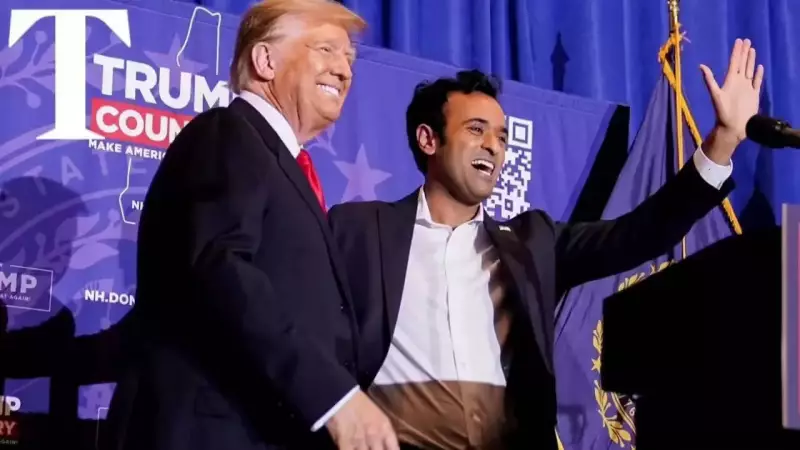
In a significant political development that could reshape the American heartland's leadership, former US President Donald Trump has thrown his weight behind Indian-American entrepreneur Vivek Ramaswamy's bid to become Ohio's next governor. The endorsement, announced on Friday, immediately catapults the 40-year-old biotech billionaire to front-runner status in the politically crucial state.
The Trump-Ramaswamy Alliance
The bond between the MAGA leader and his young acolyte was forged during the intense 2024 GOP presidential primary campaign, where Ramaswamy positioned himself as a fierce anti-woke Trump supporter. After suspending his own presidential campaign and endorsing Trump, Ramaswamy was rewarded with a plum role co-chairing the Department of Government Efficiency (DOGE) alongside tech mogul Elon Musk.
Ramaswamy resigned from this position in January 2025 to return to his home state and launch his gubernatorial campaign. Trump's "complete and total endorsement" came via his Truth Social platform, where he hailed the 40-year-old as "something special" and a "young, strong, and smart" leader who "will never let you down."

Breaking Historical Barriers
Born in Cincinnati to Indian immigrant parents, Ramaswamy is vying to become the first non-white governor in Ohio's 223-year history, let alone one of avowedly Hindu faith. This represents a potential watershed moment for a state where all 64 previous governors have been white men - a streak unbroken since statehood in 1803.
"This isn't just about policy—it's about shattering ceilings," Ramaswamy declared during his February campaign launch, vowing to make Ohio a "beacon for the American Dream." If successful, he would join the ranks of only two other Republicans of Indian heritage who have realized this political dream: Piyush 'Bobby' Jindal in Louisiana (2008-2016) and Nikki Haley in South Carolina (2011-2017).
Political Implications and Electoral Challenges
The Trump endorsement could significantly boost Ramaswamy's chances to replace incumbent Republican Mike DeWine, who is term-limited. More importantly, it may discourage other party rivals from entering the race, particularly after Ramaswamy secured the Ohio GOP's official endorsement in May 2025.
Early primary polling shows him as the overwhelming favorite for the Republican nomination, with a March survey giving him a commanding 61% support among GOP voters. However, the general election in November 2026 points to a potentially tight race against Democratic frontrunner, former Ohio Health Director Amy Acton.
A November 2025 poll from the Ohio Federation of Teachers placed Acton and Ramaswamy nearly tied at 46% to 45%, while an earlier poll showed Acton slightly ahead at 48%-46%. Trump's endorsement could prove to be a double-edged sword - while it ensures MAGA unity and financial support, it also allows Democrats to tie Ramaswamy directly to the President's potential mistakes and any decline in political fortunes.
Ohio is considered a battleground state, though Trump has won it in the last three elections. Any Trump fatigue among the electorate could become a potential liability for Ramaswamy. Conversely, a Ramaswamy victory could reinforce Trump's influence in the American heartland amid an emerging redistricting battle across the country.
A win would also substantially boost Ramaswamy's future political prospects in a state that has given the US the second-highest number of Presidents (7) after Virginia (8). Meanwhile, a Democratic flip would signal a major 2028 resurgence for the party that is only now rediscovering its momentum with multiple wins in last week's polls, including Zohran Mamdani's victory in the NYC mayoral elections and gubernatorial wins in Virginia and New Jersey.