White House's AI-Generated Penguin Image Draws Criticism Amid Trump's Greenland Focus
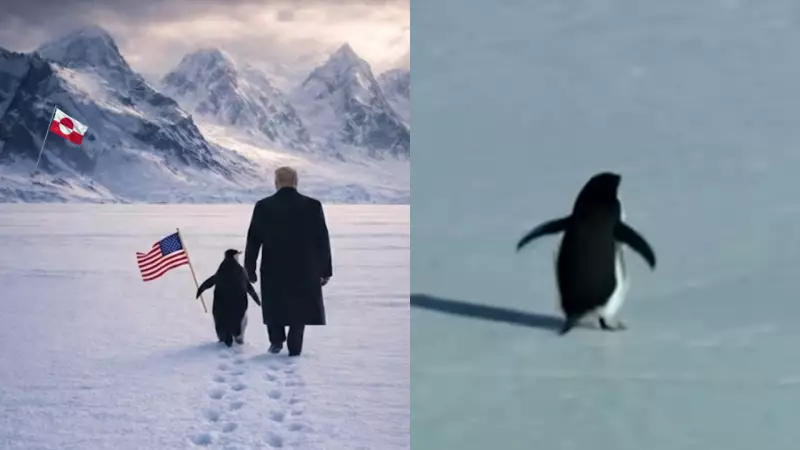
The White House has sparked significant online attention by sharing an unusual artificial intelligence-generated image featuring former US President Donald Trump walking alongside a penguin toward the Arctic island of Greenland. The post, captioned "Embrace the penguin," quickly went viral across social media platforms, drawing both criticism and mockery from users who immediately pointed out the geographical inaccuracy.
Geographical Error Sparks Online Backlash
Social media users were quick to note that penguins do not naturally inhabit Greenland or any region in the Northern Hemisphere, with the Antarctic species being exclusively found in the Southern Hemisphere. This geographical blunder triggered widespread criticism of the White House post, which many interpreted as another symbolic assertion connected to Trump's longstanding interest in the strategically important territory of Greenland.
The controversial image emerged during a period when Trump had temporarily paused tariff-related tensions with European nations while maintaining his rhetorical focus on Greenland. The timing and content of the post led many observers to view it as part of a broader pattern of attention-grabbing communications from the former administration.

The Parallel Viral Phenomenon: 'Nihilist Penguin' Documentary Clip
Interestingly, the White House's penguin-focused post coincided with an entirely separate viral trend that had already captured internet attention. A short documentary clip from Werner Herzog's 2007 film 'Encounters at the End of the World' had resurfaced online, showing a lone Adélie penguin walking away from its coastal colony toward distant Antarctic mountains approximately 70 kilometers inland.
Internet's Philosophical Interpretation
Netizens quickly dubbed this solitary penguin the "Nihilist Penguin" and transformed the footage into a cultural symbol of existential crisis, rebellion, and self-discovery. Social media platforms became flooded with memes featuring captions like "The penguin knows" and "heading toward oblivion," as users projected complex human emotions and philosophical meanings onto the animal's unusual behavior.
The stark visual imagery of a single penguin marching purposefully away from survival resources toward an inhospitable mountain range resonated deeply with online audiences, sparking widespread debate about the clip's potential symbolic significance.
Scientific Perspective on Penguin Behavior
While the internet embraced philosophical interpretations, wildlife experts and scientists offered more grounded explanations for the penguin's unusual inland trek. Seabird ecologist Dr. David Ainley, featured in the original documentary, noted that such behavior is rare and not considered normal survival conduct for Adélie penguins, which typically remain close to coastlines for breeding and hunting.
Possible Scientific Explanations
Researchers have proposed several plausible reasons for the penguin's deviation from typical behavior patterns:
- Disorientation: Particularly among younger or inexperienced birds who may lose their navigation abilities
- Health Factors: Illness or injury affecting the animal's cognitive functions and directional sense
- Exploration: Rare instances of individual dispersal or exploratory behavior within the species
- Environmental Stress: External factors causing abnormal movement patterns
Dr. Ainley further observed that even if the lone penguin had been returned to its colony, it likely would have resumed its journey toward the mountains, suggesting a persistent behavioral pattern rather than temporary confusion.

Psychological Interpretations and Scientific Caution
The viral phenomenon inspired some internet users to explore psychological frameworks to explain the penguin's behavior. References emerged to Sigmund Freud's 1920 work 'Beyond the Pleasure Principle,' which divides human behavior into life instincts (Eros) and death drives (Thanatos). Some speculated that the penguin might represent an embodiment of Freud's death drive concept, though scientists strongly caution against such anthropomorphic interpretations.
Limits of Human Interpretation
Wildlife biologists emphasize that deviations from typical animal behavior should not be interpreted as evidence of conscious intent, awareness, or philosophical understanding. In scientific terms, such unusual actions are generally attributed to:
- Individual variation within species
- Environmental pressures and stressors
- Health-related factors affecting behavior
- Natural behavioral diversity that occasionally manifests unusually
While the "Nihilist Penguin" clip has become a significant cultural symbol online, scientists view it primarily as an isolated observation of scientific interest—a reminder of the complexities of animal behavior and the limitations of human interpretation when applied to wildlife actions.
The simultaneous viral trends—one political and artificial, the other natural and philosophical—created a unique cultural moment where geographical errors, political symbolism, animal behavior, and internet philosophy converged in unexpected ways, demonstrating how digital platforms can amplify and connect seemingly disparate phenomena into cohesive viral narratives.