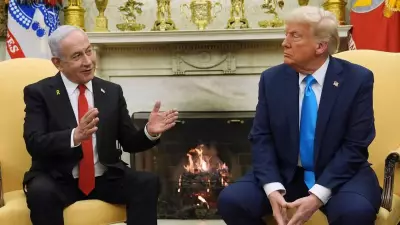
The concept of 'the West' is currently on life support, critically wounded by a transactional and Hobbesian view of international relations championed by figures like former US President Donald Trump. This perspective treats power as a protection racket and allies as expendable, placing the foundational institutions of the West—NATO and the European Union—under unprecedented strain. The seismic question now is whether this idea, built on democratic values, is worth saving and if salvation is even possible.
The Elusive Definition of a Civilizational Idea
Defining 'the West' has always been a challenge for historians and journalists alike. It is not a geographical entity, as it includes nations like Australia and the US. It is not solely a military alliance like NATO, nor is it an exclusively Christian club. Despite editorial bans in some newsrooms due to its vagueness, the term persists because it serves as crucial shorthand for a tribe of market democracies bound by shared political ideals.
This definition, however, is under threat of being hijacked. Historian Georgios Varouxakis, author of The West: The History of an Idea, argues against allowing far-right populists to claim ownership of the term. "Don't allow them to own the term, they don't own the term. Western civilization does not mean White supremacism," he states. The core fear is that if enough populists gain power in Western nations, the very identity of the West could morph into something defined by toxic nationalism, jeopardizing its major institutions.

A Historical Birth: From Christendom to a Liberal Bulwark
According to Varouxakis, the West as a distinct political identity first emerged around the time of the Greek War of Independence (1821-1829). Prior to this, 'Christendom' or 'Europe' were the rallying cries against threats like the Ottoman Empire. The weakening Ottomans and a newly assertive Russia under Tsar Alexander I changed the calculus.
Russia, though Christian, promoted absolute monarchy and faith against the secular republicanism born of the Enlightenment. This made 'Christendom' an inadequate label. The term 'Europe' also fell short because it excluded a potential ally across the Atlantic: the United States, which shared the Enlightenment values of secularism, rule of law, and individual rights.
The French sociologist Auguste Comte became a key architect of this new 'West,' envisioning it as a bulwark against Russian expansion. His West included Latin and Anglo-Saxon Europe and their New World outposts, with special consideration for Poland and Greece. This was a geopolitical construct, born from Russia's moves into territories like Bessarabia (modern Moldova) and the Caucasus, which triggered the 'Great Game' with Britain over approaches to India.
Ancient Parallels: Greece Then, Ukraine Now
The historical parallels to today are striking. Varouxakis notes that the discourse around Greece 200 years ago is "spookily reminiscent" of current talk about Ukraine. Just as the Greek elite, educated in European universities, fought to join the West for its promise of a tolerant, law-based society, Ukraine fights today for the same ideal.
Similarly, Tsar Alexander I's campaign to reshape Europe with his conservative, authoritarian values finds a strong echo in Vladimir Putin's actions and rhetoric today. The enduring desire of nations to align with the West underscores its lasting soft power—the attraction of its liberal-democratic core, despite the flaws of its member states.
Ultimately, the West is the ideological glue binding NATO and the EU. It is more than a military bloc; it represents a commitment to secularism, democratic debate, and individual rights. Compromising these values for a narrow, nationalism-based identity threatens not just the alliance, but the very principles that made it a compelling idea. The fight for the West's soul is, in essence, a fight to preserve the pluralistic and open society it once promised to champion.