Solar Wind: The Sun's Powerful Particle Stream That Shapes Our Solar System
While the term solar wind might evoke poetic imagery, it represents a very real and immensely powerful cosmic phenomenon that serves as a vital connection between our Sun and every celestial body within the solar system. Unlike the atmospheric winds we experience on Earth, solar wind is not composed of moving air. Instead, it is a relentless, high-speed stream of charged particles—primarily electrons and protons—that flows outward from the Sun in all directions.
The Origin of Solar Wind in the Sun's Corona
According to NASA, the solar wind originates from the Sun's outer atmosphere, known as the corona. Temperatures in this region soar to millions of degrees, providing particles with enough energy to overcome the Sun's gravitational pull and escape into space. The Sun also features areas called coronal holes, which are cooler, darker regions with open magnetic fields that generate particularly fast-moving solar winds. Additionally, regions with intense magnetic fields contribute to a steady plasma flow that permeates the entire solar system.
As the Sun rotates, its magnetic field is carried along by the solar wind, creating a distinctive spiral pattern in space, famously known as the Parker spiral. This continuous outflow not only transports particles but also extends the Sun's magnetic influence across vast distances.

How Solar Wind Interacts Differently Across the Solar System
The impact of solar wind on various celestial objects varies significantly, depending largely on whether they possess protective atmospheres or magnetic fields. NASA highlights that these factors determine how effectively a body can shield itself from the stream of charged particles.
Effects on Planets and Other Celestial Bodies
On Mercury: As the closest planet to the Sun, Mercury experiences intense solar wind pressure. Despite having a weak magnetic field that offers minimal protection, the planet's surface is constantly bombarded by solar wind particles. This interaction causes atoms to be stripped away, forming a thin and dynamic exosphere around Mercury.
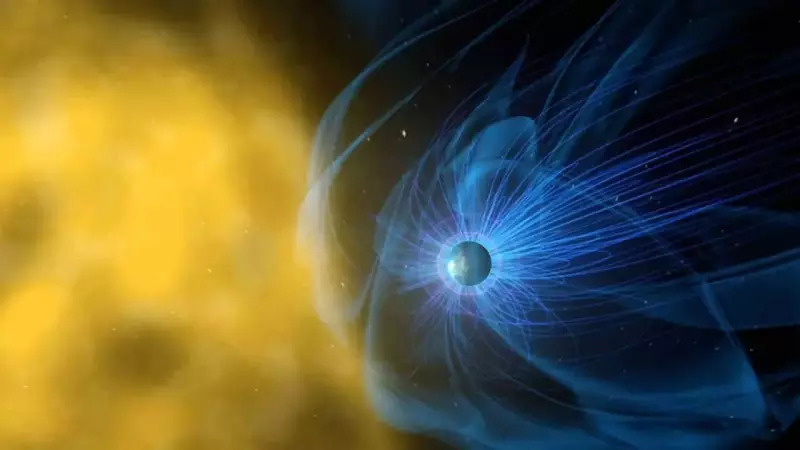
On Earth: Our planet is shielded by a robust magnetic field, the magnetosphere, which deflects most solar wind particles. However, some particles follow magnetic field lines and collide with gases in the upper atmosphere, producing the spectacular Northern and Southern Lights, or auroras. Intense bursts of solar wind can trigger space weather events that disrupt satellite operations and GPS signals.
On the Moon: Lacking both a substantial atmosphere and a magnetic field, the lunar surface is directly exposed to solar wind. Particles become embedded in the lunar soil, and scientists believe this process may facilitate the creation of trace amounts of water through reactions with oxygen in lunar minerals. This discovery offers valuable insights for future lunar exploration missions.
On Mars: Billions of years ago, Mars had a thicker atmosphere and flowing water. However, without a strong magnetic field, it has been highly vulnerable to solar wind erosion. Over eons, the constant stream of charged particles has stripped away atmospheric gases, contributing to Mars' transformation into the cold, arid world we observe today.
On Comets: When comets approach the Sun, solar wind interacts with gases released from their icy nuclei. This repels charged particles, forming a luminous tail that always points away from the Sun. Solar wind not only creates these tails but also illuminates comets, making them visible from great distances.
On Jupiter: Jupiter's exceptionally strong magnetic field interacts powerfully with solar wind, generating auroras that are far brighter than those on Earth. These interactions produce some of the most brilliant auroral displays in the entire solar system.
On Asteroids: Due to their small size and lack of protection, asteroids are highly susceptible to solar wind bombardment. This continuous particle impact alters their chemical composition and surface texture, a process known as space weathering.

Why Solar Wind Matters for Earth and Space Exploration
Solar wind is far more than a distant cosmic curiosity; it plays a crucial role in shaping planetary environments. From generating Earth's auroras and eroding Mars' atmosphere to affecting spacecraft electronics and forming the heliosphere—the vast bubble that envelops our solar system—solar wind's influence is profound. Understanding this phenomenon is essential for successful space exploration and for comprehending the Sun's interactions with all orbiting bodies.
NASA's Efforts to Protect Astronauts from Solar Wind
NASA is actively researching solar wind to mitigate risks to astronauts, especially during missions beyond low Earth orbit. Spacecraft and habitats are designed with shielding to protect against solar wind particles. By improving predictions of solar storms, mission planners can adjust spacewalk schedules, reposition spacecraft, and minimize astronaut exposure during high-radiation events. These protective measures are vital for the safety of long-duration missions to the Moon, Mars, and beyond.