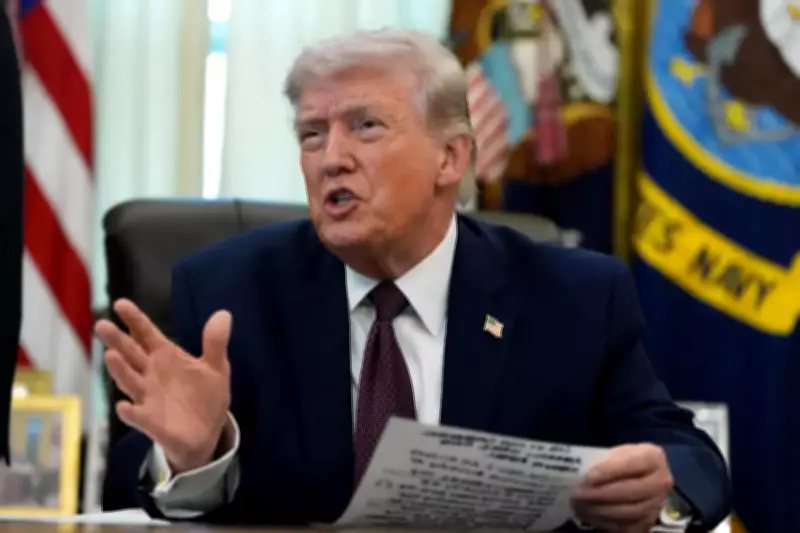
NATO's Precarious Future: Analyzing the Impact of a Potential US Withdrawal Under Trump
US President Donald Trump has once again raised the specter of withdrawing from the North Atlantic Treaty Organization (NATO), marking the latest in a series of threats dating back to 2016. The immediate catalyst for this renewed warning stems from NATO allies' refusal to participate in operations to reopen the strategically vital Straits of Hormuz for shipping. This critical maritime choke point, through which approximately 20% of global oil and gas flows, remains closed, sending energy prices soaring worldwide.
Historical Context and Trump's Stance
Established in April 1949 as a mutual defense pact among Western European nations, the United States, and Canada following World War II, NATO has grown to encompass 32 member states stretching from North America to Turkey. The alliance's cornerstone is Article 5, the collective defense clause that treats an attack on one member as an attack on all. During the Cold War, NATO faced off against the Soviet Union's Warsaw Pact until 1991, emerging as the world's most powerful military alliance after the Berlin Wall fell.
In a recent interview with The Telegraph, President Trump expressed his longstanding skepticism about NATO's effectiveness, stating, "I was never swayed by NATO. I always knew they were a paper tiger, and Putin knows that too, by the way." Trump has consistently criticized other member nations for not meeting their financial obligations, arguing they fail to "pull their weight" within the alliance.

America's Dominant Role in NATO
The United States unquestionably serves as NATO's primary military and financial contributor. In 2025, the combined defense budget of all NATO members reached $1,588 billion, with the United States alone accounting for $980 billion—approximately 61% of the total. Germany followed with $93 billion, less than 10% of the US contribution, while the United Kingdom allocated $90 billion.
This financial dominance translates directly into military superiority across multiple domains:
- Aerial Capabilities: The United States operates over 2,500 fighter aircraft across its Air Force, Navy, and Marine Corps, not including bombers, airborne early warning and control systems (AEW&CS), and refueling aircraft. European NATO members collectively possess approximately 1,300 fighter aircraft—less than half the American inventory.
- Surveillance and Support: In aerial surveillance, the US maintains a substantial lead with over 30 AEW&CS aircraft in the Air Force and about 50 in the Navy, compared to just 28 among other NATO members. Similarly, the US fleet of over 440 mid-air refuelers dwarfs Europe's combined total of 156.
- Naval Power: The United States Navy operates 11 supercarriers and 9 smaller carriers or amphibious assault ships carrying Marine Corps F-35Bs. European allies collectively field four aircraft carriers and seven helicopter carriers. However, in submarines, other NATO members outnumber the US with 78 submarines versus America's 66.
- Ground Forces: While the US maintains 2,600 active tanks with another 2,000 in storage, Turkey possesses the second-largest tank fleet with approximately 2,200 mostly older models. Greece follows with over 1,300 tanks, and Poland ranks third with nearly 800—more than the combined tank fleets of the UK and France.
Defense Spending Pressures and Strategic Shifts
President Trump has repeatedly urged European allies and Canada to assume greater responsibility for their own defense. At the 2025 Hague Summit, NATO members pledged to increase individual defense spending to 5% of GDP—a target first proposed by Trump. According to the Swedish think tank SIPRI, this commitment was partly intended to placate the US president while also demonstrating "resolve, unity and a commitment to shoulder the burden of responsibility of security and defence."

The increased spending serves multiple purposes: acting as a deterrent against Russia, with 3.5% allocated to core defense and 1.5% for dual-use purposes like infrastructure protection and industrial base strengthening. Notably, NATO members have already raised combined defense spending from 1.43% of GDP in 2014 to 2.02% in 2024. Some analysts suggest this buildup also functions as insurance against potential US withdrawal.
Current Geopolitical Tensions
The ongoing conflict in West Asia has exacerbated tensions between Washington and European capitals. Trump specifically requested European assistance in reopening the Straits of Hormuz, criticizing allies for lacking "delayed courage" and urging them to "start learning how to fight for yourself." He warned that "the USA won’t be there to help you anymore, just like you weren’t there for us."
Several NATO members have declined participation in Hormuz operations: Greece, Italy, and Poland refused outright, while Germany conditioned involvement on a ceasefire. Even close allies like the UK and France stated they would not engage in offensive actions against Iran. This conflict has particularly impacted Europe, which scrambled to secure energy supplies from West Asia after reducing dependence on Russian gas following the Ukraine invasion.
Legal and Strategic Implications of Withdrawal
President Trump told Reuters he is "absolutely considering withdrawing from the 77-year-old alliance that has been the cornerstone of the West's defensive framework." However, the National Defense Authorization Act for Fiscal Year 2024, passed in 2023, requires a supermajority (66%) vote in Congress for withdrawal—potentially creating a legal obstacle for any presidential action.
A US exit would fundamentally alter NATO's deterrent capability, which heavily relies on American military might. The alliance represents a symbiotic relationship where American hard power complements European soft power, creating mutual dependency across the Atlantic. The departure of the United States would not only weaken NATO's collective security but also diminish America's strategic influence in European affairs.
As the world watches these developments unfold, the future of the most powerful military alliance in history hangs in the balance, with profound implications for global security architecture and transatlantic relations.