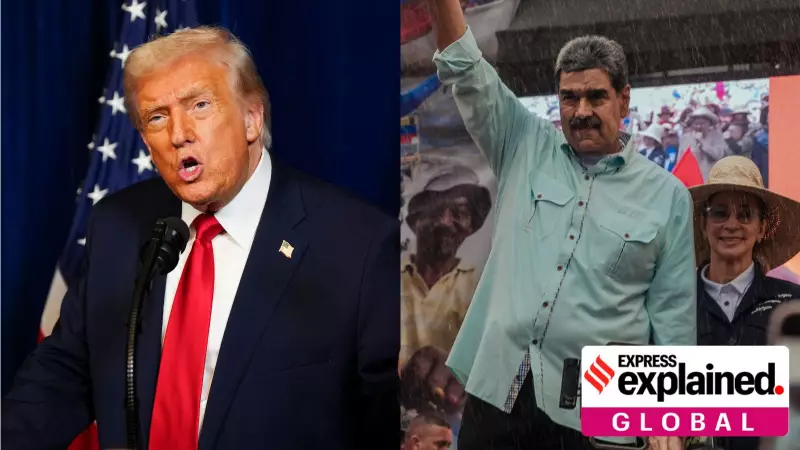
In a dramatic escalation of tensions, the United States under President Donald Trump announced the capture of Venezuelan President Nicolas Maduro and his wife, following military strikes in Caracas. The action, framed as part of Trump's intensified "war on drugs," raises critical questions about the true motivations behind targeting a nation with the world's largest oil reserves while the primary sources of deadly synthetic opioids lie elsewhere.
The Capture and the 'Weapons of Mass Destruction' Designation
Early on Saturday, January 3, US President Donald Trump declared that American forces had successfully "captured" Venezuelan leader Nicolas Maduro and flown him out of the country. This move came after weeks of threats of ground strikes against the South American nation. Trump has consistently linked his push for regime change in Venezuela to his administration's goal of stopping the flow of illegal drugs and immigrants into the United States.
This strategy took a significant turn last month when Trump formally designated "illicit fentanyl and its core precursor chemicals" as weapons of mass destruction (WMD). This designation coincided with a noticeable expansion of US military presence in the Caribbean Sea, setting the stage for the recent direct action against Venezuela's leadership.

Fentanyl: The Synthetic Opioid Fueling America's Crisis
At the heart of the US administration's justification is fentanyl, a potent synthetic opioid. According to the World Health Organisation (WHO), fentanyl is 50 to 100 times more powerful than morphine. While it has legitimate medical uses, its illicit version has become a public health catastrophe in the United States.
The US Centers for Disease Control and Prevention (CDC) data paints a grim picture: over 75% of the nearly 107,000 drug overdose deaths in 2021 involved an opioid, with fentanyl being the leading killer. The overdose death rate from fentanyl alone tripled from 5.7 per 100,000 people in 2016 to 21.6 in 2021.
Experts note that even a tiny amount—as little as 2 milligrams—can be fatal. The crisis is exacerbated by counterfeit drugs laced with fentanyl, often without the user's knowledge.
Trump's Strategy: From Tariffs to Military Action
The Trump administration's approach to the opioid epidemic has evolved. After declaring it a "national emergency" in February 2025, it later labeled fentanyl a WMD. This shift has been accompanied by aggressive economic and military measures.
Domestically, Trump has rolled back harm reduction policies, signing an executive order in July stating such efforts "only facilitate illegal drug use." He also announced $1 trillion in cuts to Medicaid and addiction treatment programs.
Internationally, Trump has imposed punitive tariffs on Canada, Mexico, and China, blaming them for failing to curb fentanyl trafficking. However, the targeting of Venezuela stands out, as evidence suggests its role in the global drug trade is minimal.
Venezuela's Minor Role vs. Major Oil Reserves
According to reports, including from The New York Times, Venezuela is a relatively minor player in illicit drug trafficking. It primarily serves as a transit country for drugs, like cocaine, produced elsewhere, with its cartels focusing on supplying Europe, not the United States.
This fact leads analysts to question the true motive behind the US action. Former Indian ambassador to Venezuela, R Viswanathan, offered a compelling explanation: "Venezuela has the largest oil reserves in the world. If Venezuela starts pumping up oil, it will be in direct competition with the US."
He argued that the US has historically used the pretext of a "war on drugs" to push for regime change when its economic interests in a region are at stake, pointing to similar dynamics with Iran and Russia.
The military campaign has been building since September, with the US launching over 30 strikes on alleged Venezuelan drug-smuggling boats, killing over 100 people, and seizing an oil tanker.
The Real Sources of Fentanyl: China, Mexico, and Canada
US focus and data reveal that the fentanyl crisis originates far from Caracas:

- China: Remains the primary source of precursor chemicals used to manufacture fentanyl. Despite a 2019 pledge to control these substances, production has partially shifted, with a BBC report in August 2025 indicating that trade in these chemicals remains poorly controlled.
- Mexico: US authorities accuse Mexican cartels, like the Sinaloa cartel, of producing fentanyl in labs using Chinese precursors and smuggling it across the southern US border. The vast majority of US fentanyl seizures occur at the Mexican border.
- Canada: Though targeted by Trump, US customs data shows only 0.8% of all fentanyl seizures were made at the Canadian border as of August 2025. Canadian officials have, however, flagged increasing domestic production.
The capture of Nicolas Maduro marks a new chapter in the long history of the US "war on drugs," initiated by President Richard Nixon in 1971. From the invasion of Panama under President George H.W. Bush to the public health focus under Barack Obama, the policy has constantly shifted. Under Trump's second term, it has taken a sharply militaristic and economically punitive turn, with Venezuela's regime change presenting its most dramatic manifestation yet, one where geopolitical and energy interests appear inextricably linked to the public health rhetoric.