Japan's Pivotal Lower House Election Commences, Testing Prime Minister Takaichi's Leadership
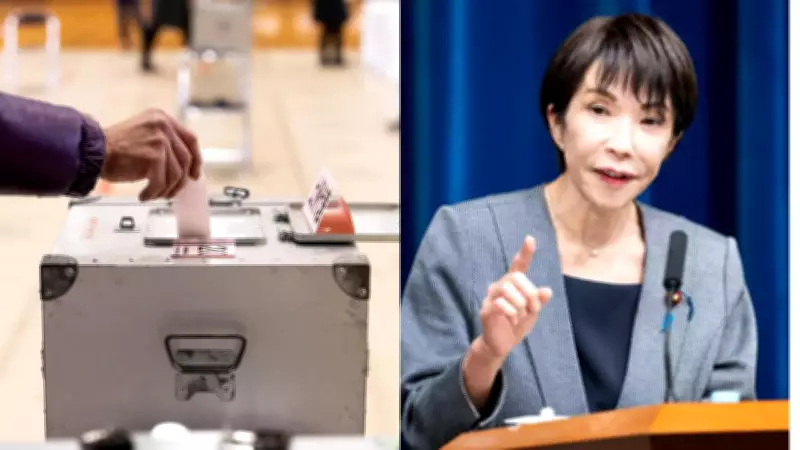
Voting began on Sunday across Japan in a crucial election for the 465-member House of Representatives, widely regarded as a referendum on Prime Minister Sanae Takaichi's leadership and her Liberal Democratic Party (LDP)-led government. The outcome will determine whether Takaichi consolidates her position or faces significant political uncertainty amid growing scrutiny of her policies and public remarks.
Modest Goals and High Stakes for the Ruling Liberal Democratic Party
The ruling Liberal Democratic Party has set a relatively modest target for this election, aiming for its coalition with the Japan Innovation Party to secure a simple majority in the Lower House. However, party insiders reveal the LDP is hoping for a stronger mandate—one that would allow it to win at least 233 seats independently, the threshold for an outright majority.
A clear solo victory would cement Takaichi's authority within the party and substantially strengthen her policymaking hand. Conversely, if the LDP-JIP coalition fails to retain a combined majority, pressure may mount for Takaichi to step down, potentially plunging Japan into yet another phase of political instability. The nation has already witnessed four prime ministers in roughly three years, highlighting the fragile political landscape.

Polls Predict LDP Edge Despite Multiple Controversies
Pre-election surveys indicated that the LDP remained on course to secure a majority on its own, with the opposition struggling to gain meaningful traction. The newly formed Centrist Reform Alliance—a coalition between the Constitutional Democratic Party of Japan and Komeito—was projected to lose ground in this critical contest.
Prime Minister Takaichi's campaign weathered several public controversies, including comments perceived as supportive of a weaker yen, ambiguity on whether her government would cut the consumption tax on food, and unscripted remarks concerning Japan's alliance with the United States. Despite these missteps, public sentiment has continued to tilt toward the LDP, buoyed by perceptions of economic competence and political stability.
Campaign Promises Focus on Economy, Industry, and Immigration
Pitching herself as a steady hand in uncertain times, Prime Minister Takaichi pledged to boost government spending in strategic sectors, revive Japan's global economic competitiveness, and implement tighter immigration policies. The ruling bloc's messaging has focused heavily on economic revival and national security, themes resonating with an electorate increasingly wary of inflation and external geopolitical tensions.
Japan Innovation Party's Expansion Bid and Osaka Focus
For the Japan Innovation Party, also known as Nippon Ishin no Kai, this contest represents a crucial test of its ability to expand beyond its traditional power base in Osaka. Unlike past elections, the LDP and JIP did not coordinate candidates in single-seat districts, resulting in direct competition across all 19 Osaka constituencies.
Simultaneously, the JIP faces local elections in Osaka, where Governor Hirofumi Yoshimura and Mayor Hideyuki Yokoyama are campaigning for a proposal to merge the city's wards into a single metropolitan government—a key plank in the party's long-term goal of establishing Osaka as Japan's "second capital."
Opposition Struggles to Unite and Define Clear Message
The Centrist Reform Alliance fielded candidates in over 200 single-member districts but was projected to lose seats overall. Its leadership framed the election as a battle to become the largest opposition force in the Lower House.
The CRA harshly criticized Takaichi's decision to call a snap election just one-third into lawmakers' four-year terms, calling it a move aimed at political convenience rather than necessity. It also pointed to recent market volatility as evidence of investor concerns over her fiscal management, particularly the proposed food tax cut, which unsettled Japan's bond markets.

Minor Parties and Challenging Election Conditions
Smaller political groups, including the Democratic Party for the People and Sanseito, also mounted aggressive campaigns against Takaichi, despite rumors of potential cooperation with the ruling bloc. The campaign unfolded under freezing temperatures and heavy snowfall across eastern and northern Japan, significantly affecting outdoor voter outreach efforts.
This election marked the first winter Lower House poll in 36 years, with all 465 seats—289 from single-seat districts and 176 through proportional representation—up for grabs. Polling stations closed at 8pm, with media projections expected shortly thereafter, according to reports.