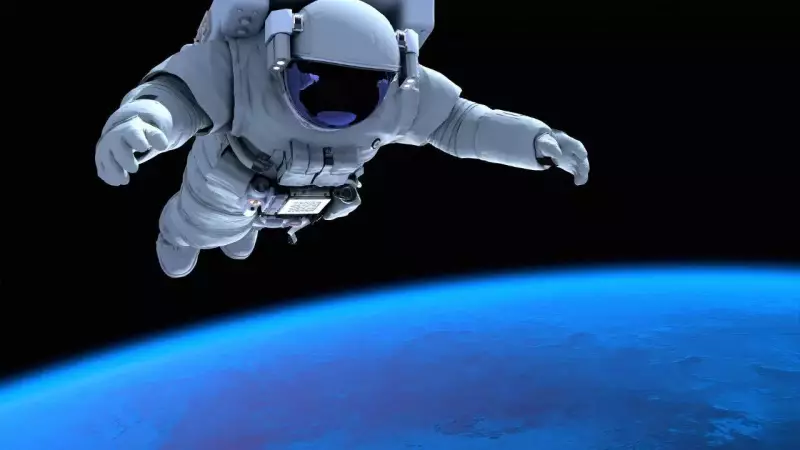
As Earth welcomed 2026 with a single midnight celebration, a select group of individuals experienced the turn of the year in a manner almost unimaginable to those on the planet. The crew aboard the International Space Station (ISS) did not just witness one New Year; they lived through it 16 separate times, offering a profound and unique perspective on the passage of time.
The Orbital Reason Behind 16 New Years
The extraordinary repetition of the New Year's moment is a direct consequence of the ISS's incredible velocity and orbital mechanics. The space station travels at a speed of approximately 28,000 kilometres per hour. At this pace, it completes a full orbit around Earth in just about 90 minutes. According to NASA, this translates to 16 orbits every 24 hours.
As the ISS circled the globe, it repeatedly crossed the imaginary line where the local time transitioned from December 31, 2025, to January 1, 2026. Each crossing over a different region meant witnessing the New Year celebrations anew, effectively allowing the astronauts to ring in 2026 again and again from their vantage point 400 kilometres above.

Life in a 90-Minute Day-Night Cycle
Existence on the ISS is fundamentally alien compared to terrestrial life. The familiar 24-hour cycle of one sunrise and one sunset is replaced by a rapid-fire sequence. Astronauts experience roughly 45 minutes of daylight followed by 45 minutes of darkness, a cycle that repeats 16 times each Earth day.
This constant shift creates a breathtaking spectacle of sunrises and sunsets, where the Earth's atmosphere glows as sunlight strikes oceans and continents. To maintain structure and synchronise with mission control, the crew adheres to Greenwich Mean Time (GMT) for scheduling work, rest, and communications.
Managing sleep is a significant challenge. The station's interior lighting is carefully controlled to mimic natural cycles, helping astronauts maintain circadian rhythms. Sticking to strict routines is critical, as disruptions can impact both their health and the success of their scientific missions.
More Than a Phenomenon: A Scientific Platform
The unusual temporal environment on the ISS is not just a curiosity; it is integral to the cutting-edge research conducted there. The microgravity conditions enable experiments impossible on Earth.
- Micro-gravity studies allow scientists to observe the behavior of living organisms, fluids, and materials free from Earth's gravity.
- Microbiology research investigates how bacteria behave in space, crucial for long-duration missions.
- Metallurgy and materials science experiments reveal how metals solidify in orbit, leading to stronger alloys.
The experience of seeing multiple New Years from space gave the astronauts a deeply different outlook. While billions on Earth celebrated a singular moment of renewal, the orbital crew observed the planet as a whole, a blue marble marking time in zones and strips. The concept of a single "new year" felt distant against the continuous, borderless flow of the planet beneath them.