For decades, the cinematic journey of Harold and Kumar Go to White Castle symbolized a specific version of the American Dream for second-generation Indian-Americans. It wasn't just about the quest for burgers; it was a landmark coming-of-age story that portrayed Asian-Americans as fully assimilated, sharing the same desires—getting high, meeting girls, indulging in fast food—as any other American. The film cleverly updated the immigrant narrative for the 2000s, suggesting that the children of those who came to America hungry could now pursue their own version of satisfaction.
The Shattered Illusion: When Visibility Becomes a Threat
This dream of seamless integration, of reaching a symbolic 'white castle' of societal acceptance, faced a rude awakening. The catalyst was a 90-foot Hanuman statue in Sugar Land, Texas. Erected on private land, the statue became a flashpoint, revealing how America's promise of welcome often frays when cultural differences cease to be discreet. Despite celebrations on temple grounds blending the Indian national song 'Vande Mataram' with 'The Star-Spangled Banner', conservative Christian protesters gathered, denouncing Hanuman as a "demon god." A local politician publicly questioned, "Why are we allowing a false statue of a false Hindu God to be here in Texas? We are a CHRISTIAN nation."
For Dr. Srinivasachary Tamirisa, who supported the project for over 25 years, the backlash was a painful disillusionment. He told the New York Times he once saw America as a promised land. To him, Hanuman represents courage and devotion, not domination. In Hindu tradition, Hanuman is the embodiment of strength governed by humility, a spiritual guide revered for loyalty and self-restraint. The protest, however, was less about theology and more about visibility—a Hindu symbol refusing to stay private, a faith declining to remain ornamental.

The Arc of Success: From "Gas, Beds, and Meds" to the Corridors of Power
The Indian-American story in the U.S. has followed a distinct trajectory. Comedian Nimesh Patel once distilled the early immigrant strategy as "gas, beds, and meds"—filling America's basic needs through gas stations, motels, and medical professions. This model minority was welcomed as long as it remained industrious, grateful, and socially quiet. However, the second generation shattered this quiet assimilation.
By the late 2010s, Indian-Americans were no longer confined to supportive roles. They led corporate giants like Microsoft (Satya Nadella), Google (Sundar Pichai), Adobe (Shantanu Narayen), and IBM (Arvind Krishna). They won Nobel Prizes (Venkatraman Ramakrishnan) and Fields Medals (Manjul Bhargava). In culture, figures like Hasan Minhaj and Mindy Kaling treated their Indian-American identity as an unremarkable fact, not an obstacle. This shift from contribution to consolidation, from being power-adjacent to calling the shots, created a uniquely combustible moment.
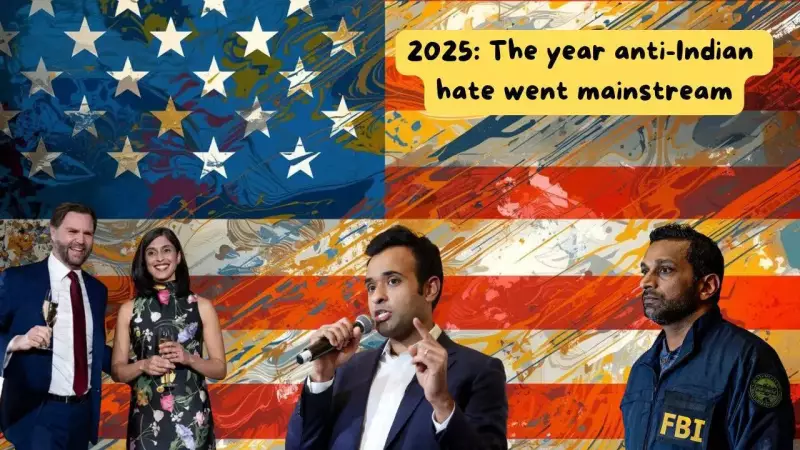
The 2024 U.S. presidential election underscored this political arrival. The contest was humorously dubbed a Telugu-Tamil tussle between Vice President Kamala Harris (Tamil) and Second Lady Usha Vance (Telugu). Indian-Americans like Vivek Ramaswamy and Nikki Haley featured prominently in GOP debates. Donald Trump actively courted Hindu voters. The administration saw a significant Indian-American contingent in key roles, from Tulsi Gabbard at the Office of the Director of National Intelligence to Sriram Krishnan advising on AI.
The Systematization of Hostility and the Redefinition of 'American'
What changed was not Indian-American behavior but American permission for open hostility. Resentment moved from background static—accent jokes, outsourcing remarks—to a systematized hate machine. A report by the Center for the Study of Organized Hate (CSOH) documented how anti-Indian and anti-Hindu narratives exploded online, amassing over 138 million views for 128 high-impact posts, before spilling into real-world actions.

The narrative shifted: Hinduism was framed not as a religion but as an incompatible ideology; Indians were recoded from model immigrants to demographic infiltrators. This rhetoric found legitimacy across the spectrum. On the right, figures like Stephen Miller argued legal immigration was a loophole for demographic change, targeting high-skilled Indian professionals. Far-right voices like Nick Fuentes told Vivek Ramaswamy to "go back to India." On the liberal side, incidents like MSNBC's Joy Reid mocking a "brown Hindu wife" revealed Hinduphobia expressed through irony and mockery.
This convergence points to a deeper, unresolved question: Who gets to be American? The once-dominant civic ideal—that anyone can become American through belief and allegiance—is being challenged by a resurgence of "Mayflower logic," where Americanness is seen as an inherited legacy. JD Vance's arguments that America is a people shaped by specific history and culture function as a gate. When Vivek Ramaswamy has to defend the binary, equal nature of American citizenship to this movement, the tension becomes stark.
The scrutiny of Usha Vance's faith and background, treated as a complication rather than a routine fact, signals that belonging remains conditional. The hate machine is, therefore, a symptom of a country renegotiating its own boundaries at the precise moment Indian-Americans have achieved unprecedented visibility.
The Uncomfortable Truth: No Destination Called Acceptance
The Indian-American experience is not unique. Every immigrant group—from Irish Catholics to Japanese-Americans—has faced the moment where its success becomes a provocation. The White Castle dream was a hope that utility and assimilation would eventually buy ordinary, unquestioned belonging. The Hanuman statue backlash revealed that acceptance is not a destination reached by working harder. It is a condition that must be defended once visibility is achieved. The statue broke an unspoken rule: you may belong, but only if you remain invisible.
Hanuman, a deity of service and humility, kneeling even when invincible, had for generations been worshipped discreetly in American basements and borrowed halls. A 90-foot statue shattered that grammar. It announced an immigrant community that was no longer being polite, no longer managing its difference. Indian-Americans are discovering, late and painfully, what others learned before them: visibility, once gained, cannot be put back in the basement. The dream was never about hamburgers; it was about the promise that one day, your presence would not be an interruption. That promise, it turns out, is perpetually under negotiation.