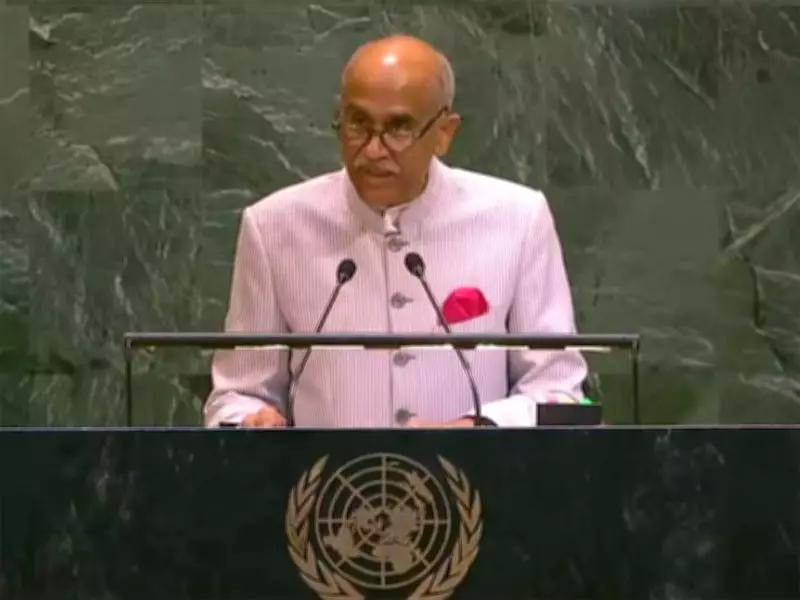
India's Permanent Representative to the United Nations, Parvathaneni Harish, on Wednesday sharply criticized the international community's prolonged gridlock on counter-terrorism and called for the immediate adoption of the Comprehensive Convention on International Terrorism (CCIT). Delivering India's statement at the adoption of the Ninth Review of the United Nations Global Counter-Terrorism Strategy (GCTS), Harish outlined a comprehensive six-point priority framework while condemning the multilateral body's failure to reach consensus on regulating emerging technologies exploited by terror groups.
Nearly Three Decades of Stalled Progress
Marking almost 30 years since India first proposed the CCIT in 1996—a decade before the UN adopted its own counter-terrorism strategy in 2006—Harish stressed that the prolonged delay has severely hampered global action. "The absence of a universally agreed legal framework continues to hobble collective action against terrorism," the ambassador stated, emphasizing that such a convention is vital to deny terrorists and their sponsors access to safe havens, funds, and arms. "The time has come to demonstrate political will to conclude the CCIT," he added.
Rejecting Justifications for Terrorism
Drawing on India's decades-long experience as a victim of cross-border terrorism, Harish firmly rejected any attempts to contextualize or excuse terrorist attacks. "A terrorist is a terrorist! We must work hand in hand to root out the murderous ideology without finding any grievance to justify terrorism. Irrespective of any grievance, political cause or strategic calculation, terrorism in all its forms and manifestations must be condemned unequivocally," he asserted.

Six-Point Framework for Global Action
Harish underlined several non-negotiable pillars that the international community must adopt to mount an effective defense against global terror. First, he called for an absolute obligation to reject double standards and hold perpetrators, organizers, financiers, and state sponsors of terrorism fully accountable without geopolitical bias. Second, he emphasized cutting off finances by enhancing financial intelligence sharing and tightening enforcement of Financial Action Task Force (FATF) standards so no jurisdiction remains a safe conduit for terror funds.
Third, Harish demanded urgent action regarding the alarming speed at which terrorist groups are exploiting advanced encrypted communications, drones, artificial intelligence, deepfakes, virtual assets, the dark web, and specialized mapping or trekking applications. He noted with regret that the review was unable to reach an acceptable landing point on this issue. Fourth, he stated that victims of terrorism must remain at the heart of global efforts, shifting the discourse away from purely institutional terms to give victims the dignity and rehabilitation they deserve.
Fifth, India highlighted that capacity-building efforts must be practical, demand-driven, and respectful of national ownership and the specific needs of recipient Global South nations, rather than having external frameworks imposed on them. Finally, he urged a universal lens on religious phobias, stating that while India condemns all acts motivated by Islamophobia, Christianophobia, and antisemitism, the General Assembly must acknowledge that such prejudices severely extend to other world faiths as well.

Disappointment Over Delhi Declaration Snub
Expressing deep disappointment that the current GCTS review failed to establish a solid landing point on regulating the misuse of new technologies, Harish further criticized the General Assembly for completely omitting any mention of the landmark Delhi Declaration—a framework on countering the terrorist use of emerging technologies that India hosted. "The Delhi Declaration on countering the use of new and emerging technologies for terrorist purposes; the No Money for Terror Conferences are cases in point. It is a matter of great privilege that the Delhi Declaration is serving global good and two of its pillars have been implemented as the Abu Dhabi Guiding principles and Algeria Guiding principles. The lack of mention of this landmark declaration in the GCTS in 2023 just reflects the unfortunate situation of how this Assembly is held hostage to petty bean counting! It is doubly unfortunate when the international community continues to tolerate this behavior," he stated.
Call for Measurable Progress
While emphasizing India's major role as a direct financial and strategic contributor to UN counter-terrorism capacity-building projects across the Global South, Harish warned that a consensus that does not lead to measurable progress is functionally meaningless. Invoking a warning from Prime Minister Narendra Modi, Harish concluded by stating that terror anywhere threatens peace everywhere, reminding the General Assembly that the world cannot afford ambiguity on terrorism because victims deserve justice and future generations deserve security. "As Prime Minister Narendra Modi has said, Terror anywhere threatens peace everywhere! The world cannot afford ambiguity on terrorism. The victims of terrorism deserve justice. Future generations deserve security. And this General Assembly must provide leadership," he said.