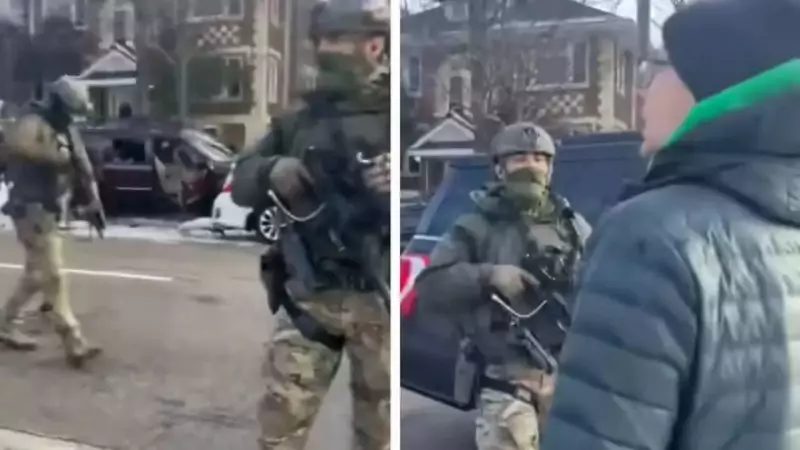
A recent shooting incident in Portland, where ICE agents shot a Venezuelan couple allegedly fleeing immigration enforcement, has dramatically intensified the confrontation between the federal government in Washington and Democratic-led states and cities across the United States. This event, occurring on Thursday, is rapidly transforming into one of the most volatile political issues as the nation heads toward the 2026 midterm elections.
The Spark and the Escalating Conflict
The Portland shooting is not an isolated event. It was sparked by a prior deadly ICE encounter in Minneapolis, where a mother of three was gunned down. That incident triggered mass protests in Democratic strongholds and led to sharply competing narratives from federal and local leaders. What began as a debate over immigration enforcement has now evolved into a deeper constitutional struggle. At its core is a sweeping assertion by senior federal officials, including Vice President J.D. Vance, that ICE agents enjoy broad — even "absolute" — immunity from state or local prosecution when acting in the course of their federal duties.
This claim has been hardened by the administration's decision to hand both the Minneapolis and Portland shooting investigations entirely to the FBI, effectively cutting out state authorities. This move has solidified opposition among Democrats and has also unsettled some Republicans, creating a rare fracture within the GOP.

Political Calculations and Internal Divisions
For Democratic leaders, particularly in urban centers and blue states, this issue has become a powerful rallying cry. They are framing it around civil liberties and local autonomy, warning that the federal sidelining of state investigators in a civilian shooting sets a dangerous precedent that could extend far beyond immigration. Civil liberties activists have accused the Trump administration of criminalizing protests as "terrorism," aiming to divide the population and erode faith in institutions to ultimately usher in authoritarian rule.
Politically, Democrats see an opportunity to energize their base, including young voters, communities of color, and progressive activists who have long viewed ICE as unaccountable. In states like Minnesota and Oregon, candidates are already leveraging video evidence and eyewitness accounts to counter federal claims of self-defense, tying the shootings to broader arguments about unchecked federal authority.
Republicans, however, face a complex calculus. While the administration's hard-line posture resonates with voters prioritizing immigration enforcement, the claim of near-total immunity for ICE agents has sparked internal dissent. Several GOP lawmakers have voiced discomfort, seeing it as a federal overreach that encroaches on states' rights—a core conservative principle. Republican Senator Rand Paul of Kentucky encapsulated this skepticism on social media platform X, writing, "Immunity isn't a blank check. If we're trampling state investigations, we're no better than the overreaching feds we criticized under Biden."
Lasting Consequences and the Risk of 'Balkanization'
Beyond immediate politics, analysts warn that this confrontation could have profound, lasting consequences for federal-state relations. Some describe an emerging "cold war" dynamic, where blue states may increasingly resist federal mandates through lawsuits, sanctuary policies, and reduced cooperation on unrelated matters like disaster response.
The FBI's unilateral takeover of the shooting investigations could become a major test case for Supreme Court battles over the 10th Amendment, which reserves powers not delegated to the federal government for the states. This threatens to further strain an already polarized judiciary. Furthermore, political pundits warn that prolonged standoffs, exemplified by events in Minneapolis and Portland, risk pushing the country toward a "de facto balkanization," with red and blue states operating under vastly different rules on issues like immigration.
The growing chasm is exacerbated by increasingly confrontational rhetoric. Following the Portland incident, Oregon Congresswoman Janelle Bynum released a stark statement telling the federal government, "Don't f**k with us," mirroring the aggressive political discourse of the era.